What Type of Therapy Is Right for Me? CBT, Psychodynamic, Solution-Focused, and More, Explained for Kenyans
Here is a number that should give you pause. The World Health Organisation estimates that the treatment gap for mental health conditions in sub-Saharan Africa exceeds 90%. In Kenya, that means fewer than one in ten people living with anxiety, depression, trauma, or any diagnosable mental health condition will ever access professional support.
When researchers ask why, the answers are varied: stigma, cost, geography. But there is another barrier that rarely makes the headlines: many of us do not know where to begin. Not just whether to start therapy, but what kind of therapy we need, and what we are actually signing up for.
Types of therapy explained, simply, accurately, and in a Kenyan context, is exactly what this guide does.
| The short answer: You do not need to arrive at your first session with a preferred modality. A good therapist will assess your situation and recommend an approach. What matters more than choosing the right type of therapy is finding a therapist you feel safe with. This guide gives you the vocabulary to walk into that conversation informed. |
What Does ‘Type of Therapy’ Actually Mean?
When you walk into a therapy room or open a video call for your first session, you are not just meeting a therapist. You are entering a specific framework: a set of tools, a way of listening, a set of questions your therapist will and will not ask. That framework is the modality, or type, of therapy.
Different therapy types were developed to address different kinds of challenges, using different mechanisms of change. Some focus on changing how you think. Others focus on understanding where your patterns came from. Others focus almost entirely on where you are going.
Knowing the difference helps you ask better questions before your first session, and helps you understand why your therapist works the way they do. At Clarity Counseling, our therapists are trained across multiple modalities and often integrate approaches based on what you bring. You do not need to arrive with a preference, but arriving informed means arriving ready.
Types of Therapy Explained: The Five Main Approaches
1. Cognitive Behavioural Therapy (CBT)
CBT therapy Kenya is the most researched psychotherapy in the world, and the one most Kenyan clients ask about when they first explore therapy. The core premise: our thoughts, feelings, and behaviours are interconnected. Change how you think, and you change how you feel and behave.
CBT is structured and goal-directed. Sessions involve identifying thought patterns, evaluating their accuracy, and replacing unhelpful thinking with more grounded perspectives. The American Psychological Association formally recognises CBT as a first-line evidence-based treatment for a range of mental health conditions.
Used for:
- Anxiety disorders (generalised anxiety, panic, phobias, social anxiety), depression
- OCD, PTSD
- Eating disorders
- Stress-related presentations
Typical duration: 12–20 sessions, one of the shorter modalities, suited to clients managing demanding schedules.
What CBT is not: Positive thinking or minimising real problems. CBT builds a more grounded, accurate relationship with your own thinking.
2. Psychodynamic Therapy
Where CBT asks what you are thinking, and if it is accurate, psychodynamic therapy asks: where did this pattern come from, and what is it protecting you from?
Rooted in psychoanalysis but considerably more flexible in its modern form, psychodynamic therapy holds that our present patterns, how we relate, react, choose, and feel, are shaped by experiences we may not be fully conscious of.
Used for:
- Depression (especially chronic or recurring),
- Relationship patterns that repeat across contexts,
- Unresolved grief,
- Identity challenges,
- Generalised sense that something is fundamentally off but hard to name
Duration: Longer than CBT, months to years for deeper work.
Kenyan relevance: This modality is particularly valuable for navigating the intersection of family expectation, cultural identity, and personal desire that many Kenyans live within. The family system, its unspoken rules, transmitted beliefs, patterns of conflict and connection, is often where the deepest work happens.
3. Solution-Focused Brief Therapy (SFBT)
Solution-focused therapy takes a deliberately different stance: it is not interested in the problem or its history. It is interested in one question: what does your life look like when the problem is not there?
Developed by Steve de Shazer and Insoo Kim Berg, SFBT works by building on the times when the problem was smaller or absent, using those moments as a template for change. Sessions are future-focused and strengths-based.
Used for: Specific, bounded problems,
- Work challenges,
- Parenting difficulties,
- Life transitions,
- Situations where someone is fundamentally functional but stuck.
Duration: Three to eight sessions, the most time-efficient modality available.
Note: For significant trauma, complex depression, or long-standing relational patterns, a more exploratory modality may serve you better. Your therapist can assess this in a first consultation.
4. Narrative Therapy
Narrative therapy is built on a powerful premise: the story you tell about yourself is not the whole story.
Most of us carry a dominant narrative, a version of ourselves as not good enough, fundamentally flawed, or responsible for everyone else’s happiness. These stories were often written for us by others: family, culture, and painful experiences.
Narrative therapy invites you to examine that story, separate yourself from it, and begin writing a more complete, more accurate account.
Kenyan relevance: In a context where cultural narratives around gender, age, ethnicity, and economic status shape powerful internal stories about what a person is worth or capable of, narrative therapy resonates deeply. It is especially effective for identity questions, cultural transitions, and trauma recovery.
See our therapy FAQ for more on Clarity’s approach to trauma-informed work.
5. Person-Centred (Humanistic) Therapy
Developed by Carl Rogers, person-centred therapy is built on three core conditions: unconditional positive regard (being accepted without judgment), empathy (being genuinely understood), and congruence (an honest, authentic relationship with your therapist).
The therapist’s role is not to direct or diagnose; it is to create the quality of presence in which you can explore, make sense, and find your own direction.
Used for:
- Self-esteem
- Major life transitions
- Relationship difficulties
- General well-being
Particularly suited to people who need a safe, non-judgmental space to think and feel.
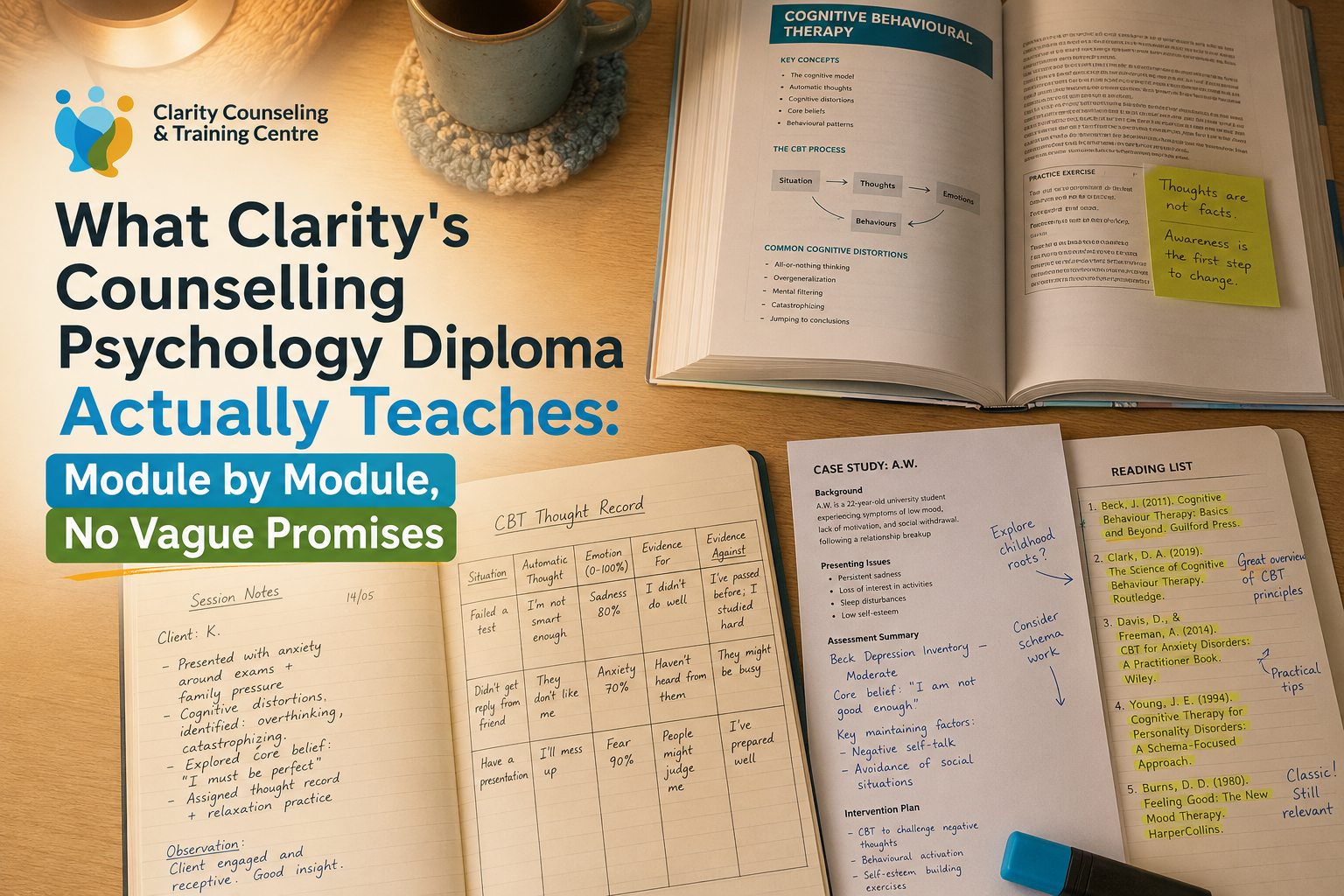
Person-centred therapy is the direct lineage from which most Kenyan counselling training is drawn, including Clarity’s own Certificate and Diploma programmes.
Which Type of Therapy Is Right for You? A Quick Reference
| Therapy Type | Best For | Typical Duration | Core Approach |
| Cognitive Behavioural (CBT) | Anxiety, depression, OCD, phobias, and eating disorders | 12–20 sessions | Structured; changes thought patterns in the present |
| Psychodynamic | Chronic depression, repeating relationship patterns, identity, and grief | Months to years | Exploratory; insight into unconscious patterns |
| Solution-Focused (SFBT) | Specific problems, transitions, and short-term goals | 3–8 sessions | Future-focused; strengths-based; brief |
| Narrative | Identity, trauma, cultural pressure, meaning-making | 10–20 sessions | Story-based; separates the person from the problem |
| Person-Centred | Self-esteem, transitions, and general well-being | Flexible | Relationship-based; entirely client-led |
Common Questions Kenyans Ask Before Choosing
Which therapy is best for anxiety?
CBT has the strongest evidence base for anxiety disorders and is the first-line recommendation for generalised anxiety, panic disorder, social anxiety, and phobias. If your anxiety is rooted in deeper patterns, relational, identity-based, or connected to unprocessed experiences, a psychodynamic or integrated approach may serve you better long-term.
Our guide to anxiety in Kenya covers this in more depth.
Which therapy is best for depression?
Both CBT and psychodynamic therapy have strong evidence for depression. CBT works well for moderate depression with identifiable thought patterns; psychodynamic therapy is often more effective for chronic or recurring depression. Most Clarity clients with depression benefit from an integrative approach. See our guide to depression in Kenya for a fuller picture.
What is the difference between CBT and talk therapy?
‘Talk therapy’ is a colloquial term for any therapy conducted through conversation, which includes virtually all modalities. CBT is a specific type of talk therapy. The meaningful distinction is between structured approaches (CBT: agenda-driven, technique-based, with between-session exercises) and exploratory approaches (psychodynamic, person-centred: less structured, more open-ended and insight-oriented).
What type of therapy do I need?
You probably do not need to decide before your first session. Your therapist will assess your history and situation and recommend an approach. The most important factor is not the modality; it is finding a therapist you feel safe with. The therapeutic alliance, the quality of the relationship between therapist and client, is the single strongest predictor of therapy outcomes across all modalities, according to decades of psychotherapy research.
Does Clarity Offer CBT?
Yes. CBT therapy Kenya is one of the primary approaches our therapists use for anxiety, depression, and stress-related presentations. We also work in psychodynamic, narrative, person-centred, and integrative frameworks. The approach adapts to what you bring, not the other way around.
If you have a strong modality preference, mention it when booking, and we will match you with a therapist whose training aligns with what you are looking for.
We offer both in-person and online therapy, meaning clients outside Nairobi or in the diaspora can access the same quality of care. If you want to know what to expect before booking, our guide to what happens in your first therapy session takes you through the process step by step.
You Do Not Need to Have It Figured Out Before You Begin
Most people who come to therapy do not arrive with a modality preference. They arrive with a problem, a feeling, a question, something they cannot name. They arrive tired, stuck, or carrying something too heavy to keep carrying on their own.
The therapist’s job is to understand what you have brought and offer a framework for working with it. That framework may be CBT therapy Kenya. It may be psychodynamic. It may integrate several modalities as the work deepens. What you need to do is show up. Everything else is negotiable.
Frequently Asked Questions
What is CBT?
Cognitive Behavioural Therapy (CBT) is a structured, evidence-based form of talk therapy that identifies and challenges unhelpful thought patterns to produce changes in mood and behaviour. It is recognised by the American Psychological Association and the National Institute of Mental Health as a first-line treatment for anxiety, depression, OCD, and related conditions. Both in-person and online CBT are available at Clarity.
Which therapy is best for depression?
Both CBT and psychodynamic therapy have strong clinical evidence for depression. CBT is most effective for moderate depression with identifiable thought patterns. Psychodynamic therapy is often more effective for chronic or recurring depression. Many clients benefit from an integrative approach tailored to their specific presentation.
How do I choose a therapy type?
You do not need to arrive with a preferred modality. In the first one or two sessions, your therapist will assess your history and what brings you in, and recommend an appropriate approach. A free 15-minute consultation with Clarity is the best starting point if you are unsure.
Does Clarity offer CBT?
Yes. Clarity therapists are trained in CBT as well as psychodynamic, narrative, person-centred, and integrative approaches. Mention your preference when booking, and we will match you accordingly. Both in-person and online therapy sessions are available.
What is the difference between therapy types?
CBT is structured, present-focused, and targets thought patterns. Psychodynamic therapy is exploratory and past-focused. Solution-focused therapy looks entirely at the future. Person-centred therapy is client-led with no fixed agenda. In practice, most effective therapists draw from multiple modalities based on what the individual client actually needs.
| Not sure which approach is right for you?
Book a 15-minute consultation, and we’ll help you figure it out. → Book your consultation WhatsApp: +254 (0) 101 515 101 · claritycounseling.co.ke Related reading: Depression in Kenya · Anxiety in Kenya · Online vs In-Person Therapy · |