Counselling Psychology Courses Kenya September 2026: Your Complete Enrolment Guide
The September 2026 intake is open.
If you have been thinking about studying counselling psychology in Kenya — whether for a career change, to support the people around you better, or because you have always known this is where you were headed — this is the guide that answers every question before you have to ask it.
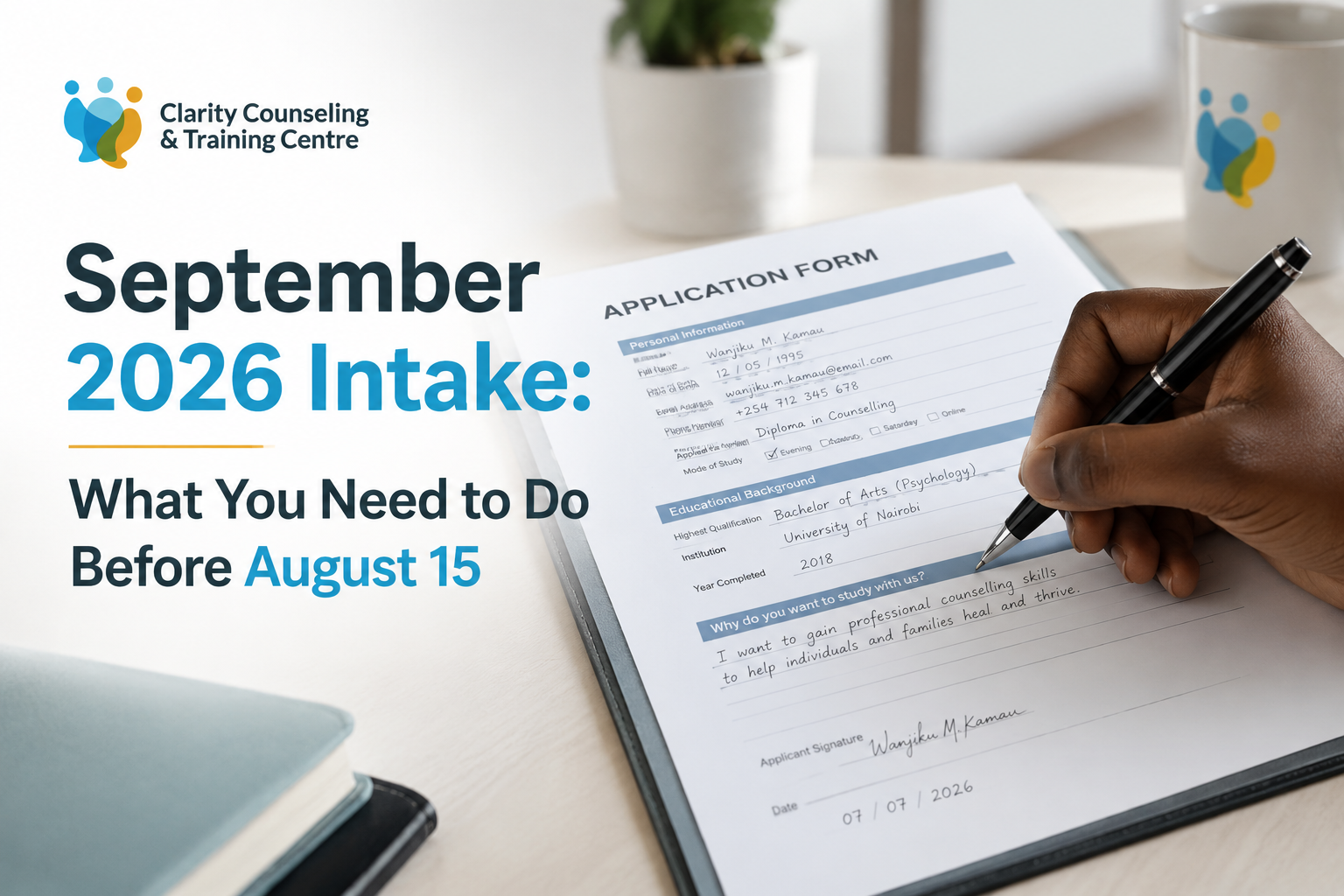
Applications for Clarity’s September 2026 intake close on August 15. This post covers every programme on offer, exactly what you will study, who each course is for, what it costs, how to apply, and what happens after.
Which Courses Are Available for September 2026?
Clarity Counselling & Training Centre offers three qualification levels, each designed for a different starting point and career destination.
| Programme | Duration | Format | Fee (KSh) | Best For |
| Certificate in Counselling Psychology | 6 months | Evening and weekend classes, online option available | 60,000 | Working professionals adding counselling skills to an existing role — teachers, HR, pastors, nurses, community leaders |
| Diploma in Counselling Psychology | Full programme (multiple semesters) | Evening, weekend, and online options | 181,500 | Career changers and those building toward professional practice, KCPA registration, and CPB licensing |
| Short Courses and Workshops | Varies by course | Intensive weekend and online formats | Contact Clarity | Specific skill areas — Basic Counselling Skills, Emotional Intelligence, Self-Awareness and Personal Development
Business Leader’s Transformation Course |
Not sure which level is right for you? The section below on the five questions walks you through it. You can also call or WhatsApp Clarity’s admissions team directly — they will not push you toward a longer or more expensive programme if it is not the right fit.
What You Will Study
Certificate in Counselling Psychology
The Certificate is the entry point. Six months, designed for a working schedule. You will cover:
- Foundations of counselling psychology — theory, ethics, professional boundaries
- Core counselling skills — active listening, reflective practice, the therapeutic relationship
- Introduction to common mental health presentations: depression, anxiety, grief, trauma
- Supervised practice hours with real clients in structured settings
- Personal development and self-awareness sessions — because effective counsellors know themselves first
The Certificate qualifies you for practice in non-clinical settings and creates the foundation for diploma-level study. See the full Certificate course page for module details.
Diploma in Counselling Psychology
The Diploma is the professional standard for practising counselling psychologists in Kenya. It meets the training requirements for registration with both the KCPA (Kenya Counselling and Psychological Association) and the CPB (Counsellors and Psychologists Board). You will cover:
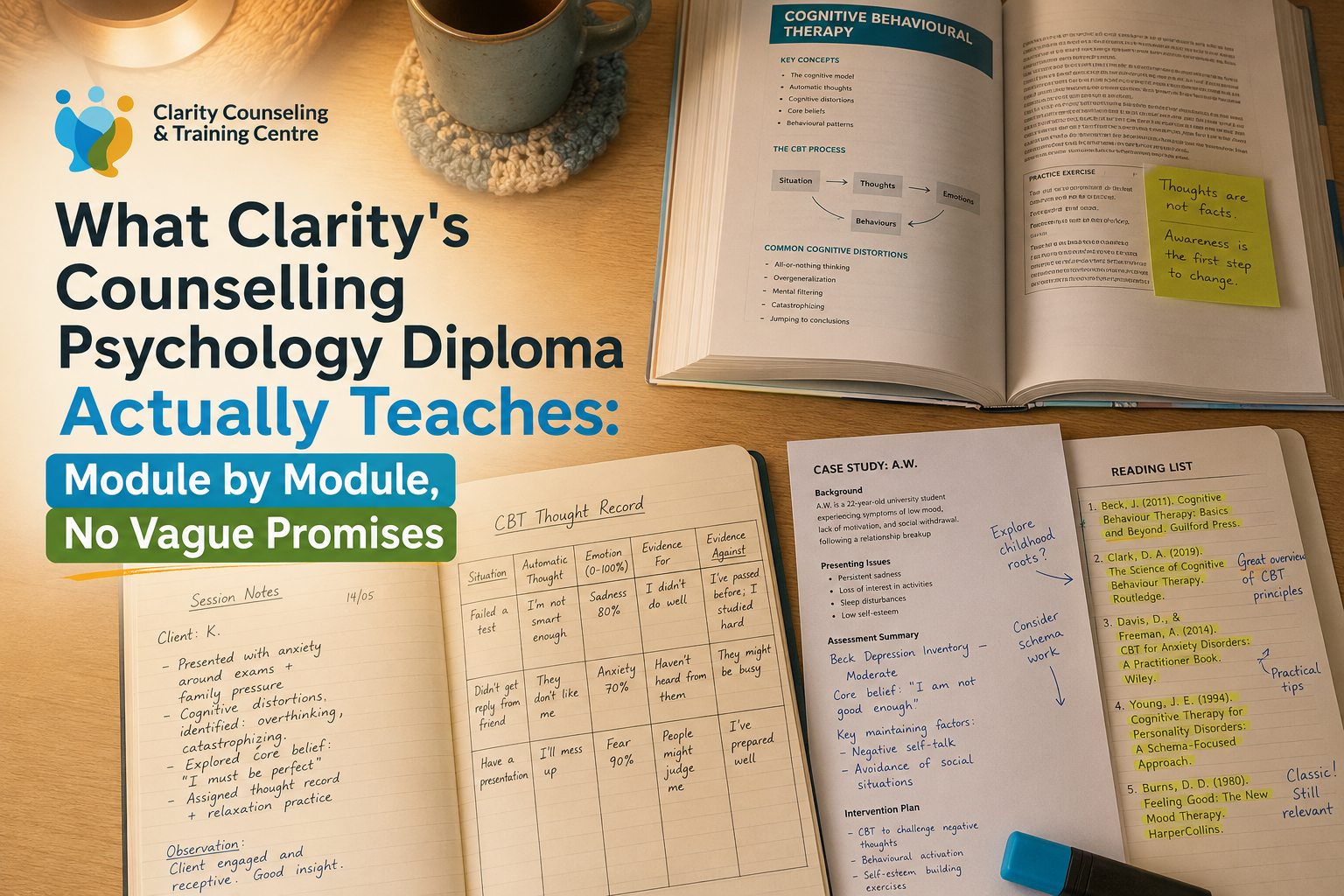
- Advanced counselling theory — CBT, person-centred, narrative, solution-focused, and integrative approaches
- Psychopathology and mental health assessment
- Trauma-informed practice
- Group therapy facilitation
- Couples and family counselling
- Supervised practicum — a required component, working with real clients under licensed supervision.
- Mandatory personal therapy sessions, because Clarity believes you cannot take clients where you have not been yourself.
- Ethics, professional law, and the regulatory landscape in Kenya
After completing the Diploma, you are eligible for KCPA membership and CPB registration — the two credentials that open the doors to hospital, school, NGO, corporate, and private practice work in Kenya. See the full Diploma course page for module breakdown.
Short Courses and Workshops
Clarity’s short courses are not entry-level fillers. They are intensive, practical, and designed for people who already work with people and want to do so better. Current offerings include Basic Counselling Skills, Emotional Intelligence, and Self-Awareness and Personal Development. New courses are added each intake — contact Clarity to confirm what is running in September 2026.
Accreditation: What KCPA, CPB, and NITA Actually Mean
Clarity is accredited by the Kenya Counselling and Psychological Association (KCPA No. KCPA/INST/0147/019) and registered with the National Industrial Training Authority (NITA). Here is what that means in practice:
| Body | What It Is | Why It Matters to You |
| KCPA | Kenya Counselling and Psychological Association — the professional membership body for counsellors | KCPA membership is the professional credibility marker that institutional employers (hospitals, schools, NGOs, corporates) look for when hiring. Clarity’s accreditation means your qualification meets KCPA’s standards. |
| CPB | Counsellors and Psychologists Board — the statutory licensing body under the Counsellors and Psychologists Act 2014 | CPB registration is legally required to practise as a counselling psychologist in Kenya, especially in private practice and regulated settings. The Diploma meets CPB’s minimum training requirements. |
| NITA | National Industrial Training Authority — Kenya’s vocational and professional training regulator | NITA registration means your training can be supported through the NITA levy refund scheme, which many Kenyan employers use to fund staff training. If your employer pays the NITA levy, ask HR about funding your course. |
Who Is This For? Ten Specific People
One of the most common things prospective students say is, “I am not sure I am the right type of person for this.” Here are ten people who are exactly the right type.
- The HR manager who has sat with an employee in crisis one too many times and wants to know how to actually help rather than just refer.
- The teacher who sees what is happening with her students and has run out of adequate responses.
- The pastor or church leader who has been informally counselling their congregation for years and wants formal grounding for what they are already doing.
- The nurse or midwife who works with people in physical crisis and sees the mental health dimension constantly being missed.
- The NGO programme officer whose work brings them into direct contact with trauma, displacement, or crisis, and who is starting to feel it themselves.
- The mother who came through something — her own depression, a difficult marriage, a loss — and now wants to help other women find what she eventually found.
- The professional in their late 30s or 40s who built a successful career in something else and has spent years knowing it is not quite where they are supposed to be.
- The recent graduate who studied something unrelated and has finally admitted that counselling psychology was always the answer.
- The diaspora Kenyan considering a return and wanting a qualification that will matter here.
- The person who has been to therapy themselves, experienced what it changed, and wants to be for someone else what their therapist was for them.
- The life or leadership coach who keeps encountering clients whose struggles run deeper than motivation, accountability, and performance, and wants the clinical knowledge and therapeutic skills to support them ethically and effectively.
- The retiree who is looking for a meaningful second career that allows them to use their life experience to make a difference.
- The psychology enthusiast who has always been fascinated by why people think, feel, and behave the way they do and is ready to turn that curiosity into a professional qualification.
How to Apply — Step by Step
The process is straightforward. Here is exactly what to do before August 15.
- Step 1: Decide which programme level is right for you. If you are unsure, call or WhatsApp Clarity’s admissions team — this is a five-minute conversation that saves weeks of uncertainty.
- Step 2: Gather your documents. You will need: a copy of your national ID or passport, copies of your academic certificates (KCSE certificate minimum for the Certificate programme; C- (minus) at KCSE or equivalent for the Diploma), and a brief statement of why you want to study counselling psychology.
- Step 3: Submit your application. Applications can be submitted in person at Finance House, 13th Floor, Loita Street, Nairobi, or by contacting Clarity directly to confirm the current online application route.
- Step 4: Fee arrangement. Clarity offers installment payment plans. Ask the admissions team about the specific schedule for September 2026 — you do not need to have the full fee ready before confirming your place.
- Step 5: Confirmation. Once your application is reviewed, you will receive confirmation and orientation details for the September start.
Frequently Asked Questions
What qualifications do I need to apply for the counselling courses?
For the Certificate, you need a minimum of KCSE grade D or equivalent. For the Diploma, a minimum of KCSE grade C – minus or equivalent, or a Certificate in a relevant area from a recognised institution. If you are unsure whether your qualifications meet the requirements, contact Clarity directly — the admissions team assesses applications individually.
Can I study while working full-time?
Yes. Both the Certificate and Diploma programmes are structured around working schedules, with evening and weekend class options. Many Clarity students are full-time professionals. The supervised practicum hours are the most time-intensive commitment and are scheduled collaboratively.
Is the Diploma recognised for private practice in Kenya?
Yes. The Diploma meets the training requirements for registration with the CPB (Counsellors and Psychologists Board), which is required for legal practice as a counselling psychologist in Kenya, including in private practice.
What is the deadline to apply for September 2026?
Applications close on August 15, 2026. Clarity recommends not waiting until the final week — spaces are confirmed in the order applications are received and reviewed.
Are there payment plans for the fees?
Yes. Instalment payment plans are available for both the Certificate and Diploma programmes. Contact Clarity’s admissions team to discuss the specific schedule for September 2026.
Can I study online if I am in the diaspora or outside Nairobi?
Yes. Clarity offers online options for both the Certificate and Diploma programmes, making the courses accessible to students across Kenya and in the diaspora. Online students receive the same supervised practicum arrangements and access to the same trainers.
What can I do after completing the Certificate?
The Certificate qualifies you to practise in non-clinical support roles and forms the foundation for Diploma-level study. Many Certificate graduates go on to enrol in the Diploma. Others use the qualification to enhance their current roles in teaching, HR, social work, pastoral care, or community development.
What happens if I miss the September intake?
Clarity runs multiple intakes per year. The next intake after September 2026 is January 2027. That said, September is the primary intake with the most course options and the largest cohort — it is worth applying for rather than waiting.
| September 2026 intake is open. Applications close August 15.
Certificate in Counselling Psychology — KSh 60,000. Diploma in Counselling Psychology — KSh 181,500. Instalment plans available. → Explore the Certificate course → WhatsApp the admissions team: +254 (0) 101 515 101 | Call: +254 (0) 114 444 300 → Related: How to Become a Counselling Psychologist in Kenya |