You’ve Tried Everything Else, Is It Time for a Professional?
You’re caught in a storm of overwhelm feeling tired, stuck, and unsure where to turn.
You’ve read the self-help books, taken deep breaths, had long, honest conversations with friends. But somehow, the weight remains. It lingers in the quiet moments, heavy and unyielding.
In Kenya, where daily life is marked by both perseverance and pressure, it can be especially difficult to know when to reach out for help. Many struggle silently with mental health challenges, unsure whether their pain is valid enough to warrant professional support or if support is even accessible.
This article is a calm space to reflect. It may be the mirror you need to recognize if it’s time to invite a professional into your journey.
Mental Health in Kenya: What’s Happening Beneath the Surface
Recent studies show that mental health challenges in Kenya are both widespread and under-treated.
The African Population and Health Research Center (APHRC), in a 2022 policy brief on adolescent mental health, highlights a troubling reality. While many individuals seek support, only 10% receive care from medical professionals. Which points to a significant gap in formal treatment for mental disorders.
Further, the World Health Organization further notes that depression and anxiety are among the leading causes of illness and disability among adolescents and adults across East Africa. Yet despite this growing burden, mental health services account for less than 1% of Kenya’s health budget, as highlighted in the Kenya Mental Health Action Plan 2021–2025.
[convertkit form=8327689]
Many counties still lack dedicated psychiatric care units. The gaps are clear, but so is the opportunity to bridge them. While the statistics paint a picture, it’s about the silent fatigue you carry, the ache that refuses to fade. And you may be wondering:
- How do I know if I need help?
- What does “needing help” even look like?
Is Something Inside You Asking for More?
There are moments in life when our usual coping tools lose their edge. What used to work including prayer, exercise, and journaling, no longer lifts the fog. You may notice shifts in your thoughts, body, or energy that are difficult to explain.
Here are signs that may indicate it’s time to talk to someone trained to listen:
- A lingering heaviness: You wake each morning with a tightness in your chest or a dread that makes getting out of bed feel impossible.
- Persistent worry: Everyday situations begin to feel unmanageable. Your thoughts spiral, and peace feels out of reach.
- Emotional numbness or fatigue: Even happy moments don’t register fully. You feel tired in your bones, despite rest.
- Withdrawal from others: Isolation becomes the default. Social connection feels too draining.
- Substance use to cope: You increasingly rely on alcohol, weed or other substances to manage daily emotions.
- Loss, trauma, or major change: A breakup, job loss, or death shakes your emotional foundation.
- Thoughts of harm: If you’re having thoughts of hurting yourself or others, this is a serious sign, please seek immediate support.
These signs are signals from your inner world letting you know something important needs care
Why Counseling? Understanding What Support Can Offer
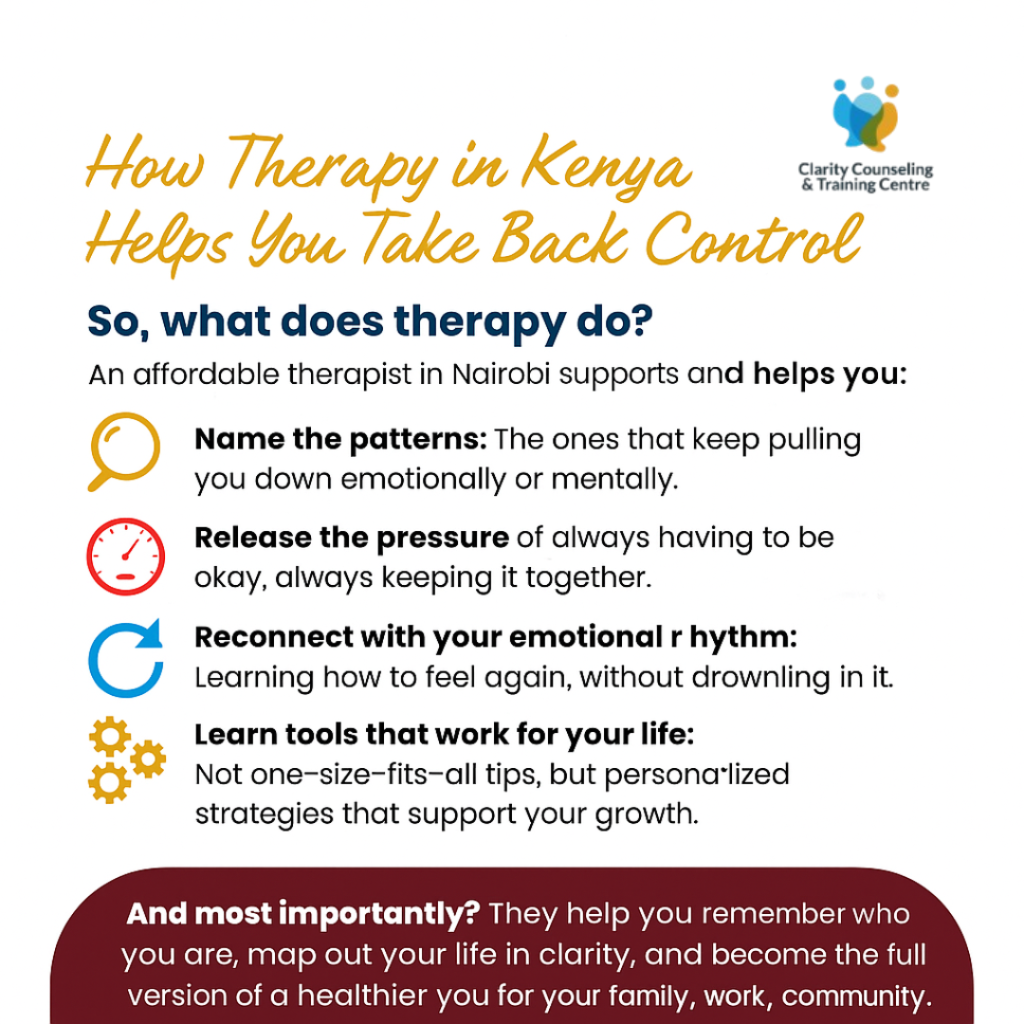
Many people assume counseling is simply “talking about your problems.” But it’s far more than that. Counseling in Kenya is evolving into a powerful, personalized tool for emotional health. Whether you’re navigating grief, trauma, relationship issues, or burnout, working with a therapist can:
- Offer clarity: You begin to understand the patterns that have been shaping your experiences.
- Provide emotional relief: Naming your emotions with someone trained to hold space can be healing in itself.
- Develop coping tools: Learn proven techniques like mindfulness or CBT (Cognitive Behavioral Therapy) to manage symptoms and emotions.
- Support relationships: Marriage counseling in Nairobi, for instance, is helping couples build honest communication and mutual understanding.
- Strengthen self-worth: As you do the inner work, you begin to feel more grounded and capable in everyday life.
Sometimes, people feel like they should be able to figure things out alone. But insight and healing don’t require suffering in isolation. Just like you’d see a doctor for a lingering cough, seeing a counselor for emotional distress is a wise, responsible act of care.
Finding the Right Counselor: Where to Start
Choosing a therapist is personal. It may take a few conversations before you find the right fit, but that’s okay. The process is part of your healing.
Here is what to consider as you take the steps towards healing through therapy sessions:
- Check for credentials: Look for professionals registered with the Kenya Counselling and Psychological Association (KCPA) or trained through institutions like the Kenya Institute of Professional Counseling.
- Define your needs: Do you want to process trauma? Work on your relationship? Manage anxiety? Match your needs with the counselor’s area of expertise.
- Ask about their approach: Therapists may use Cognitive Behavioral Therapy, narrative therapy, solution-focused brief therapy, or integrative approaches. Ask questions to see what aligns.
- Explore accessibility: If cost or location is a barrier, look for affordable therapists in Nairobi or explore online counselling psychology in Kenya that also offer guided sessions.
- Follow your intuition: The connection matters. Do you feel seen and heard? Do you feel safe to explore deeper layers?
What Counseling Actually Looks Like
If you’ve never been to therapy before, it can feel intimidating. Many imagine a stiff, clinical room or a stranger probing into painful memories. But in reality, counseling is more like a calm, focused partnership.
- Your first therapy session is often exploratory. You share what brings you in. The therapist listens, not to fix you, but to understand.
- Together, you set goals. These could be emotional (I want to feel more hopeful) or practical (I want to manage panic attacks).
- Regular sessions (often weekly or bi-weekly) give you space to process thoughts and explore new coping strategies.
- Your therapist may suggest exercises like journaling, mindfulness, or breathing techniques to deepen progress between sessions.
- Progress is monitored, but not rushed. Therapy isn’t linear, it may feel slow at times, but growth happens steadily.
You’re not being “treated”, but being guided. And over time, many discover a new sense of resilience they didn’t think was possible. After a couple of sessions you will find out that indeed therapy is worth the cost and it’s an investment in yourself.
A Gentle Invitation: Start Where You Are
At Clarity Counseling & Training Centre, we’ve walked alongside hundreds of clients across Kenya, offering therapy in Nairobi and beyond that is rooted in compassion and professionalism.
Whether you’re exploring counselling services in Nairobi, or simply wondering if it’s time to begin, we meet you where you are.
You don’t have to have everything figured out. You don’t need to be in crisis to benefit. Counseling is for anyone seeking clarity, peace, or direction. Let’s talk. Your next chapter begins with one simple, courageous step and you don’t have to take it alone. Book a free consultation. We’ll walk with you.
[convertkit form=8314973]