10 Questions You Should Ask Before Booking a Therapist in Kenya?
You’ve googled “therapists in Nairobi.” You’ve maybe even saved a number.
But how do you know if a therapist is the right fit?
Whether you’re exploring therapy for the first time or returning after a break, it’s normal to feel unsure about where to begin. The decision to seek help is deeply personal, and choosing the right therapist can make all the difference in how supported and safe you feel.
In Kenya, where mental health awareness is growing, access to therapy is more available than ever. Still, many people aren’t sure what to look for or what to ask before booking that first session.
This guide breaks down the essential questions to ask, so you can choose a therapist who’s not just qualified, but also right for you.
Why Choosing the Right Therapist Matters
The relationship between a therapist and a client is a key predictor of how well therapy works. According to the American Psychological Association, the quality of the therapeutic relationship accounts for up to 30% of successful treatment outcomes, often more than the techniques themselves.
In Kenya, the Ministry of Health’s Mental Health Taskforce reported in 2020 that one in four Kenyans may be suffering from a mental illness at any given time. Yet only a fraction seek professional help, partly due to stigma and uncertainty around what to expect.
Understanding what makes therapy effective, and what makes a therapist the right match empowers you to seek support early and confidently.
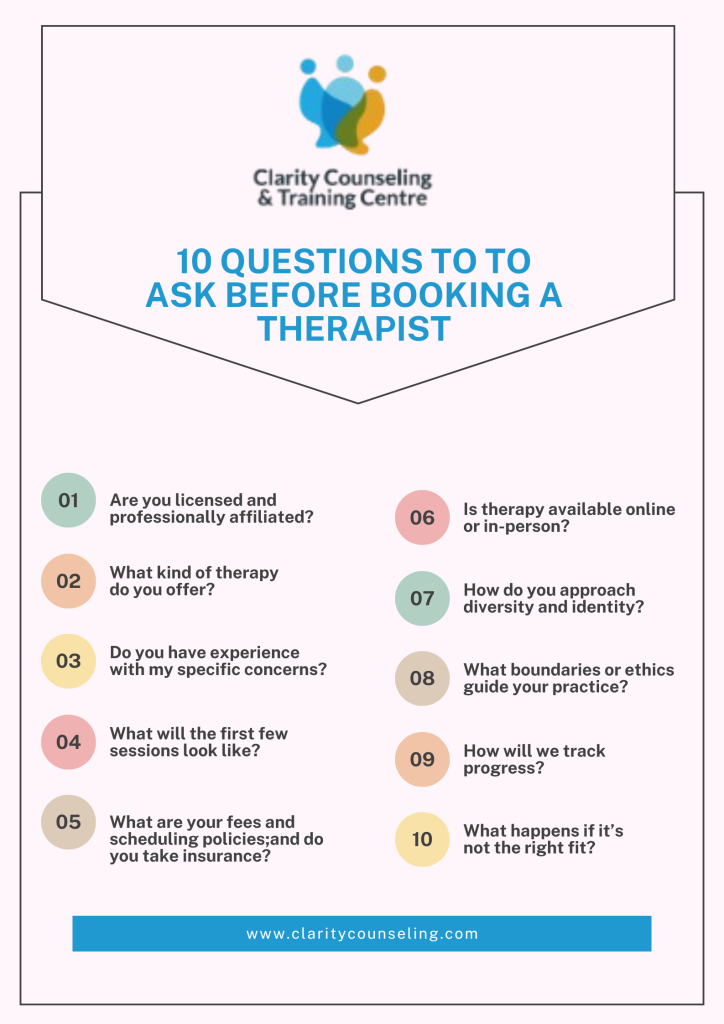
1. Are They Licensed and Qualified to Practice in Kenya?
Not all counselors are equally trained or regulated. In Kenya, qualified therapists typically hold degrees in counseling psychology or clinical psychology and are registered with professional bodies such as the Kenya Counselling and Psychological Association (KCPA) or the Clinical Psychologists Association of Kenya (CPAK).
Ask:
- Are you licensed or registered with a professional body?
- What’s your training background?
A credible therapist should be able to provide these details transparently. You can also verify licenses or memberships through the association websites.
2. What Type of Therapy Do They Offer?
Different issues respond better to different therapeutic methods. Cognitive Behavioural Therapy (CBT) is effective for anxiety and depression. Trauma-informed approaches support healing from past abuse or loss. Solution-focused therapy can help with navigating life transitions or burnout.
Ask:
- What therapeutic approach do you use?
- Is your method effective for what I’m going through?
For example, a 2022 meta-analysis published in World Psychiatry showed that CBT is among the most evidence-based methods for treating depression globally. Knowing the approach can help you gauge how sessions may unfold and what progress might look like.
3. Do They Have Experience With Issues Like Yours?
Your life context matters. A therapist who understands your environment is more likely to offer relevant insights. For example, working professionals in Nairobi may face burnout due to long commutes, family pressure, and workplace expectations. Meanwhile, young adults navigating unemployment or exam stress need different support.
Ask:
- Have you worked with clients dealing with [insert concern]?
- How do you tailor your sessions to a client’s background?
This gives you a sense of how attuned the therapist is to Kenya-specific realities, including social, economic, and cultural dynamics.
4. What Does a Typical Session Look Like?
Understanding the structure of therapy can help reduce anxiety about what to expect. Sessions might include guided conversations, homework assignments, or mindfulness techniques. Online sessions may look slightly different than in-person ones.
Ask:
- What happens in the first session?
- How long are sessions and how often do they take place?
This helps you plan your time and budget, and reduces the emotional uncertainty that can come with starting therapy.
5. What Are the Costs, and Do They Offer Sliding Scales or Packages?
Therapy affordability is one of the most common concerns. In Nairobi, private sessions can range from KES 2,500 to KES 7,000, depending on the therapist’s qualifications, location, and mode of delivery. Some centers offer group therapy or income-based rates.
Ask:
- What are your session rates?
- Do you offer packages or sliding scales?
- Is there a cancellation policy?
- Do you take insurance?
According to a 2022 survey by the Kenya Psychological Association, over 60% of respondents said high costs prevented them from attending therapy consistently. Don’t hesitate to ask about financial flexibility. Clarity Counseling and Training Center partners with leading insurance companies to support your journey.
6. Do You Offer In-Person, Online, or Hybrid Sessions?
Since the COVID-19 pandemic, teletherapy has expanded significantly in Kenya. Studies show that virtual therapy can be as effective as in-person care for many mental health issues.
Ask:
- Do you offer virtual sessions?
- Are you trained in providing teletherapy?
If you’re outside of Nairobi or juggling a tight schedule, online therapy may offer greater consistency and privacy. Just be sure to confirm that secure platforms are used and confidentiality is maintained.
7. What Are Their Views on Identity, Culture, and Spirituality?
Therapy should be a safe space for your whole self. That includes your cultural background, gender identity, language, religion, or lack thereof. Kenya’s diversity makes it essential that therapists can practice cultural humility.
Ask:
- How do you approach cultural or spiritual topics in therapy?
- Have you worked with clients from diverse backgrounds?
This is especially important if you belong to a marginalized group or are exploring sensitive identity questions.
8. What Are Their Boundaries and Ethics?
Kenyan therapists are bound by professional ethical codes that prioritize client safety, privacy, and neutrality. Understanding their ethical stance can build your confidence in the process.
Ask:
- How do you handle confidentiality?
- What happens if we know someone in common?
In close-knit communities, this question is more common than you might think. A professional therapist will answer it directly and without defensiveness.
9. How Will We Measure Progress?
Progress isn’t always linear. Still, it’s important to know how your therapist checks in on growth and whether you’re on track. Some use tools like mood trackers, session reviews, or goal-setting frameworks.
Ask:
- How do we know if therapy is working?
- What happens if I feel stuck or uncertain?
A good therapist helps you notice change over time, even if it’s slow or subtle, and is open to adjusting the approach when needed.
10. What If It Doesn’t Work Out?
Not every therapeutic relationship will be a perfect match, and that’s okay. What matters is whether the therapist is open to honest feedback and can guide you elsewhere if needed.
Ask:
- What if I feel like we’re not a good match?
- Can you refer me to someone else if needed?
This removes the pressure to “make it work” when it doesn’t feel right and reinforces your right to advocate for your wellbeing.
Therapy Should Work for You, Not the Other Way Around
The most effective therapy begins with informed choice. When you ask questions upfront, you move from uncertainty to clarity, saving time, money, and emotional energy.
At Clarity Counseling, we believe therapy should be confidential, culturally sensitive, and empowering. Our team offers professional support to individuals across Kenya and the diaspora, with flexible in-person and virtual options.
If you’re ready to take the next step, we’re here to help you do it with confidence. Book a free consultation for help in choosing a therapist in Kenya. Visit ClarityCounseling.co.ke for trusted professionals, helpful resources, and upcoming mental health workshops.
Curious about whether online or in-person sessions are better for you? Read our blog post on choosing between online and in-person therapy in Kenya.
Quick Checklist: What to Ask Before Booking a Therapist