5 Myths About Becoming a Therapist in Kenya (That Are Holding You Back)
“You want to be a therapist?”
The words land heavy, more like a veiled warning than genuine curiosity, almost as if someone’s trying to steer you away from danger rather than toward possibility.
Maybe you’ve heard them from a friend, a parent, or even from your own cautious inner voice.
“Is there a future for a therapist in Kenya?”
“Aren’t you too emotional to handle other people’s problems as a counselor in Nairobi?”
“Therapists just talk for a living, how is that a real job?”
Suddenly, something that once felt like a calling starts to feel impossible. But what’s standing in the way is not your ability. It’s misinformation.
After walking with hundreds of students at Clarity Counseling & Training Centre, many of them began right where you are and with the same questions. Some were teachers and coaches, others were business owners or caregivers, but all shared a deep desire to help and to heal. They weren’t sure where to begin, or if they were even the “right kind of person” for this work.
This blog post is for you, who is asking those same questions.
Let’s untangle the confusion. Let’s challenge five common myths together, and show you what it really looks like to become a therapist in Kenya today.
1. “You Need A Degree In Psychology From Day One.”
Among the many assumptions people carry about this field, this one quietly lingers, and holds the most power to discourage potential counselors before they even begin.
It’s easy to think the door to counseling only opens if you’ve already studied psychology at university. But that’s not how most therapists in Kenya begin.
The minimum requirement to practice as a therapist in Kenya is a Diploma in Counselling Psychology. What’s more the diploma course is skills and competence based, meaning you’re ready to practice as soon as you’re done with the diploma program.
In fact, many start their journey with a Certificate in Counseling Psychology or Basic Counseling Skills & Self-Awareness Course from accredited institutions like Clarity.
[convertkit form=8142907]
The Kenya Counselling and Psychological Association (KCPA) allows for a structured, progressive learning path. You don’t need to leap into a four-year degree. You can begin with a certificate, grow into a diploma, and build your experience over time.
“I didn’t have a background in psychology,” shares one Clarity graduate. “But the certificate course helped me gain confidence and skills, and it was the first step toward a new purpose.”
Your story may have started elsewhere. But it doesn’t mean it can’t lead here.
2. “Therapists Don’t Earn Enough to Live on.”
This fear is real, and valid.
When you’re choosing a career path, passion matters. But so does provision. Can you really support yourself and your family doing this work?
Here’s what’s happening in Kenya:
The demand for qualified therapists in Kenya is rising, with institutions such as schools, faith-based organizations, corporations, and NGOs increasingly investing in mental health services. Although official statistics do not specify exact employment growth in the mental health sector, broader labor force surveys indicate a gradual increase in overall employment alongside a stronger national focus on mental health.
Efforts to expand and improve mental health care are driving attention to the urgent need for more trained professionals in this field. Beyond formal employment, many therapists diversify their income, offering workshops, consulting, writing, online support groups, and private practice.
“I started counseling part-time while still in my admin job,” one alumna says. “Eventually, I built up a client base and transitioned into it full-time.”
It’s not a path to overnight wealth. It’s more like planting a tree, slow at first, but over time, it grows into something steady, rooted, and deeply fulfilling. For those who approach it with strategy and consistency, it becomes a source of meaningful, flexible, and sustainable work. Subscribe below and get a copy of your guide to starting a career in Counseling Psychology in Kenya today.
[convertkit form=8383362]
3. “You Have to be Emotionally Perfect to Help Others.”
Have you ever caught yourself thinking, “Who am I to help others when I’m still figuring myself out?” This quiet doubt often lingers beneath the surface, unspoken but deeply felt.
“I still struggle with my own issues. How can I help anyone else?”
But therapy doesn’t begin with perfection. It begins with honesty. At Clarity, we emphasize self-awareness and personal development as the foundation of all our programs. We don’t expect our students to have it all figured out. We encourage them to begin the journey of knowing themselves better.
This is not just helpful, it’s essential. Because the best therapists aren’t perfect. They’re reflective, curious, and willing to grow.
“Clarity’s self-awareness class helped me confront parts of myself I had ignored for years,” said one graduate. “It made me a more compassionate counselor, and human being.”
It turns out that your pain doesn’t disqualify you. It deepens your empathy. And that’s the heart of this work.
4. “Therapy in Kenya is all Just Theory and Talking.”
If you’ve ever imagined counseling as endless conversations with no real impact, where the therapist or counselor just nods and asks “how does that make you feel?” You are in good company but that’s further from the truth.
Modern therapy is structured, evidence-based, and hands-on. It’s rooted in psychological science and focused on real-life outcomes.
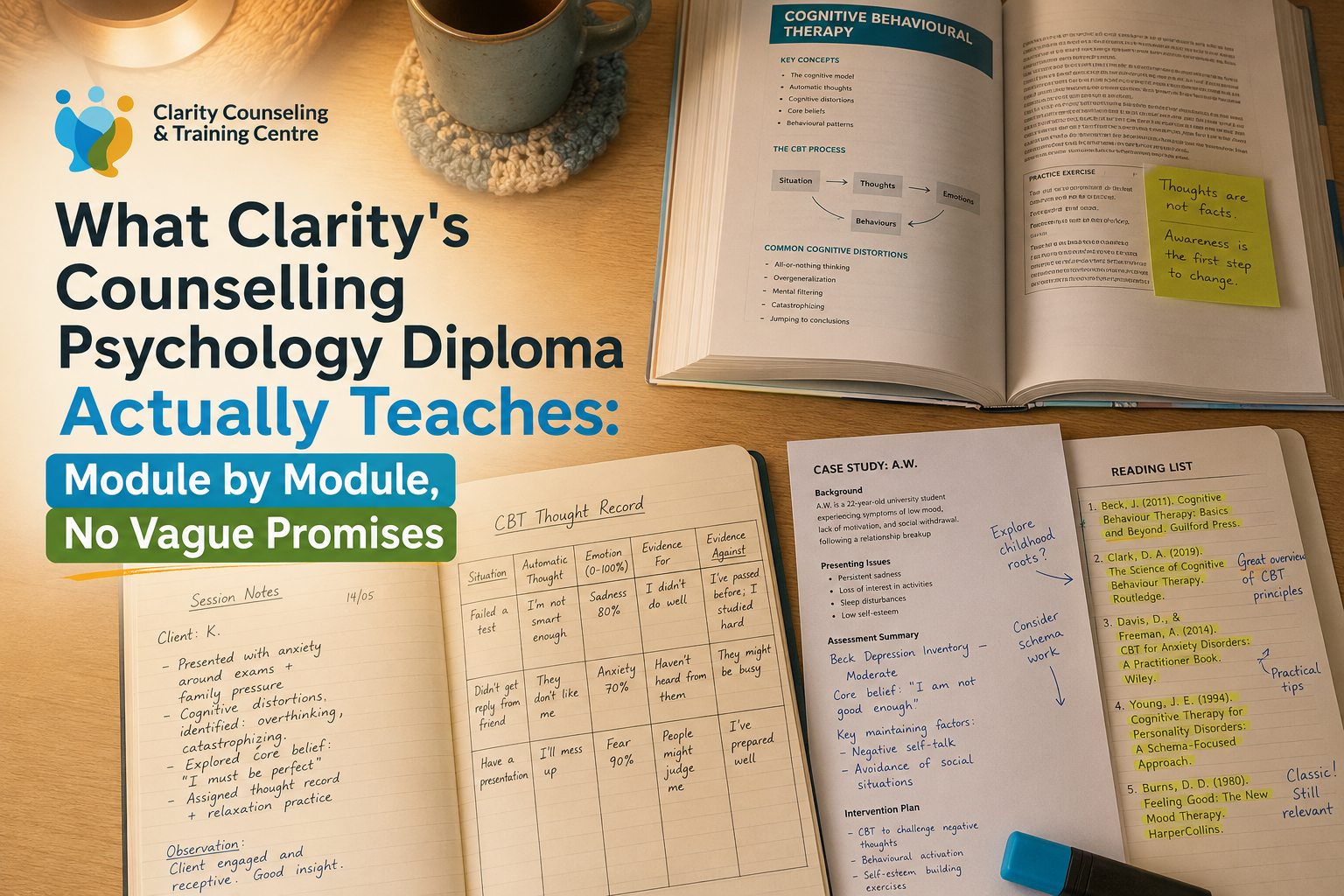
At Clarity, our programs integrate theory with deep practice. You won’t just read about techniques. You’ll rehearse them. You’ll get feedback. You’ll be shaped by experience.
Here’s what our students engage with:
- Cognitive Behavioral Therapy (CBT) frameworks
- Trauma-informed care
- Solution-focused interventions
- Reflective journaling
- Live simulations and supervised practicums
“I was nervous I’d just be memorizing terms,” shared one student. “But we practiced real scenarios. It was intense, but I grew so much.”
Counseling is not soft. It’s skilled, rigorous, and rooted in practice. Yes, you’ll talk, but with purpose, insight, and powerful results.
5. “It’s Too Late For Me To Start a Career in Therapy.”
This is perhaps the quietest myth, and the heaviest.
Maybe you’ve raised children. Maybe you’ve built a career. Maybe you’re in your 40s or 50s and wondering whether you missed your chance.
You haven’t.
Over 40% of Clarity’s students are adult learners. They’re teachers, pastors, caregivers, social workers, and stay-at-home parents who felt the nudge toward counseling later in life.
Their maturity is an asset. Their lived experience is a strength.
“I joined the program at 44,” one alum says. “Today, I facilitate support groups for single mothers in my county. It’s never too late to align with your calling.”
Therapy in Kenya is one of the few professions where who you are matters as much as what you know.
Your past wasn’t wasted, it was soil. Every season, every stumble, every story you’ve carried has been quietly preparing you for this moment of growth and purpose.
What if the door is already open?
Let’s recap what we’ve uncovered:
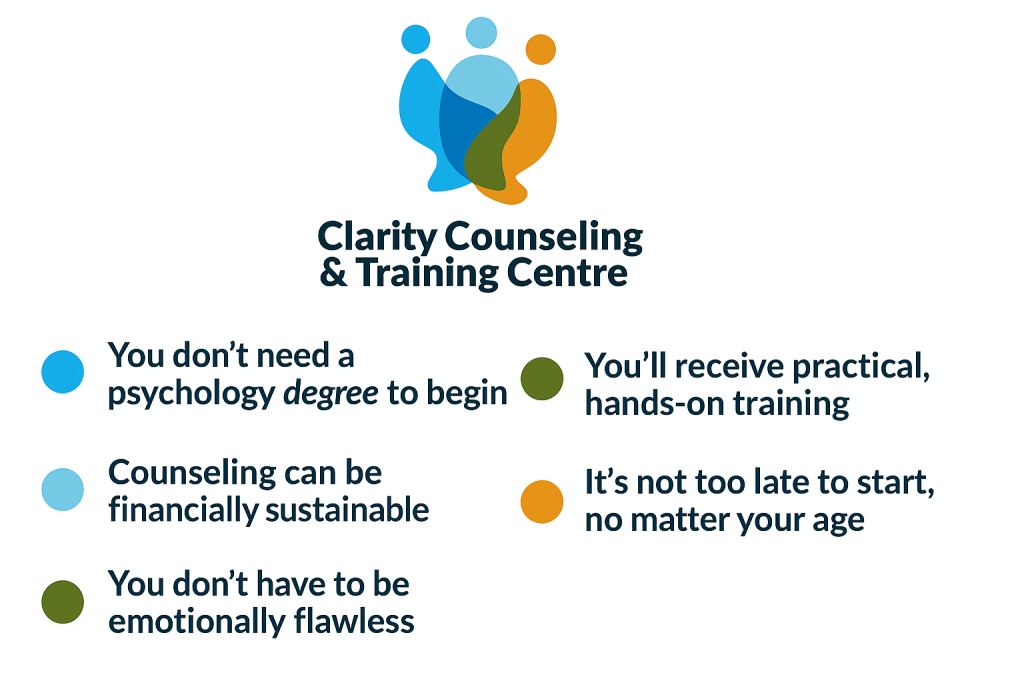
- You don’t need a psychology degree to begin
- Counseling can be financially sustainable
- You don’t have to be emotionally flawless
- You’ll receive practical, hands-on training
- It’s not too late to start, no matter your age
So the real question is not whether you’re ready. It’s whether you’re willing.
Imagine sitting across from someone who feels completely alone. And then, because of your presence, your training, your compassion, they begin to believe in themselves again.
That’s the quiet power of therapy. And it might just be your next chapter.
Frequently Asked Questions (FAQs)
Q: How long does it take to become a therapist in Kenya?
A: A Certificate in Counseling Psychology can be completed in 6–12 months. Many students pursue a diploma or degree over time, depending on their goals.
Q: Is Clarity accredited?
A: Yes. Clarity Counseling & Training Centre is a NITA accredited training center No. NITA/TRN/2202.
We are also accredited by the Kenya Counselling and Psychological Association No. KCPA/INST/0147/019, and aligned with TVETA training standards.
Q: Can I study while working full-time?
A: Yes. Our evening and weekend classes are designed for working adults.
Q: Do I need any experience before applying?
A: No prior experience is required. All you need is a willingness to learn and a heart for others.
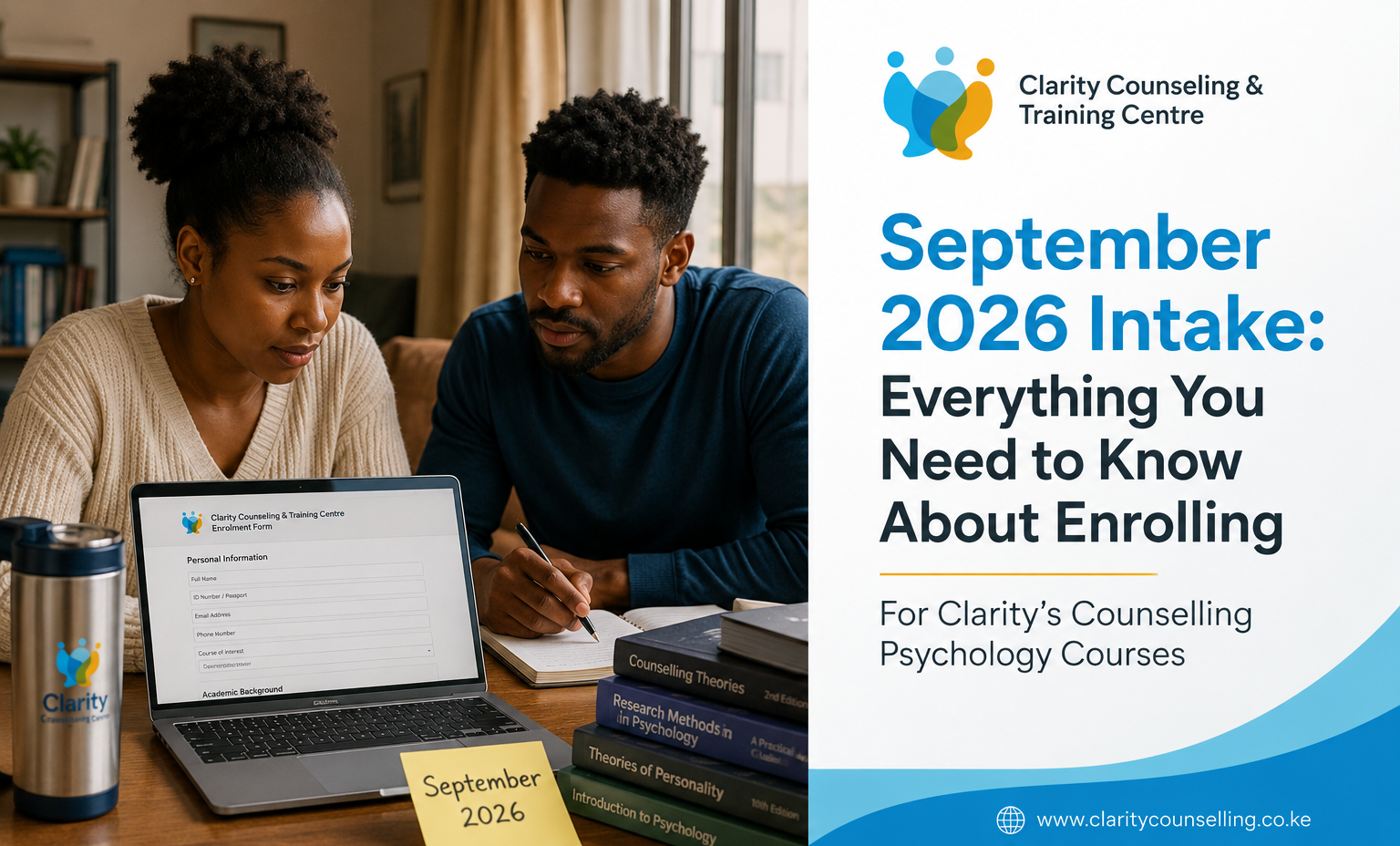
Your next step starts here, Join Clarity Counseling September 2025 Intake
Our programs are more than just gaining qualifications. They’re about becoming the kind of person who can sit with others in their hardest moments, and offer hope. They are:
- Hands-on, practical training
- A warm and supportive learning environment
- Flexible scheduling for working adults
- Accredited and trusted in the mental health community
Call us today to learn more or begin your application today. Let Clarity walk with you, every step of the way.
[convertkit form=8293677]
Clarity Counseling & Training Centre , Where your journey to becoming a therapist begins.