How Therapy Helped Me Save My Marriage
How Therapy Helped Me Save My Marriage: A Real Kenyan Couple's Story (With Therapist Commentary)
| Note on this post: The account below is a composite narrative drawn from the experiences of couples who have worked with Clarity’s therapists. Names and identifying details have been changed. The therapist’s commentary is written by one of Clarity’s couples therapists. This is not a single case study. It is a representative story. |
The Year We Stopped Talking
James, 38, Nairobi. Works in logistics.
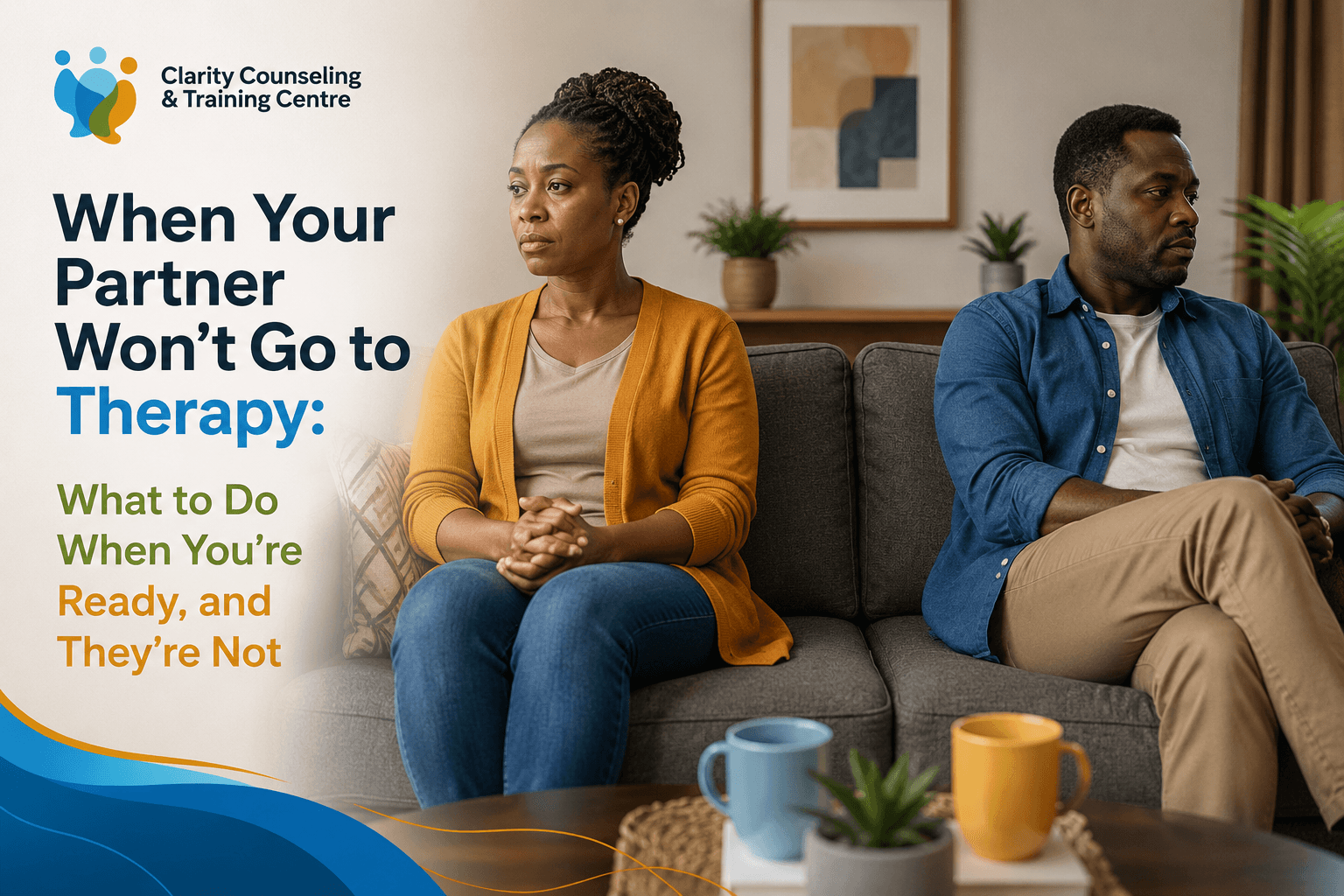
“I want to be honest about where we were. We were not screaming at each other. We were not violent. By all the visible signs, we had a functioning marriage. We had a three-bedroom in Ruaka. Two kids in school. We went to church every Sunday.”
“But we had not had a real conversation in maybe eight months. I mean a conversation where one of us said something true and the other one actually heard it. Everything was logistics. Who is picking up the kids? What time are you home? Did you pay the school fees?”
“I remember the moment I thought: I am lonelier inside this marriage than I was before I got married. And that thought frightened me more than I can describe.”
Wanjiru, 36, James’s wife works in finance.
“I had been trying to tell him something was wrong for two years. Not with those words. I do not know if I even had those words. But I had been trying in smaller ways: starting conversations that went nowhere, suggesting we go somewhere together, things like that. And he would say yes and then it would not happen. And after a while I stopped asking.”
“I was not angry. I was tired. And the tiredness felt worse than anger. Anger at least means you still care.”
| Therapist commentary: What James and Wanjiru are describing is one of the most common presentations in couples work. Not a dramatic rupture, but a slow accumulation of disconnection. When couples arrive at this stage, they often tell us nothing happened. And they are right. The relationship did not break under the weight of a single event. It frayed. The pattern James describes, two people living parallel lives under the same roof, has a name in the research. John Gottman calls it the distance and isolation cascade. It is the stage that precedes the most serious relational deterioration. It is also, importantly, the stage at which couples therapy is most effective. |
How Did Couples Therapy in Kenya Actually Start for You?
James: “My wife had been the one asking. For maybe a year she had been saying maybe we should talk to someone, and I had been saying we would be fine. That we just needed time, or a holiday, or for work to slow down.”
“And then one night she said something to me that I still think about. She said: I am not asking anymore. And the way she said it was not aggressive. It was just final. She sounded like someone who had made peace with something. And I realised she was not threatening to leave. She was telling me she had already started to go. In her head, she had already started to leave.”
“I booked the appointment the next morning.”
Wanjiru: “I want to be honest. I did not believe it would work. I had heard too many stories of couples therapy in Kenya being a session where you sit across from someone who tells you to communicate better. I thought it would be a waste of time and money and that James would say the right things in the session and nothing would change.”
“The first session surprised me.”
| Therapist commentary: The dynamic James and Wanjiru describe, one partner pursuing and one withdrawing, is called the pursue-withdraw cycle. It is possibly the single most common pattern in distressed couples. The pursuing partner reaches for connection. The withdrawing partner disengages, sometimes because the connection attempt feels like criticism, sometimes because emotional engagement has never been modelled as safe. Both partners end up feeling unloved. Both are doing the best they can with what they have. The first therapeutic task is helping both people see the cycle itself, rather than each other, as the problem. |
What Actually Happened in the Sessions?
James: “I expected to be asked to talk about my feelings. And we did, eventually. But the first session was not like that. The therapist spent a lot of time just listening to both of us, separately but in the same room. She was watching how we talked to each other. Or how we did not talk to each other.”
“Then she said something that I have never forgotten. She said: The two of you have a cycle. You do not have a conflict. You have a cycle. And she explained what she meant. And I looked at Wanjiru and something shifted. Because I realised that what I had been experiencing as her attacking me was not an attack. It was fear. It was her fear that I did not want her anymore.”
“I had no idea. I thought she was angry with me. She thought I was indifferent to her. Neither of us was right. But we had both been responding to the story we had made up, not the person in front of us.”
Wanjiru: “There was a session, I think our fourth, where I said something to James that I had never said out loud before. About what his withdrawal felt like to me. Not what he was doing wrong. Just what it felt like. And he heard it. He heard it in a way that had never happened before. And he told me later that he had not known. That he genuinely had not understood that his silence felt to me like abandonment.”
“That session changed something fundamental.”
| Therapist commentary: What Wanjiru is describing is a corrective emotional experience, one of the core goals of couples therapy. For many couples, the breakthrough is not a technique or a communication framework. It is the moment when one partner genuinely understands the impact of their behaviour on the other, not intellectually, but emotionally. This is something that is very difficult to reach without a structured, held space. In the ordinary back-and-forth of conflict, one person’s vulnerability tends to produce the other’s defensiveness. In therapy, a skilled couples therapist can hold both people’s vulnerability at the same time. |
How Long Did Couples Therapy Take? Was It Worth the Cost?
James and Wanjiru attended 14 sessions over approximately eight months, weekly at first and then fortnightly as they built momentum.
The Kenya Vital Statistics Report 2024 documents a significant shift in Kenyan family structure:
|
These are not abstract numbers. They represent real families in mid-change, many of whom did not have access to the support they needed when it could have made a difference.
James: “Was it worth the money? I will answer this the way I would answer it to a friend. I have spent more on a single family holiday than I spent on the whole therapy process. The holiday is a memory. What changed in those sessions is still here every day.”
Wanjiru: “I would tell anyone who is hesitating: do not wait until you are at the end. We almost waited too long. What I know now is that the conversation that changes things can happen. But you need someone who knows how to hold the space for it.”
What James and Wanjiru Want Other Kenyan Couples to Know
You do not have to be falling apart to go.
James: “The stigma is real. I know men who would never go. Those who think it means something is wrong with them, or that a good marriage should not need help. I thought that. And then I thought: I also go to the doctor when something is wrong with my body. Why is this different?”
Wanjiru: “I want women who are in the position I was in, exhausted, asking, being told it will be fine, to hear this: you are not imagining it. And you are not wrong to want more. The right therapist can help both of you find your way back to each other. But you have to start.”
Common Concerns Kenyan Couples Have Before Starting Therapy
| Concern | What We Hear From Couples Who Came Anyway |
|---|---|
| My husband/wife won’t come | Individual therapy is still meaningful. The changes you make in how you show up often create conditions for your partner to engage differently. |
| We’re Christian. Will a therapist respect our faith? | At Clarity, faith-integrated therapy is not a special service. It is part of how we work with clients who hold faith as central to their lives. |
| Is it confidential? | Yes. What happens in sessions stays between you and the therapist. Your employer, family, and friends are not part of the conversation unless you choose to make them so. |
| How many sessions will we need? | It varies. James and Wanjiru needed 14 over eight months. Some couples see significant change in six. An initial consultation gives you a clearer picture. |
| What if the therapist takes sides? | A good couples therapist does not take sides. The cycle is the problem. Both of you are understood. |
A Note on Christian Couples Seeking Therapy
James and Wanjiru are practicing Christians. This mattered to them.
James: “We were worried about finding someone who understood our faith. Not someone who would push it aside or who would make us feel like seeing a therapist meant our faith was not enough. Our therapist at Clarity understood that framework. She never dismissed it. She worked with it.”
At Clarity, faith-integrated couples therapy is part of how we work with clients who hold faith as central to their lives. Read more in our post on faith and mental health in Kenya.
Frequently Asked Questions
Can couples therapy really save a marriage in Kenya?
Yes, but the word save deserves some nuance. Couples therapy does not guarantee a specific outcome, and a good therapist will not tell you it will. What it does is create the conditions, held, structured, and honest, in which real change becomes possible. A 2023 Kenyan study found that 86% of respondents saw counselling as a major factor in saving their relationships. The couples most likely to benefit are those who come before the disconnection has become a decision.
When should Kenyan couples seek therapy: before or after a crisis?
Before, if at all possible. The couples who get the most from therapy are not always in crisis. They are the ones who have noticed a pattern: the same argument, the growing distance, the communication that never quite lands, and have decided to address it before it hardens. Crisis is not a prerequisite. Willingness is.
How much does couples therapy cost in Kenya?
At mid-range private counselling centres in Nairobi, couples therapy typically runs between KES 3,500 and KES 6,000 per session. Senior therapists or specialist practices may charge more. For a full breakdown of therapy costs and insurance options, see our guide: Does SHA Cover Therapy? At Clarity, session costs can be discussed directly on WhatsApp: +254 (0) 101 515 101.
What if my husband or wife refuses to come to couples therapy?
This is extremely common. Individual therapy is still a meaningful option. The changes you make in how you show up in the relationship often create conditions for your partner to engage differently, sometimes enough to join eventually. See our post on men and therapy in Kenya for more.
Does Clarity offer couples therapy for Christian couples in Kenya?
Yes. Our therapists work with faith-integrated approaches, holding your shared values as part of the therapeutic framework rather than setting them aside. Sessions are available in person in Nairobi and online.
Related reading: Couples Therapy in Kenya: When to Go, What It Costs · Marriage Counselling in Nairobi · Men and Therapy in Kenya · Faith and Mental Health in Kenya · Individual Therapy at Clarity
| You do not need to be in crisis to start.
Couples therapy at Clarity is confidential, evidence-based, and designed for Kenyan couples at any stage of the relationship. Book a couples consultation: https://claritycounseling.co.ke/therapy/ WhatsApp: +254 (0) 101 515 101 Related: Couples Therapy in Kenya: When to Go, What It Costs, and Why It Is Not Just for Marriages in Trouble |