Is Your Child Truly Ready for the Campus Journey Ahead?
A quiet, honest reflection on campus life, inner strength, and what preparation really means
It starts long after the celebration has ended.
The admission letter has been framed.
Relatives have congratulated you.
Photos have been taken, posted, and liked, and then life returns to normal.
Except something has shifted.
One night, the house is eerily quiet, and you realise this is the sound of a chapter closing. Your son or daughter is no longer under your roof every day. They’re stepping into a world that expects independence, resilience, and confidence, without asking whether they’ve been taught how to develop these qualities.
You lie awake, not because you doubt their intelligence or character, but because a quieter question keeps surfacing:
“Did I prepare them enough for what campus life asks of them, emotionally, not just academically?” But there is a solution. Shall we show you?
When You Imagine Them There, What Do You See?
Maybe you picture them at the University of Nairobi, rushing through packed lecture halls where asking questions feels intimidating, and anonymity is easy to slip into.
Or at Strathmore, where discipline and excellence are the culture, and pressure quietly rides alongside ambition.
Perhaps it’s USIU, where freedom comes fast, routines are self-made, and comparison is constant.
Or Makerere, or a campus thousands of kilometres away —in the UK, the U.S., or Canada— where everything from teaching styles to social cues feels unfamiliar, and “home” exists in a different time zone.
You imagine them in their room late at night.
The lights are off, but sleep hasn’t come.
Their mind keeps circling the same thoughts:
“Am I keeping up?”
“Why does everyone else seem to be managing better than me?”
“If I struggle now, what does that say about who I am?”
You recognise that tone, because you’ve heard it before—in yourself.
What Campus Life Quietly Demands (But Rarely Teaches)

Campus is not just an academic environment. It is an emotional one.
It asks young people to:
- Regulate stress without supervision
- Navigate new relationships and boundaries
- Make decisions with long-term consequences
- Carry expectations—spoken and unspoken
Many students discover, often painfully, that intelligence alone is not enough.
A first-year student may skip two lectures in a row, not out of laziness, but because anxiety convinces them they’ve already fallen too far behind to return without embarrassment.
Another sits surrounded by classmates yet feels profoundly alone, scrolling through social media at night, absorbing the illusion that everyone else is coping better.
This isn’t speculation.
A 2025 study across Kenyan universities found that 31% of students experience significant mental health challenges, with the number rising above 40% among first-year students, especially those lacking strong support systems. (Frontiers in Public Health, 2025)
These struggles don’t announce themselves loudly.
They whisper.
They accumulate.
And without the tools to understand what’s happening inside, many students internalise distress as personal failure.
The Skill That Changes Everything: Self-Awareness
Resilience is often misunderstood as toughness. But the students who thrive aren’t the ones who never struggle. They’re the ones who can recognise struggle early and respond wisely.
Self-awareness allows a young person to notice:
- When stress is building instead of exploding
- When fear is influencing decisions
- When perfectionism has crossed into self-criticism
It gives them language for their inner world.
Research consistently shows that students with strong emotional awareness:
- Adapt more easily to change
- Experience lower burnout
- Build healthier relationships
- Perform better academically over time
Self-awareness doesn’t eliminate difficulty. Instead, it transforms how difficulty is met.
Resilience Isn’t About Endurance
It’s About Recovery, pushing through pain without pause. True resilience is about:
- Recovering after failure
- Asking for help before a crisis
- Holding disappointment without collapsing
- Choosing growth over shame
These are learned skills, and for many young adults, no one ever taught them explicitly.
Why Waiting Until Something Breaks Is Too Late
Most families act when the signs become impossible to ignore, such as when grades drop, phone calls home change in tone, and motivation disappears.
But emotional strength works best when built early, before the pressure peaks. Think of it like learning to swim before deep water. Preventive emotional skills:
- Normalise emotional conversations
- Reduce stigma around support
- Equip students to handle pressure from the very beginning
This is preparation rooted in care, not fear.
A Gentle Bridge: The Certificate in Counseling Psychology

At Clarity Counseling & Training Centre, we walk alongside families walking this transition.
Parents who want their children to succeed without losing themselves.
Young adults who want more than survival—they want understanding.
Our 6-month, part-time Certificate in Counseling Psychology (TVETA-accredited) is designed for young adults preparing for, or already navigating, campus life.
It’s not about becoming a counsellor.
It’s about becoming emotionally grounded.
What This Course Builds—In Real-Life Terms
This programme doesn’t live in textbooks alone. It meets students in lecture halls, hostels, group chats, family WhatsApps, and the quiet spaces where doubts tend to grow.
Here’s how each part shows up in real life:
Personal Development & Self-Awareness
Students learn to notice what’s happening inside before it spills over into panic, shutdown, or self-blame.
They begin to recognise patterns like how:
- Stress shows up in their bodies
- Fear influences decisions
- Certain thoughts repeat when pressure rises
Instead of being swept away by emotions, they learn to pause, name what they’re feeling, and choose a response rather than react on autopilot.
This is often the moment they stop asking, “What’s wrong with me? and start asking, “What is this feeling trying to tell me?”
Human Growth & Development
Many young adults believe struggle means failure.
This unit gently dismantles that myth.
Students learn that confusion, emotional swings, identity questions, and self-doubt are not personal defects; they are part of a normal developmental stage. With this understanding, they stop interpreting every hard moment as proof they’re falling behind and begin to see growth as a process rather than a performance.
It replaces quiet shame with compassion, pressure with perspective.
Counselling Theories & Practice
Here, students begin to understand how thoughts, emotions, and behaviour influence one another in daily life.
They notice how a single unchallenged thought—“I’m not good enough”—can spiral into avoidance, procrastination, or burnout. They learn practical ways to interrupt those cycles, think more clearly under pressure, and make decisions rooted in awareness rather than fear.
They understand the origin of human behavior, providing answers to long-standing questions about who they are and why they behave the way they do. They notice how their childhoods have shaped them, helping them to embrace their uniqueness rather than living in self-comparison.
This doesn’t just improve emotional health. It sharpens focus, strengthens judgment, and supports academic performance.
Group Counselling
Campus life is relational, whether students feel ready for it or not.
In this space, they practise listening, expressing themselves honestly, setting boundaries, and navigating disagreement without withdrawing or becoming defensive. They learn how to be present with others while staying grounded in themselves.
For many students, this is where they realise:
“ I’m not alone in this,” and just as importantly, “I don’t have to disappear to belong.”
Trauma, Loss & Psychological First Aid
Life does not pause because someone is in school.
This unit equips students with tools to navigate disappointment, grief, sudden change, and emotional shock, whether it’s the loss of a loved one, a failed exam, a broken relationship, or a moment when life simply doesn’t go as planned.
They learn how to stabilise themselves in difficult moments, offer support to others without becoming overwhelmed, and recognise when professional help is needed.
It builds calm in the middle of uncertainty and steadiness when emotions run high.
Ethics & Boundaries
Many young adults give too much, too quickly, to the wrong people or situations.
This module teaches students how to protect their emotional energy, clarify their values, and recognise where responsibility ends and self-care begins. They learn to say no without guilt, yes without resentment, and to relate to others without losing themselves in the process.
These are life skills—ones that shape friendships, leadership, work environments, and future families.
The Kicker: Your Child Gets Eight Subsidised Personal Therapy Sessions
This is where learning deepens, not just through discussion, but also through lived experience.
Each student attends eight personal therapy sessions, spread over a six-month period. In these sessions, participants engage in inner work, processing their own fears, patterns, and stories in a safe and guided space.
Theory becomes insight, Insight becomes integration, and integration becomes change.
Practical Details (Because Life Still Needs Structure)
- Duration: 6 months (January–June 2026)
- Schedule:
- One full Saturday (8:00 AM–4:30 PM)
- Or three evenings per week
- Format:
- In-person (Nairobi)
- Fully online (ideal for diaspora families)
- Investment: KSh 50,000 (flexible instalments available)
- Certification: TVETA-accredited
What Others Have Noticed
“This course helped me understand myself. Campus stopped feeling like something I had to survive.”
— First-year university student
“I watched my daughter grow calmer, more confident, and more open. It changed how we relate as a family.”
— Parent
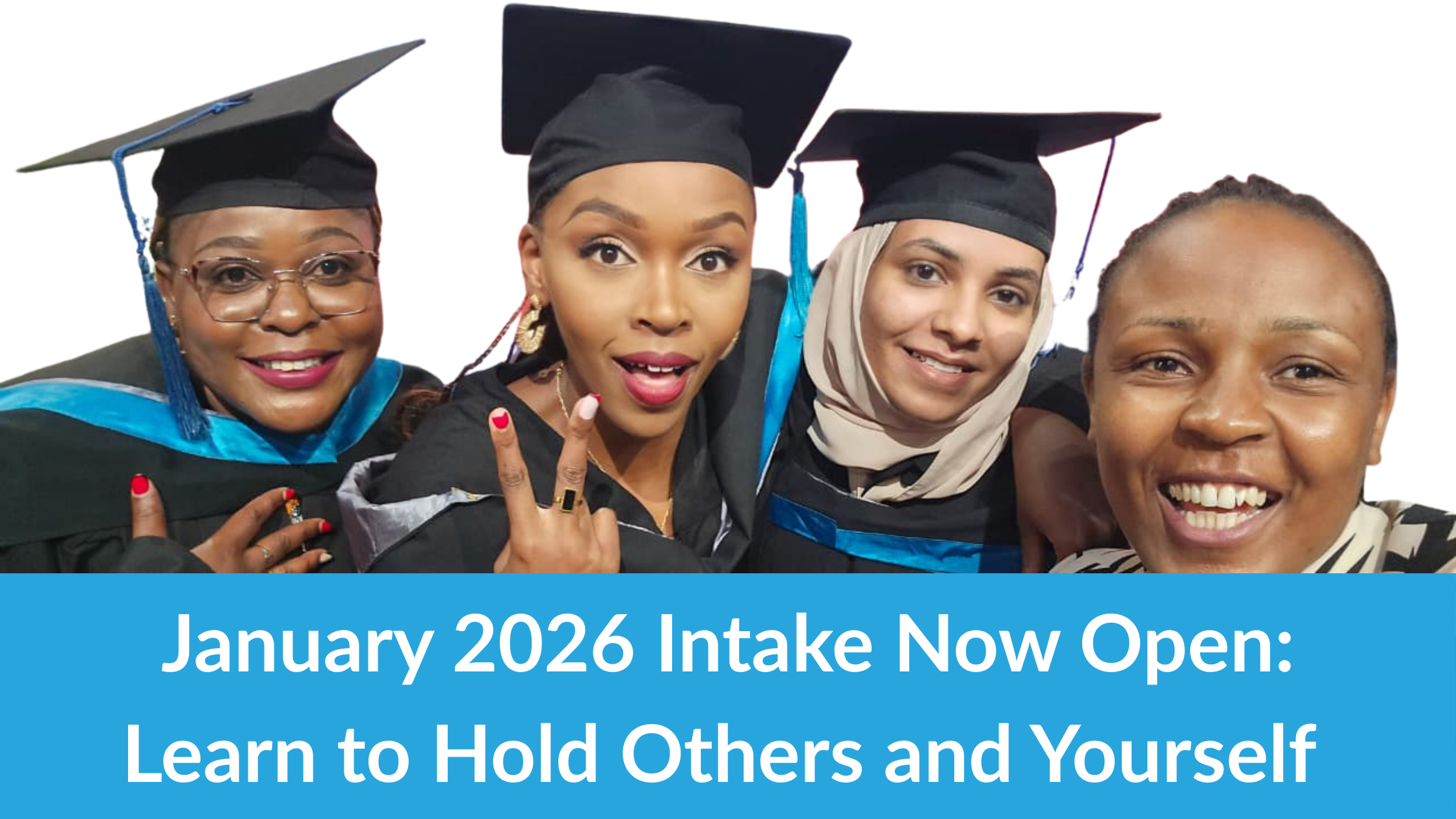
January 2026 Intake Now Open, Classes Begin on the 25th

This isn’t fixing your child, but equipping them with:
- Language for their inner world.
- Resilience that bends instead of breaks.
- The confidence to face uncertainty without losing themselves.
And perhaps, as you walk this path with them, you find something healing for yourself, too.
January 2026 Intake Now Open, and classes begin on the 25th.
If this resonates, trust that pause in your chest. When a young person understands themselves,
the world becomes lighter to carry, and you rest, knowing they are not walking alone.