What Clarity’s Counselling Psychology Diploma Teaches: Module by Module, No Vague Promises
"What Clarity's Counselling Psychology Diploma Actually Teaches: Module by Module, No Vague Promises"
Kenya has 150 psychiatrists.
For a population of more than 50 million people. One specialist for every 333,000 Kenyans. And only 16 out of Kenya’s 47 counties have even one psychiatrist working in the public sector. None of those 16 counties have a public sector psychologist.
One in four Kenyans will experience a mental health condition at some point in their lives. The people who are supposed to help them do not yet exist at the scale needed. They are going to have to be trained.
That is the context you are walking into when you enrol in a counselling psychology programme in Kenya in 2026. Not a crowded field where another qualification is one more certificate on a wall. A field with a gap so large that every properly trained counsellor who enters it serves people who would otherwise have nowhere to go.
This post tells you exactly what Clarity’s Diploma prepares you to do. The curriculum, the structure, the demands. What happens in each module and what you become through the process of completing it.
| Clarity’s Diploma in Counselling Psychology is accredited by the Kenya Counselling and Psychological Association (KCPA No. KCPA/INST/0147/019) and meets the training requirements for registration with the Counsellors and Psychologists Board (CPB), the statutory licensing body under the Counsellors and Psychologists Act 2014. It is the professional qualification for counselling practice in Kenya. |
The Philosophy Behind the Programme
Before the modules, the approach.
Clarity’s Diploma is built on a foundational belief that you cannot take a client somewhere you have not been yourself. This is not a motivational metaphor. It is a clinical principle. Therapists who have not done their own work carry their unexamined material into the room. It shapes how they hear, what they miss, and what they unconsciously avoid.
This is why personal therapy is a mandatory component of the Diploma. Not recommended. Required. It is also why the programme includes personal development modules alongside clinical training. The two are not separate. They are the same work.
The theoretical orientation is integrative, meaning students learn multiple approaches and develop the clinical judgment to know which tool is right for which person, rather than applying a single framework to everyone.
What You Study: The Core Modules
Module 1: Foundations of Counselling Psychology
The programme begins with the ground. What counselling psychology is and is not. The difference between counselling, psychotherapy, coaching, and pastoral care, and why those distinctions matter clinically and legally. The history of the profession in Kenya, the East African context, and globally.
You will also begin your personal development work here. The first question the programme asks you is not what you know. It is who you are, what you carry, and why you are here.
- History and philosophy of counselling
- The Kenyan regulatory landscape: KCPA, CPB, the Counsellors and Psychologists Act 2014
- Ethics in counselling: confidentiality, boundaries, duty of care, and the situations where they become genuinely difficult
- Theories of human development across the lifespan
- Introduction to personal development and self-awareness practice
Module 2: Core Counselling Skills
This is where the craft begins. The skills that look simple and are not: how to listen in a way that makes a person feel genuinely heard. How to reflect without parroting. How to ask a question that opens rather than closes. How to hold silence without filling it.
Students practise these skills in triads: one person as the client, one as the counsellor, and one as the observer. The feedback is specific, structured, and often uncomfortable in the most useful way.
- Active listening and empathic responding
- Reflection of feeling and content
- Open and closed questioning, and when each is right
- Summarising and paraphrasing
- Working with silence
- Managing the therapeutic relationship in the first session
- Video review of your own practice sessions
Module 3: Theories of Counselling
Every therapist works from a theoretical framework, even if they have never named it. This module makes the implicit explicit. Students engage with the major theoretical traditions: what each one says about how people develop, why they suffer, and the mechanisms of change.
- Person-centred therapy (Carl Rogers): the core conditions, unconditional positive regard, and what happens when you actually provide them
- Cognitive Behavioural Therapy (CBT): the relationship between thought, feeling, and behaviour, and the evidence base for structured intervention
- Psychodynamic approaches: how the past lives in the present, transference, countertransference, and what the therapeutic relationship reveals
- Solution-focused brief therapy: working with what is already working
- Narrative therapy: how the stories we tell about ourselves shape the problems we experience
- Integrative approaches: how to hold multiple frameworks and move between them with clinical intention
Module 4: Mental Health and Psychopathology
You cannot help with what you cannot recognise. This module builds the clinical vocabulary for understanding how mental health challenges present, what distinguishes common presentations from clinical conditions, and when and how to refer.
- Depression: presentations across different populations, co-occurring conditions, clinical thresholds
- Anxiety disorders: generalised anxiety, panic, social anxiety, OCD, and how each presents differently
- Trauma and PTSD: the neuroscience of trauma, developmental trauma, single incident trauma, and complex PTSD
- Psychosis and severe mental illness: recognition, appropriate response, and referral pathways
- Substance use disorders: assessment, motivational interviewing approaches, and co-occurring presentations
- Personality presentations that affect the therapeutic relationship
- Culturally competent diagnosis: why the DSM and ICD categories do not always map onto African presentations, and what to do when they do not
Module 5: Trauma-Informed Practice
Given Kenya’s context, this module carries specific weight. Trauma is not rare here. It is in the consultation room in forms that training from other contexts does not always prepare you for: post-election violence, GBV, road accident trauma, community violence, and the long aftermath of displacement.
- The neuroscience of trauma: what trauma does to the brain and nervous system
- The Window of Tolerance and how to work within it
- Somatic approaches to trauma: introduction to body-aware therapeutic practice
- Secondary traumatic stress and compassion fatigue in the counsellor
- Working with survivors of GBV in the Kenyan context
- Trauma-informed principles applied to assessment, contracting, and the therapeutic relationship
Module 6: Group Therapy Facilitation
Therapy does not only happen one-to-one. Group therapy is a powerful, evidence-based modality that is particularly relevant in resource-limited settings and community contexts. This module teaches students to facilitate therapeutic groups rather than simply chair discussions.
- The theory and evidence base for group therapy
- Group dynamics, roles, and common group phenomena
- Facilitation skills: how to work with the group as the primary therapeutic agent
- Structuring a therapeutic group: open versus closed, time-limited versus ongoing
- Managing conflict, silence, and monopolisation in a group setting
- Practical facilitation sessions observed and supervised
Module 7: Couples and Family Therapy
Individual distress rarely happens in a relational vacuum. This module introduces students to systemic approaches: what happens when you put more than one person in the room and work with relationships rather than individuals.
- Systems theory and how it changes the therapeutic lens
- Common presentations in couples work: communication breakdown, infidelity, sexual difficulties, parenting conflict, financial stress
- Culturally informed couples work in the Kenyan context: polygamy, extended family pressure, bride price, and religious framing of marriage
- Family therapy approaches: structural, strategic, and narrative
- Working with children in family therapy
- Ethics in couples and family work: confidentiality when there is more than one client in the room
Module 8: Ethics, Law, and Professional Practice
The final core module returns to the ground. Ethics is not a one-time induction topic. It is the ongoing discipline of the professional counsellor. This module deepens the ethical reasoning skills introduced in Module 1 and applies them to the complex situations practitioners actually encounter.
- The KCPA Code of Ethics in practice
- Confidentiality and its limits: when disclosure is legally required or ethically necessary
- Managing dual relationships in small or close-knit communities, which is the norm in much of Kenya
- Supervision as a professional obligation: what it is, why it matters, and how to use it
- Record keeping, documentation, and what a clinical file should contain
- Building a sustainable practice: private practice, institutional employment, and the NGO sector
The Supervised Practicum
No counselling psychology diploma is complete without supervised practice with real clients. The practicum is the component that transforms knowledge into clinical competence.
At Clarity, the practicum involves a required number of client contact hours (150 hours) conducted under the supervision of a licensed clinical supervisor. Sessions are recorded for supervision purposes (with client consent). Students receive both individual supervision and group supervision, which is a professional development format they will continue using throughout their careers.
The practicum is scheduled collaboratively to accommodate working students. It is also the part of the programme that students most consistently describe as transformative in ways that the taught content alone cannot be.
Mandatory Personal Therapy
Every Diploma student at Clarity is required to complete a minimum of 20 personal therapy sessions during the programme. This is standard practice in reputable counselling training worldwide. The reasons are clinical, not punitive.
A counsellor who has not experienced the vulnerability of the client chair, who has not sat across from someone and tried to say the true thing, who has not felt the specific exposure of being genuinely seen, has a significant blind spot. Personal therapy fills it.
Many students report their personal therapy sessions as among the most significant experiences of the programme.
Who Teaches
Clarity’s trainers are practising counselling psychologists and clinical supervisors, not academics who stopped seeing clients to lecture. The training draws on current clinical experience, which means the case material is real, the dilemmas are live, and the supervision reflects what is actually happening in Kenyan consulting rooms right now.
What You Can Do With the Diploma
| Setting | Role |
| Private practice | Licensed counselling psychologist (CPB registered) |
| Hospital or clinic | In-house counsellor, liaison mental health worker |
| NGO or humanitarian organisation | Psychosocial support officer, trauma counsellor |
| School or university | School counsellor, student wellness coordinator |
| Corporate EAP | Employee assistance counsellor |
| Community organisation | Community mental health worker, group facilitator |
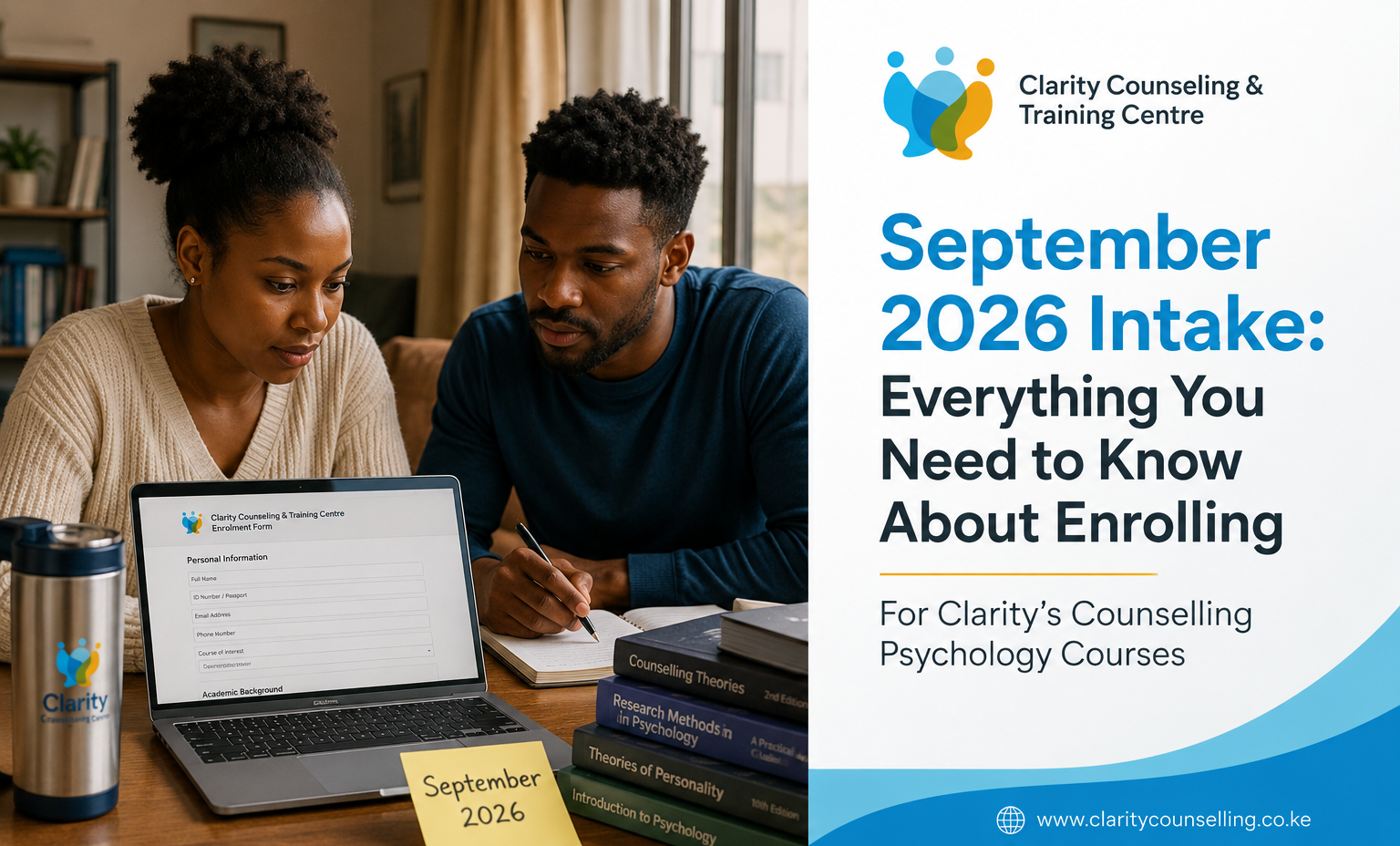
September 2026 Intake
Applications for September 2026 close August 15. The Diploma runs in the evening and weekend schedule, with online delivery also available.
Instalment payment plans are available. Fees for the full Diploma programme are KSh 177,000.
→ Full September 2026 Enrolment Guide
→ Certificate course page (6-month entry point)
→ WhatsApp the admissions team: +254 (0) 101 515 101 | Call: +254 (0) 114 444 300
Frequently Asked Questions
How long does the Clarity Diploma in Counselling Psychology take?
The Diploma is a full programme delivered over multiple semesters. The exact duration depends on your schedule and delivery mode. Contact Clarity directly for the current programme timeline for the September 2026 intake.
Is the Diploma recognised for private practice in Kenya?
Yes. The Diploma meets the training requirements for registration with the Counsellors and Psychologists Board (CPB), which is the statutory requirement for legal private practice in Kenya.
Can I work while completing the Diploma?
Yes. The programme is structured around evening and weekend classes. Many current students are full-time professionals. The practicum hours are the most time-intensive requirement and are scheduled collaboratively.
What is the difference between the Certificate and the Diploma?
The Certificate is a six-month programme that qualifies you for support roles and non-clinical counselling settings, and creates a foundation for diploma study. The Diploma is the full professional qualification that opens the pathway to CPB registration and licensed practice. See the comparison guide for a detailed breakdown.
Do I need a background in psychology to apply?
No. The minimum entry requirement for the Diploma is KCSE grade C plain or equivalent, or a Certificate in a relevant area. Many students come from non-psychology backgrounds, including teaching, HR, social work, nursing, and community development.
| This is what the work actually looks like. September 2026 intake is open.
KCPA-accredited Diploma in Counselling Psychology at Clarity. Applications close August 15. → September 2026 Enrolment Guide → Explore the Diploma programme → WhatsApp: +254 (0) 101 515 101 | Call: +254 (0) 114 444 300 → Related: How to Become a Counselling Psychologist in Kenya |