Financial Stress and Mental Health in Kenya
"Financial Stress and Mental Health in Kenya: When Money Anxiety Becomes a Mental Health Problem"
December is the easiest month to explain it. School fees. Rent going up. Relatives arriving. The price of everything rising faster than the salary that was already not quite enough.
But December is not when the financial stress starts. It is just when it becomes impossible to ignore.
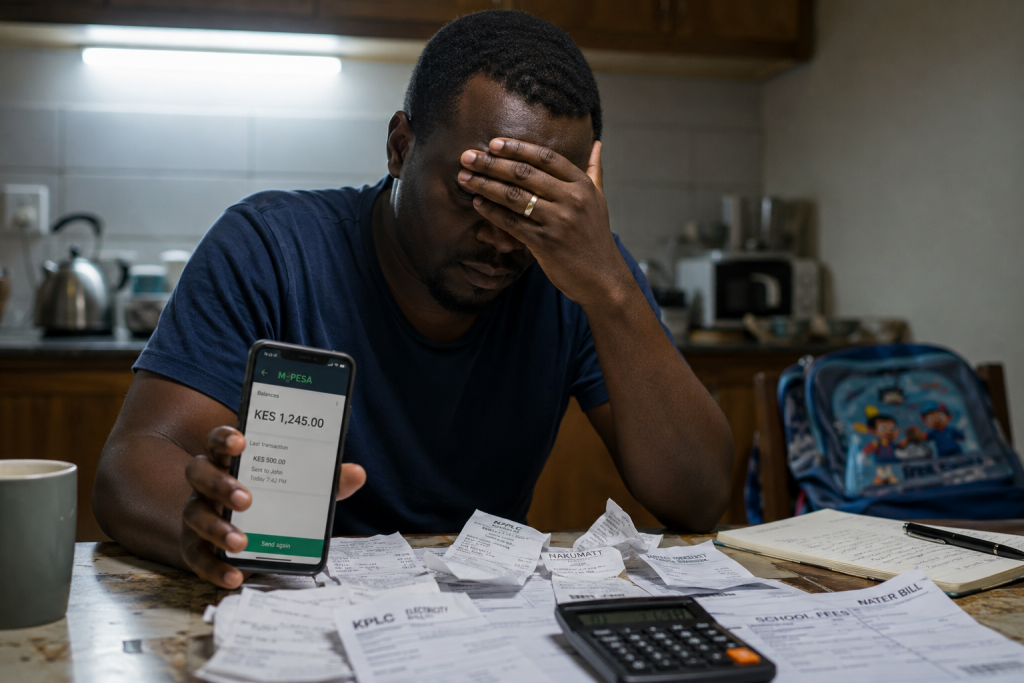
For most working Kenyans, financial stress is not a seasonal event. It is the background noise of daily life. The M-Pesa balance you checked before the supermarket. The mental arithmetic running quietly behind every conversation. The sleep that does not come properly because the numbers are still running when everything else has gone quiet.
And it is making people ill. Not metaphorically. Clinically, measurably ill.
| The 2024 Old Mutual Financial Services Monitor found that 4 in 10 working Kenyans are highly stressed about their financial situation. 47% say financial stress is badly affecting their mental and physical health. 7 in 10 have no emergency funds left at the end of the month. The Infotrak End-of-Year Poll of December 2025 found that 1 in 2 Kenyans reported increased overall stress due to economic conditions, with 1 in 4 reporting mental health challenges directly linked to financial strain. |
What Financial Stress Actually Does to the Body and Mind
Financial stress is not just uncomfortable. It activates the same physiological stress response as a physical threat. The body cannot distinguish between a lion and a debt. Both trigger cortisol release, elevated heart rate, and the kind of nervous system activation that is useful for short-term survival and deeply damaging when it becomes chronic.
In the brain, chronic financial stress does something specific: it narrows cognitive bandwidth. Researchers at Princeton and Harvard found that people under significant financial pressure show measurable reductions in cognitive capacity, specifically in the mental resources available for planning, problem-solving, and self-regulation. This is not a character flaw. It is the predictable output of a brain that is running too many urgent calculations simultaneously to have much left over for anything else.
What this looks like in practice:
- Difficulty concentrating at work, not from laziness but from a brain that keeps running financial calculations in the background.
- Short temper with family members, because the regulation resources that normally buffer irritability are already depleted.
- Poor sleep, because financial worry does not observe bedtime.
- Physical symptoms including headaches, stomach problems, and chest tightness that have no clear medical cause
- Avoidance, which makes things worse. Not opening the bank statement. Not reading the loan notice. Not answering the call from the landlord. Because engaging with the thing feels like it will make it more real
When Financial Stress Becomes a Mental Health Condition
There is a difference between financial pressure, which is real and nearly universal among Kenyans right now, and financial stress that has crossed into a clinical mental health presentation.
The shift happens when the stress is no longer proportionate to the situation, or when it persists and intensifies even when the financial situation is not actively worsening, or when it begins to significantly affect daily functioning, relationships, or physical health.
| Normal financial pressure | Financial stress becoming a mental health concern |
| Worry about a specific bill or expense that resolves once the bill is paid | Worry that persists after the immediate financial problem is resolved |
| Stress that motivates problem-solving: looking for solutions, making a budget, cutting expenses | Stress that paralyses: avoidance of financial information, inability to engage with the problem even when you want to |
| Occasional poor sleep when something specific is looming | Persistent insomnia or disrupted sleep over weeks or months regardless of what is immediately due |
| Irritability that is traceable to a specific stressor and resolves with it | Chronic irritability, low mood, or emotional flatness that has become a persistent state |
| Physical symptoms during a specific crisis period | Ongoing physical symptoms including chest pain, headaches, or stomach problems that medical investigation does not explain |
The Kenyan Specific Dimensions
Financial stress in Kenya does not happen in a vacuum. It happens inside a specific set of cultural and economic conditions that shape how it is experienced and expressed.
The obligation economy
Working Kenyans are rarely managing their own finances alone. The expectation that employed family members support parents, siblings, extended family, and community members is real, culturally embedded, and not going away. The weight of this collective obligation, which many Kenyans carry with genuine love and also genuine exhaustion, adds a layer to financial stress that is specific to this context and that is almost never accounted for in standard financial stress research.
Debt that is invisible to others
Mobile money has made borrowing frictionless and invisible. Many Kenyans are managing multiple loan apps simultaneously, rolling debt from one platform to another, and doing all of it without anyone in their household knowing the full picture. The shame of this, layered on top of the financial reality itself, is a significant driver of the mental health impact.
The gap between the appearance of success and the reality
Nairobi especially runs on performance. The clothes, the car, the school the children attend, the holiday posted on Instagram. Many Kenyans are managing a significant gap between how they appear financially and how things actually are. Maintaining that performance while the underlying reality is precarious is an enormous and largely unacknowledged source of psychological strain.
Cost of living versus salaries that have not kept up
Between 2020 and 2024, the cost of essential goods in Kenya rose significantly faster than median wages. 7 in 10 working Kenyans in the Old Mutual study reported a decline in real income over that period. This is not a personal failure. It is an economic context. But it feels personal, and that feeling is where the mental health impact lands.
What Therapy Does With Financial Stress
Therapy does not pay the bills. It is important to be honest about that. A therapist cannot resolve the structural economic pressures that are driving financial stress for millions of Kenyans.
What therapy can do is specific and meaningful:
- Address the cognitive patterns that financial stress tends to produce. Catastrophising, which turns a bad month into evidence of permanent failure. Avoidance, which makes a manageable problem unmanageable. All-or-nothing thinking, which makes partial progress feel worthless. These patterns are treatable.
- Create a space to speak about financial reality without shame. For many people, therapy is the first place they have been fully honest about their financial situation. The relief of that is real and clinically significant.
- Separate the financial facts from the identity story. The distance between ‘I am struggling financially’ and ‘I am a failure’ is enormous, but financial stress tends to collapse it. Rebuilding that distinction is therapeutic work.
- Address the relational impact. Financial stress is one of the leading drivers of conflict in Kenyan marriages and families. Couples therapy can create a container for financial conversations that otherwise happen as arguments.
- Treat the co-occurring conditions. Anxiety and depression that develop in the context of financial stress are treatable, even when the financial context does not immediately change.
Clarity offers confidential individual sessions, couples therapy for financial conflict, and workplace mental health support for organisations whose staff are carrying financial strain. Book a session here.
What Helps Outside of Therapy
These are not solutions to structural poverty. They are things that reduce the mental health impact of financial stress for people who have some degree of agency in their situation.
- Name it to someone. Financial stress thrives in silence. The shame keeps it from being spoken about, which keeps it from being shared, which means it sits entirely inside one person’s head. Telling one trusted person the actual situation reduces the psychological load measurably.
- Separate the worry time. Some people find it useful to designate a specific time to think about financial problems, rather than letting the financial worry run as background noise all day. Outside that window, when the thought comes, the instruction to the brain is: not now, we have a time for this. This is a cognitive behavioural technique that reduces the total cognitive bandwidth consumed by financial stress.
- Address the avoidance first. The financial document you cannot bring yourself to open is almost always less catastrophic than the version your anxiety has constructed. Opening it reduces the mental burden even when the news is not good.
- Understand your actual numbers. Financial anxiety flourishes in vagueness. Knowing exactly what you owe, what you earn, and what the gap is, however uncomfortable, is less psychologically costly than managing a financial situation you do not fully know.
Frequently Asked Questions
How does financial stress affect mental health in Kenya?
Financial stress activates the body’s stress response, narrows cognitive bandwidth, disrupts sleep, and over time produces or worsens anxiety and depression. In Kenya specifically, the 2024 Old Mutual Monitor found 47% of working Kenyans say financial stress is badly affecting their mental and physical health.
When does financial worry become a mental health problem?
When worry persists beyond the immediate financial trigger, begins to significantly affect daily functioning, relationships, sleep, or physical health, or when it produces a sense of hopelessness or paralysis rather than motivating problem-solving, it has moved into clinical territory that benefits from professional support.
Can therapy help with financial stress?
Therapy does not resolve the external financial situation but it addresses the cognitive patterns, shame, avoidance, and relational conflict that financial stress produces. It also treats the anxiety and depression that commonly develop alongside significant financial stress.
Is financial stress normal in Kenya right now?
Yes. The 2025 Infotrak poll found 1 in 2 Kenyans reporting increased stress due to economic conditions. Normal does not mean harmless. The widespread nature of financial stress in Kenya makes it more important, not less, to address the mental health dimension.
| The numbers are not the whole story. How you are carrying them is.
Confidential individual therapy and couples counselling at Clarity Counselling and Training Centre in Nairobi, in person or online. → WhatsApp: +254 (0) 101 515 101 | Call: +254 (0) 114 444 300 → Related: Anxiety in Kenya | Workplace Mental Health Kenya |