Men & Therapy in Kenya: Why Men Don’t Talk and What It’s Costing Them
He is the strong one.
He has carried his family since he was nineteen.
School fees for younger siblings. Rent for his mother. The deposit for the house. The car. The wedding. The hospital bill when his father got sick. The funeral when his father did not make it.
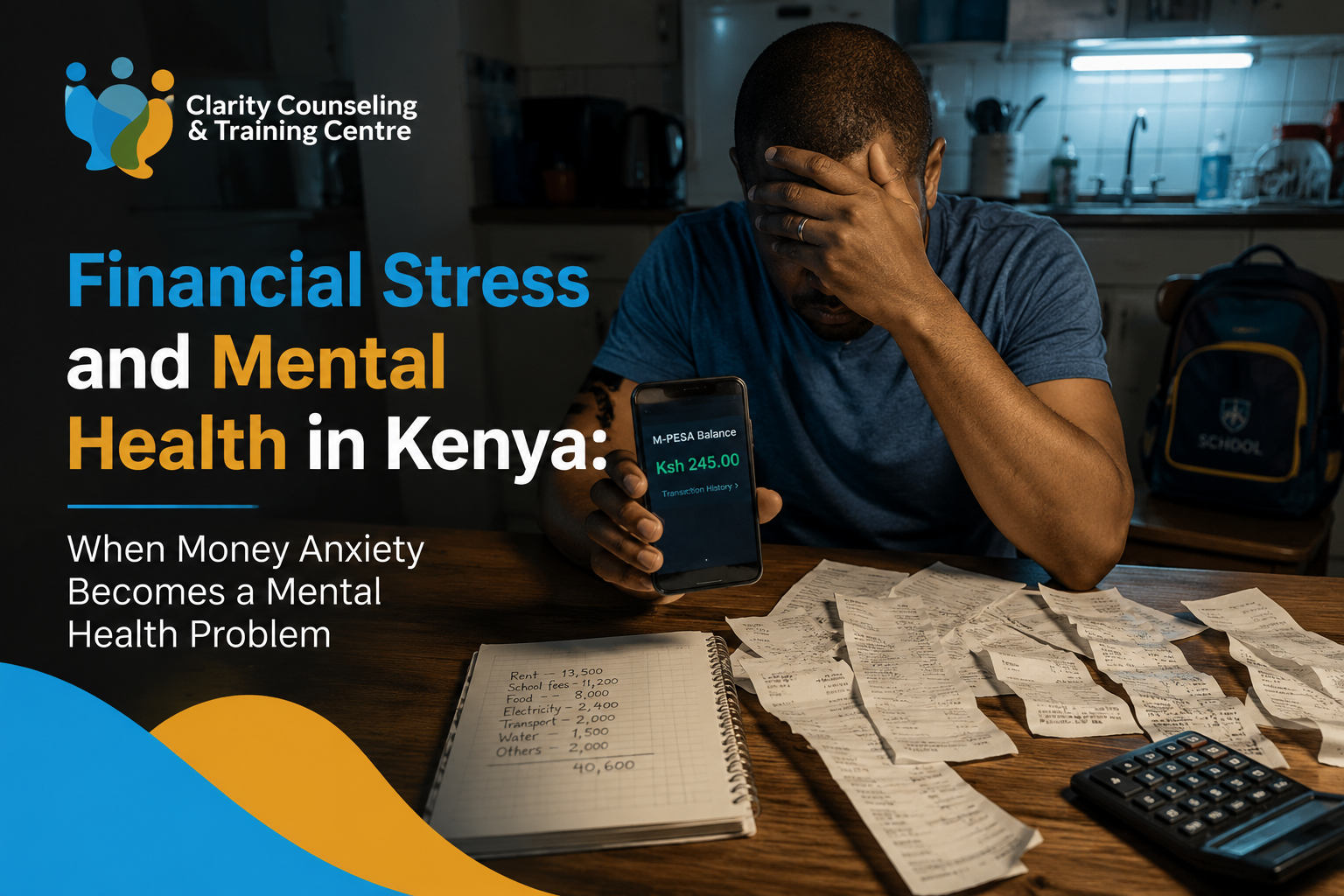
Now he is thirty-eight. He has a wife. Two kids. A job that pays well enough but eats him alive. He has not slept properly in eight months. He drinks more than he used to. He snaps at his wife over nothing.
His chest sometimes tightens for no reason while he is driving on Mombasa Road. Last Tuesday, he sat in his car in the parking lot at work for forty minutes before he could go in.
If you asked him how he is doing, he would say, “I am okay. Just tired.”
He has never spoken to a therapist. He probably never will.
This blog is for him. And it is for the wife who is reading this on her phone right now, trying to figure out how to help a man who will not admit anything is wrong. Both of you are in the right place.
Why Don’t Kenyan Men Go to Therapy?
Globally, men are far less likely than women to seek help for mental health concerns. In Kenya, the gap is even wider. Population Services Kenya, citing KNBS data, has noted that Kenyan men have higher suicide rates than women, while seeking less help, less often, and later. If any of this sounds familiar, therapy in Kenya is more accessible than most men realise. The reasons they avoid it are not weakness. They are cultural, economic, and deeply learned.
1. “A Man Does Not Cry”
From the time a Kenyan boy is old enough to walk, he is taught that emotions are a liability. Crying is for women. Complaining is for the weak. The compliment a Kenyan boy hears most often is “umekomaa” — you have hardened. Hardness is the goal. Softness is shameful.
By the time he is a grown man, expressing emotion no longer feels like relief. It feels like failure.
2. The Provider Burden
In most Kenyan families, the man is expected to provide. School fees, rent, medical bills, funeral contributions, the unspoken extended family payroll. The money rarely matches the demand. He is one bad month away from disappointing everyone.
Admitting he is struggling feels like admitting he cannot carry the load. So he does not admit it. He just carries more.
3. Stigma in the Workplace
In a Kenyan office, calling in sick because of the flu is acceptable. Calling in because you are depressed is not. Mental health leave is rare. Many men fear that disclosing therapy attendance, even informally, will affect their career trajectory or how they are perceived by colleagues and bosses.
4. “Just Pray About It”
Faith is a real and powerful resource for many Kenyan men. But in too many congregations, depression and anxiety are framed purely as spiritual problems — a lack of faith, a generational curse, a need for more prayer. Therapy is dismissed as “worldly.” Men who go are told they should have prayed harder.
The truth, which the best Kenyan pastors are now beginning to teach, is that faith and therapy are not in competition. A man can pray and still see a therapist. A man can love Jesus and still need help processing his trauma. One does not cancel the other.
5. They Have Never Seen It Modeled
Most Kenyan men have never watched another man — their father, their uncle, their boss, their pastor — speak openly about going to therapy. There is no model to follow. The behavior is unfamiliar, and unfamiliar feels unsafe. If you want to understand what actually happens in the first 6 sessions of therapy in Kenya, we have written a step-by-step guide that demystifies it.
What It Is Costing Kenyan Men

This is not an academic question. The data is brutal, and Kenyan men are paying with their lives.
The World Health Organization estimates Kenya’s age-standardized suicide rate at around 11 per 100,000 — among the higher rates in Africa. That translates to roughly four suicide deaths per day in Kenya, with men dying by suicide at significantly higher rates than women. The Ministry of Health’s National Suicide Prevention Strategy 2021–2026 has flagged this as a public health priority.
Behind every one of those numbers is a man who got to the point where he could not see another way. Almost every one of them was the strong one. The one who never asked for help. The one who said, “I am okay. Just tired.”
Beyond suicide, untreated male depression and anxiety in Kenya show up as:
| How it shows up | What it looks like in practice | Who pays the price |
| Self-medication
Alcohol abuse |
The most socially acceptable form of self-medication for Kenyan men
after-work drinks that quietly become every-night drinks |
His liver, his wallet, his family’s trust |
| Emotional
Chronic anger & irritability |
The only emotion Kenyan men are culturally allowed to express, so depression wears the mask of rage | His wife, his children, his colleagues |
| Relational
Marital breakdown & emotional absence |
Wives reporting “he is here, but he is not really here” — present in body, gone in spirit | His marriage, his partner’s mental health |
| Physical
Cardiovascular disease |
Chronic, untreated stress raises blood pressure, accelerates heart disease — the body keeping score | His lifespan, his family’s future |
| Professional
Workplace burnout & career derailment |
Productivity collapses long before anyone connects it to mental health — missed promotions, unexplained decline | His income, his team, his self-worth |
| Family
Distant fatherhood |
Children who grow up never knowing what their father felt about anything — silence mistaken for strength | His children’s emotional development |
| Behaviour
Risk-taking behaviour |
Reckless driving, gambling, infidelity, substance abuse — adrenaline and numbness chasing each other | Everyone in the blast radius |
Is Anger a Sign of Depression in Men?
Yes. This is one of the most important things Kenyan men and their families need to understand, and our depression in Kenya guide explains the full clinical picture.
In women, depression often presents as sadness, withdrawal, and tearfulness. In men, it more often shows up as:
| Sign | What it actually looks like |
| Emotional: Anger & Irritability | Short fuse, snapping at family over nothing, road rage that didn’t used to be there |
| Emotional:Aggression | Verbal outbursts, slamming doors, sometimes physical — directed at people or objects |
| Withdrawal: Numbness | Not feeling much of anything, going through the motions, “I’m fine” on autopilot |
| Behaviour: Risk-taking | Driving fast, drinking heavily, gambling, multiple affairs |
| Behaviour: Workaholism | Burying everything in productivity, 14-hour days to avoid being still or feeling anything |
| Physical: Body complaints | Chest tightness, persistent headaches, back pain, insomnia, and gastric issues with no clear cause |
| Disconnect: Loss of interest | Football, friendships, faith, sex, hobbies — things that used to bring joy now feel flat |
A wife often realizes something is wrong long before her husband does. She is not imagining it. The cold, distant, easily angered version of the man she married is not who he is. It is who depression has turned him into.
If you recognise yourself or your husband in this list, the diagnosis may not be that he is “a difficult man.” It may be that he is a depressed one.
“How Do I Convince My Husband to Go to Therapy?”

This is one of the most common questions we get from Kenyan women, and one of the hardest to answer — because the honest answer is: you cannot force him. But you are not powerless. Here is what works, in our experience, walking many Kenyan couples through this. If you want more guidance on signs you are ready for professional therapy in Kenya, our full guide is a good place to start.
1. Stop Calling It Therapy at First
The word “therapy” carries baggage for many Kenyan men. Try a language he can hear without defensiveness:
- “Talking to someone confidentially.”
- “A coach, like the ones top athletes have”
- “A consultation about stress, the way you would see a doctor about your back.”
- “A neutral third party to help us work through what is happening between us.”
Once he is in the room and experiences how it actually works, the word “therapy” stops being scary.
2. Frame It Around What He Cares About
Most Kenyan men respond better to performance and family framing than to emotional framing.
Instead of: “I think you’re depressed and you need help.”
Try: “Your sleep has been bad for months. Your performance at work matters. Your kids need their father present. Talking to someone could help you get back to being the man you want to be.”
3. Offer Couples Therapy First
Many Kenyan men who would never agree to individual therapy will agree to couples therapy, especially if it is framed as “for us, not for you.” Once they experience the safety of a skilled therapist’s room, they often book individual sessions on their own.
4. Make the First Call Yourself
Decision fatigue is real. Asking him to research therapists, compare prices, check his insurance, and book a slot is asking too much of a man who can barely face the morning. Make the call. Explain the situation. Get the time slot. Tell him: “I’ve booked us in. Just come.” You can book a free consultation with Clarity Counseling, and we will sort the rest.
5. Do Not Make It an Ultimatum (Yet)
Threats — “go to therapy, or I leave” — almost always backfire. They make him dig in. They make therapy feel like a punishment.
Save the ultimatum for last resort, and only when his behaviour is genuinely unsafe. For most cases, patience, repetition, and removing friction work better.
6. Take Care of Yourself in the Meantime
You cannot drag a man into healing. You can take care of your own mental health while you wait for him to be ready. Many Kenyan women come to Clarity for individual therapy first, and find that as they grow stronger, the dynamic at home shifts. Sometimes this is what eventually opens the door for their husband to come too.
Is Therapy Actually Confidential in Kenya?
Yes. This is a fair question and one many Kenyan men quietly worry about. In Kenya, the relationship between a registered counselling psychologist and a client is legally and ethically protected. The Counsellors and Psychologists Act of 2014 and the professional code of ethics of the Kenya Counselling and Psychological Association (KCPA) require strict confidentiality. What you say in the room stays in the room.
There are very narrow legal exceptions: if a client is at imminent risk of taking their own life or someone else’s, if there is ongoing abuse of a child, or if a court issues a specific order. Outside those rare situations, your sessions are private. Your employer cannot find out. Your wife cannot find out unless you tell her. Your pastor cannot find out.
At Clarity, every counsellor is KCPA-registered and CPB-licensed. Confidentiality is foundational — not an add-on. Our guide on essential questions to ask before booking a therapist in Kenya walks you through what to verify before your first session.
What Happens in a Therapy Session for a Man Who Has Never Done This Before?

Most Kenyan men walk into the first session expecting one of two things: either to lie on a couch while someone analyses their childhood, or to be lectured. Neither of these will happen.
A first session at Clarity looks like this (and we have written a full session-by-session guide if you want the details):
- You and the therapist sit in chairs across from each other. No couch. No notepad of judgment.
- The therapist asks what brought you in. You talk as much or as little as you want.
- The therapist asks practical questions — sleep, work, relationships, alcohol, and what your week looks like.
- You discuss what you would like to be different. Specific. Measurable. Things like “I want to stop snapping at my kids,” or “I want to be able to sleep,” or “I want to figure out why I feel nothing anymore.”
- The therapist agrees on a plan with you — usually a series of weekly sessions, often 8 to 12 to start.
- You leave. You think about it. You decide if you want to come back.
There is no requirement to cry, to talk about your father, to “open up” before you are ready, or to discuss anything you do not want to discuss. Good therapy moves at the speed of the client. You set the pace.
Most Kenyan men who try therapy and stay say the same thing after a few sessions: “I wish I had done this years ago.”
Where Should Kenyan Men Go for Therapy?
Private Therapy
Clarity Counselling and Training Centre, located at Finance House, 13th Floor, Left Wing, Nairobi, offers individual therapy for men at KSh 3,500 per session. We have male and female therapists on the team — you can request a male therapist if that feels easier. We also offer fully confidential online sessions for clients who prefer not to be seen walking into a counselling office, or who live outside Nairobi.
Workplace EAP
If you work for a corporate or NGO, ask HR (discreetly) whether you have access to an Employee Assistance Programme. Many Kenyan companies now offer free, confidential counselling sessions through external providers. Your employer is not told who used the service.
Public and Subsidised Options
- Mathari National Teaching and Referral Hospital — outpatient psychiatric clinic, subsidised under SHA
Your nearest county or sub-county hospital — most now offer at least basic counselling under SHA’s Primary Healthcare Fund. Read our full guide on does SHA cover therapy in Kenya for the complete 2026 breakdown.
- Befrienders Kenya helpline: +254 722 178 177 — confidential emotional support for men in distress
- Niskize 24/7 mental health helpline: 0900 620 800
A Word on Faith and Therapy for Kenyan Men
If you are a man of faith reading this, you are not betraying your faith by seeking help. The Bible is full of men who broke down. David wept openly. Elijah was so depressed that he wanted to die. Job sat in ashes for seven days. Even Jesus, in the garden of Gethsemane, sweat blood and asked for the cup to pass.
What therapy gives you, that prayer alone often does not, is a trained human being who can sit across from you, hear what you are not saying, and walk you through the practical work of changing the patterns that are killing you.
God uses doctors. God uses surgeons. God uses therapists, too. Many of our clients are deeply faithful Kenyan men. They come for therapy, and they keep praying. The two work together. If you want to explore this tension further, our colleagues have written about basic counselling skills every Kenyan should have — including pastors and community leaders.
You Have Been Carrying This Alone for Long Enough
You have built the house. You have paid the bills. You have shown up. You have held it together when everyone else fell apart.
You are allowed to put it down for an hour a week and let someone help you carry it.
Therapy is the same kind of investment you would make in your physical health if your back was hurting for a year. Your mind is also a system. Systems break down. Systems can be repaired. The man your wife married, the father your children deserve, the friend your friends miss — he is still in there. Therapy is how you find him again. And if cost is the barrier, our guide on is therapy worth the cost for Kenyan professionals breaks down the real numbers.
Book a confidential session — no judgment, just clarity.
Clarity Counseling and Training Centre — KCPA accredited (No. KCPA/INST/0147/019), Counsellors and Psychologists Board-registered.
Sessions are KSh 3,500. Insurance accepted. In-person at Finance House, 13th Floor, Left wing, Nairobi, and online across Kenya and the diaspora. Male therapists available on request.
Call: +254 114 444 300
Or visit: claritycounseling.co.ke/contact-us