5 Signs Your Organization Needs Employee Wellness Training
6:15 AM. Thika industrial area.
David pulls into the factory parking lot, gravel crunching under tires. Truck engines rumble from the loading bay. Welding sparks spray orange against the grey morning. The smell of burnt coffee drifts from the break room—someone left the pot on overnight again.
He’s been operations manager here for eight years.
He knows this place. The rhythm of machines starting up. The morning banter as workers clock in from their matatu rides from Juja and Ruiru. The predictable hum of a well-run operation.
Except lately, something’s off. The rhythm’s broken. The hum sounds wrong.
He’s been lying awake at 3 AM for the past month. Running scenarios. Calculating losses. His wife asks what’s wrong. ‘Just work,’ he says. But it’s more than work. It’s watching something he built start to crack.
The numbers tell a stark story:
- 3.7 million Kenyans in the workforce fighting wellness battles right now
- Ksh 62.2 billion lost annually to declining productivity
- 59% of workers showing signs of stress, burnout, disengagement
You’re reading this because you’ve noticed something too. Maybe your top performers suddenly making rookie mistakes. Maybe your HR reports show patterns you can’t explain. Maybe you’re David, standing in a factory parking lot at dawn, finally admitting something’s breaking.
Here are the five signs your organization needs employee wellness training—and what happens when you pretend you don’t see them.
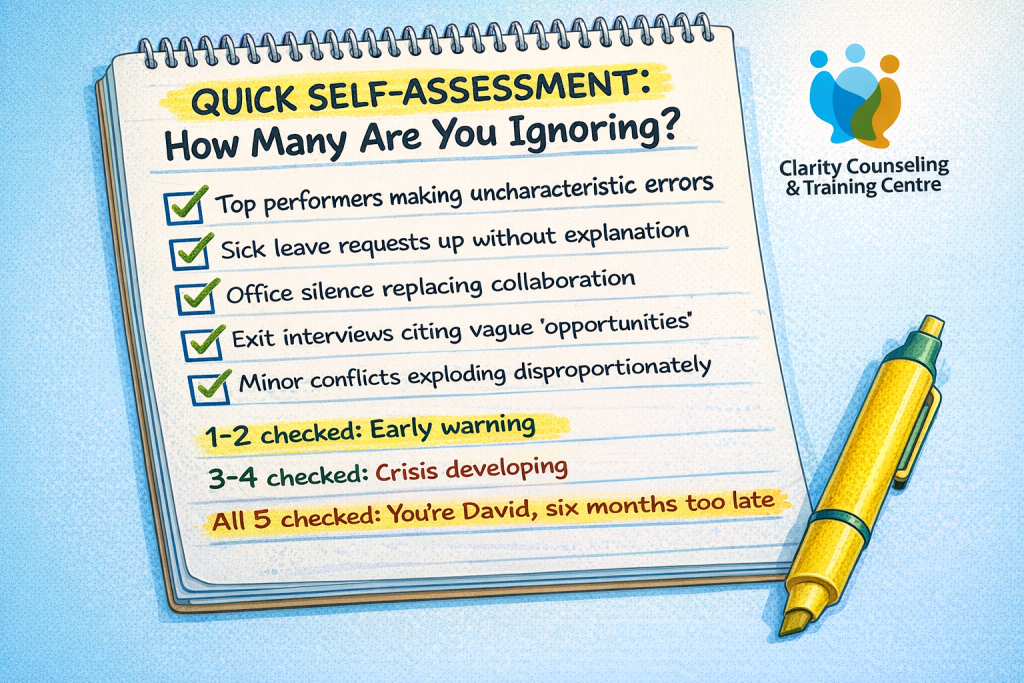
QUICK SELF-ASSESSMENT: How Many Are You Ignoring?
- Top performers making uncharacteristic errors
- Sick leave requests up without explanation
- Office silence replacing collaboration
- Exit interviews citing vague ‘opportunities’
- Minor conflicts exploding disproportionately
1-2 checked: Early warning
3-4 checked: Crisis developing
All 5 checked: You’re David, six months too late
Sign #1: Your Star Employee Can’t Remember How to Do Her Job
Maria’s been David’s star analyst for five years. She spots production inefficiencies before they become problems. Catches errors in supplier contracts that saves the company thousands. Delivers reports two days early.
Delivered. Past tense.
Last month, she submitted a cost analysis with calculation errors a first-year intern wouldn’t make. This week, she missed a deadline for the first time ever. Yesterday, David found her staring at her computer screen—Excel spreadsheet open, cursor blinking, no data entered—for twenty minutes.
What David doesn’t know: Maria sits in her car for twenty minutes every morning, building courage to walk in. She’s interviewing elsewhere. Three companies. Any offer, she’s taking it.
Here’s what you’re actually seeing (even if you’re pretending not to):
- Uncharacteristic mistakes in routine tasks
- Missed deadlines from people who used to be early
- Paralysis—staring at work without starting
- Decreased quality across the board
Here’s what’s counterintuitive: this isn’t laziness. Maria’s working harder than ever. She’s just producing less because she’s running on fumes. Workplace wellness Kenya organizations track shows productivity drops 40% when employees experience chronic stress without employee wellness programs support.
What’s it costing you? If Maria earns Ksh 120,000 monthly and her productivity has dropped by 40%, you’re paying Ksh 48,000 monthly for output you’re not getting. Multiply that across your team.
What to do this week: Have a private conversation with your declining star performer. Not a performance review—a check-in. Ask: ‘I’ve noticed some changes. Is everything okay? How can I support you?’ Listen without fixing.
That’s one sign. Here’s the second—and it’s costing you more.
Sign #2: The Sick Leave Patterns That Mean ‘I Can’t Face This Place’
Grace in HR brings David the attendance reports. Three months of data spread across her desk. The afternoon sun cuts through the window, catching dust motes. She’s wearing her reading glasses, the ones she only uses for serious conversations.
‘Look at the pattern,’ she says, finger tracing the columns.
Sick leave requests up 47%. But here’s the thing—they’re all one or two days. ‘Migraine.’ ‘Stomach issues.’ ‘Not feeling well.’ ‘Family emergency.’ Never long enough to trigger HR intervention protocols. Just frequent enough to bleed the operation dry.
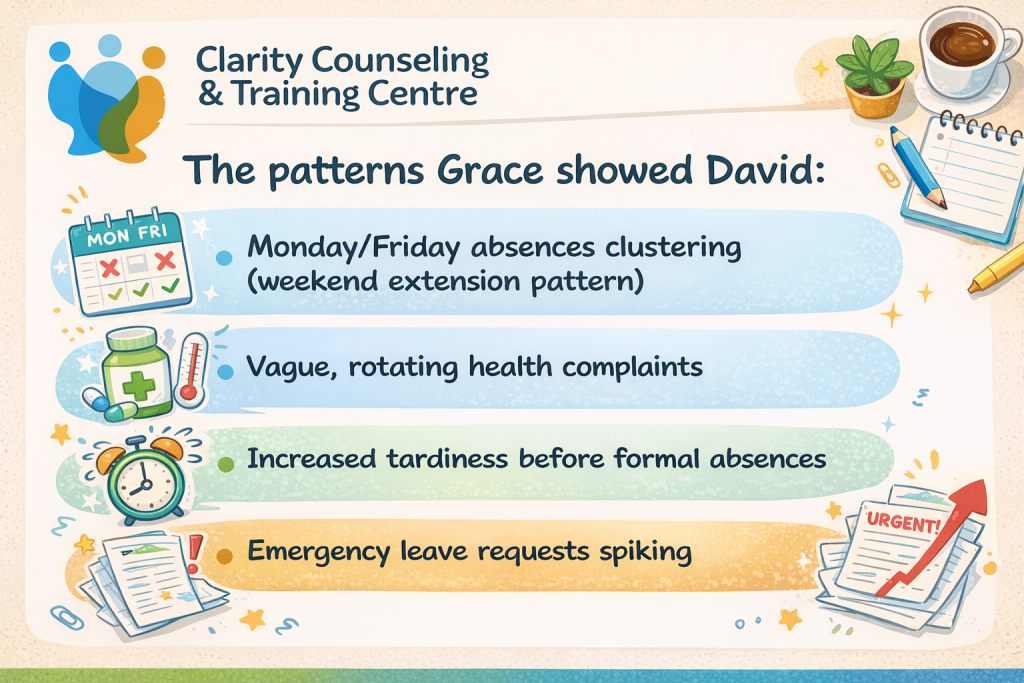
The patterns Grace showed David (check your own reports):
- Monday/Friday absences clustering (weekend extension pattern)
- Vague, rotating health complaints
- Increased tardiness before formal absences
- Emergency leave requests spiking
But absenteeism’s just the visible problem. Presenteeism—people physically present but mentally checked out—costs more. Kenya’s National Workplace Wellness Guidelines estimate that presenteeism accounts for 30% of the economic burden of mental health. That’s people sitting at desks producing nothing while you pay full salary.
David knows this. He’s seen it. Maria was at her desk for eight hours. Two hours of actual work produced. The math is brutal.
What to do this week: Pattern analysis with HR. Pull three months of attendance data. Look for clusters—same people, same days, similar reasons. Then ask why. What changed three months ago?
Three down. The fourth one loses you your best people.
Sign #3: The Day Your Office Became a Funeral Home
David walks through the factory floor during morning break. Six months ago, this place buzzed. Workers clustered around the coffee station, arguing about football, teasing each other, and making plans for the weekend.
Now?
People grab coffee and return to stations. Headphones in. Eyes down. The break room feels like a library where someone died. The smell of coffee mixing with machine oil. No laughter. No arguments about Gor Mahia versus AFC Leopards. Just the hum of fluorescent lights and the shuffle of feet.
His weekly production meetings have the same hollow quality. He asks questions. Silence. He requests input on process improvements. Blank stares. People show up physically—bodies in chairs, eyes on screens—but mentally, they’ve checked out.
Employee engagement decline looks like:
- Social interaction dropping to zero
- Meeting participation evaporating
- No one volunteering for anything
- Innovation and suggestions stopping completely
This matters more than you think. Disengaged employees aren’t just unproductive—they’re contagious. One disengaged person can infect a whole team. And in Kenya’s tight-knit workplace culture, where team cohesion drives results, silence spreads like smoke.
Organizations implementing employee wellness initiatives in Kenyan businesses report seeing engagement scores improve 34% within six months. That’s people talking again. Contributing again. Actually caring again about this place where they spend most of their waking hours.
What to do this week: Anonymous engagement pulse survey. Three questions: (1) Do you feel comfortable speaking up in meetings? (2) Do you feel connected to your colleagues? (3) What would make you more engaged? Actually read the responses.
Four signs down. This next one bleeds your talent.
Sign #4: When Your Best People All Quit for the Same Lie
Peter hands in his resignation. Two weeks’ notice. Production team leader. Been with the company for six years.
David’s shocked. ‘Better opportunity,’ Peter says, not meeting his eyes.
Two weeks later, Jane from quality control quits. Same reason. Month after that, Tom from logistics. ‘Better opportunity.’ Three key people in two months. All citing the same vague reason. Funny how ‘better opportunity’ sounds the same in three different mouths.
Because in Kenya, you don’t tell your boss ‘this place is killing me.’ You thank them for the opportunity and cite career growth.
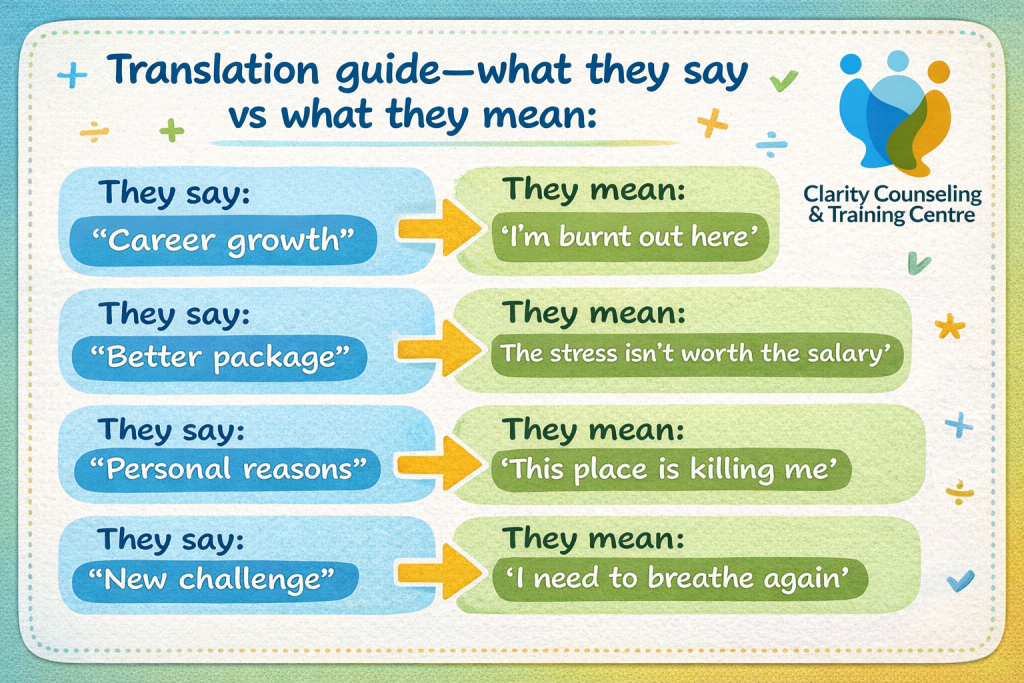
Translation guide—what they say vs what they mean:
- They say: ‘Career growth’ → They mean: ‘I’m burnt out here’
- They say: ‘Better package’ → They mean: ‘The stress isn’t worth the salary’
- They say: ‘Personal reasons’ → They mean: ‘This place is killing me’
- They say: ‘New challenge’ → They mean: ‘I need to breathe again’
Replacing Peter costs Ksh 1.2 million. Recruitment fees. Training time. Lost productivity during transition. The institutional knowledge walking out the door? Priceless.
Here’s what nobody tells you: high performers always have options. They’re not staying because they’re trapped. They’re leaving because competitors offer something you don’t—corporate wellness training. Kenyan companies that invest in workplace wellness programs see 52% better retention of top talent.
What to do this week: Exit interview deep dive. Pull the last six months. Look beyond the polite reasons. Track: who’s leaving, from which departments, what they have in common. Then ask your remaining team what they’re hearing from people who left.
Fifth sign. This is where violence enters the picture.
Sign #5: The Clipboard That Almost Became a Weapon
Wednesday, 2:37 PM. David hears shouting from the warehouse.
Two supervisors—colleagues for years, played in the same company football team, attended each other’s kids’ birthdays—screaming at each other over a scheduling issue.
Not disagreeing. Not arguing. Screaming.
One throws a clipboard. Metal edge. It clatters against the concrete wall, papers scattering. The other shoves him—both hands, full force. Other workers freeze mid-task, watching. The warehouse goes silent except for the echo of that shove.
David separates them, hands shaking. HR gets involved. Written warnings. Mandatory cooling-off period. The whole procedure.
Later, trying to understand what triggered this, he gets nowhere. ‘It was just the schedule’ they both say, not meeting his eyes. But scheduling conflicts happen weekly. They’ve never escalated to violence before.
Organizational wellness breakdown shows in:
- Minor issues triggering disproportionate reactions
- Interpersonal conflicts multiplying exponentially
- HR complaints spiking—harassment, hostile environment, bullying
- Team cohesion completely fracturing
Here’s what’s actually happening: everyone’s operating at their breaking point. Patience gone. Resilience depleted. The smallest trigger—a scheduling conflict, a perceived slight, someone taking the last cup of coffee—becomes the match that lights the fuse.
This is what Kenya’s Occupational Safety and Health Act calls a ‘psychosocial hazard.’ When workplace wellness programs that Kenyan organizations implement address these systematically, conflict resolution improves 67%. Not because people become nicer, but because they’re not constantly running on empty.
What to do this week: Conflict root cause meeting. Not to assign blame—to understand patterns. When did conflicts start increasing? What’s changed in workload, staffing, and pressure? Map the triggers. You’ll find they all point to the same source: overwhelmed people with zero reserves left.
⚫ ⚫ ⚫
Now Watch What Happens When David Ignores All Five
What David’s Factory Looks Like Six Months Later
6:15 AM.
Same parking lot. But different. There are empty spaces now where Peter, Jane, and Tom used to park. Maria’s spot is still filled—for now. She gave her two weeks’ notice yesterday. The gravel sounds different under his tires. Or maybe that’s just in his head.
10:00 AM.
Client call about quality issues. First in company history. David’s apologizing, promising corrections, offering discounts. The client’s considering switching suppliers. ‘Your quality used to be impeccable,’ they say. ‘What changed?’
David knows what changed. But he can’t say: ‘We lost our best people and the ones who stayed are running on fumes.’
2:00 PM.
Ministry of Labour inspector at reception. Someone filed a complaint about a hostile work environment. The inspector has a clipboard. Interviews scheduled with fifteen employees. David’s lawyer is on the way.
5:00 PM.
Alone in his office. Door closed. Head in hands. The factory floor is quiet—too quiet. Production down 38%. Seven key employees have gone this quarter alone. Replacement cost: Ksh 8.4 million. And counting.
His phone buzzes. Another resignation email.
The damage:
- Productivity down 38% across all departments
- Seven key employees gone (replacement cost: Ksh 8.4 million)
- Two harassment complaints with Ministry of Labour
- Client threatening to switch suppliers
- Reputation in Thika industrial area: ‘That place where everyone’s miserable’
Maria’s still there. Physically. Mentally, she left months ago. Her replacement starts in three weeks. She’ll spend two weeks ‘training’ someone who won’t last six months. Because good people don’t join sinking ships.
The morning banter David used to hear? Dead. The place operates in sullen silence. Machines run. Work happens. Bodies show up. But the life’s gone out of them.
And this is the conservative estimate.
This is what ignoring the signs costs. Not just money—though the financial bleeding is real. It costs culture. Trust. The intangible things that make a workplace function.
And here’s the terrifying part: there’s a point of no return. A moment when the culture’s so toxic and the talent drain is so severe that no amount of staff wellness programs fixes it. You’re starting from scratch. Building a new team. A new culture. From ruins.
⚫ ⚫ ⚫
Or This Could Be Your Story
The Other Timeline: What Happens When David Acts
Different timeline. David doesn’t ignore the signs.
When Maria starts declining, he doesn’t dismiss it as ‘a bad week.’ When attendance patterns shift, he doesn’t just forward the report to HR. When the office goes quiet, he doesn’t assume people are ‘just focused.’
He acts.
His company implements comprehensive employee wellness training programs Kenya organizations use. Not fruit baskets and yoga mats. Real wellness training Kenya businesses report that addresses the actual problems:
- Stress management training for all employees
- Manager training in recognizing burnout signs
- Workload assessments and redistribution
- Psychological safety workshops
- Ongoing mental health support access
It wasn’t magic. The first month was hell. People were skeptical—’Another corporate initiative.’ Training sessions felt awkward. Managers fumbled the new conversations. Some employees thought it was HR surveillance.
But by month two, things shifted. Not dramatically. Small changes. A manager having that conversation with Maria. Workload getting redistributed. People actually using the mental health resources without fear.
Results within three months:
- Productivity stabilizes, then climbs
- Absenteeism drops 31%
- Morning break room buzzes again—actual football arguments resume
- Zero resignations from key personnel
- Conflicts resolve faster, escalate less
Maria’s still there. Not just physically—actually present. Contributing. The analyst David hired her to be. She’s not job-hunting. She’s engaged. When asked why she stayed, she says: ‘Because they noticed. And they did something about it.’
Which Parking Lot Are You Standing In?
David’s standing in that parking lot again. 6:15 AM. Thika industrial area. Gravel crunching. Machines starting. Coffee brewing.
But which timeline?
The one where empty parking spaces multiply, and Ministry of Labour inspectors visit? Where quality issues cost him his best client and his reputation crumbles? Where the place operates in sullen silence punctuated by violence?
Or the one where he saw the signs early and acted? Where Maria’s still there, engaged, contributing? Where the morning break room buzzes with life? Where conflicts resolve instead of explode?
The five signs are clear:
- Your star employee can’t remember how to do her job
- Sick leave patterns that mean ‘I can’t face this place’
- Your office became a funeral home
- Your best people all quit for the same lie
- The clipboard that almost became a weapon
You’ve seen at least one. Probably more. And now you know what they mean.
Employee wellness training isn’t a luxury. It’s infrastructure. The foundation your organization either stands on or collapses without.
You don’t have to figure this out alone.
Clarity Counseling and Training Centre specializes in workplace wellness programs Nairobi organizations trust. We’ve worked with companies across Kenya—manufacturing in Thika, tech in Kilimani, service industries in Mombasa—helping them recognize warning signs and implement employee wellness initiatives Kenya businesses report actually work.
Our corporate wellness Kenya programs deliver:
- Customized assessment of your specific warning signs
- Culturally appropriate training addressing Kenyan workplace realities
- Manager training in early intervention
- Ongoing support and measurable results tracking
The question isn’t whether you can afford employee wellness training.
The question is: can you afford to keep ignoring the signs?
It’s 6:15 AM tomorrow. You’re pulling into your parking lot. Your operation shows all five signs. What do you do? Walk in and pretend you don’t see them? Or admit that David’s story is yours—and make a different choice?
Contact Clarity Counseling & Training Centre today to discuss how our employee wellness programs can help you recognize warning signs early and transform your workplace before it’s too late.
Because your people deserve better than silent suffering in factory parking lots.
Including David. Including you. Including Maria who’s sitting in her car right now, building courage to walk into your building.