Become a Licensed Counseling Psychologist in Kenya: The Complete Guide
She did not plan to become a counselor.
She was a secondary school teacher for seven years.
She watched her students carry weight that had nothing to do with exams —grief from losing a parent, anxiety so thick it looked like laziness, depression that wore the face of bad behavior.
And week after week, she sent them back to class because she did not know how to help them. She just knew how to teach.
Then one afternoon, a Form Three girl sat down in front of her and told her things she had never told anyone. And the teacher sat there and listened, because what else could she do?
And when the girl finally left, the teacher cried in the empty classroom —not because the story was sad, though it was. She cried because she had felt, for the first time in seven years, that she was exactly where she was supposed to be.
She enrolled in a Counseling Psychology Diploma programme that same month.
Three years later, she runs a counseling clinic attached to three schools in Nairobi’s Eastlands. She is registered with the Counsellors and Psychologists Board. She earns more than she did as a teacher. She has never once wished she had stayed.
If you have been thinking about this career —whether you are a teacher, a pastor, an HR professional, a nurse, or simply someone who has always been “the one people talk to” — this is the complete 2026 roadmap for how to make it official in Kenya.
Why Kenya Needs More Licensed Counselors
The demand for qualified mental health professionals in Kenya has never been higher. The Mental Health Act 2023 formally mandates mental health integration across healthcare, education, and workplace settings —creating a structural need for trained practitioners that the current workforce cannot yet meet.
Therapy in Kenya remains inaccessible for many Kenyans not because people do not want it, but because there are not enough qualified practitioners to provide it. That gap is both a challenge and an opportunity.
According to the Kenya Health Workforce Report, Kenya has approximately 0.19 mental health workers per 100,000 population — far below the WHO-recommended minimum of 1 per 100,000. The practical reality: trained, CPB-registered counseling psychologists are in shortage across schools, hospitals, NGOs, corporates, and private practice.
Step 1: Understand the Landscape — Who Regulates Counseling in Kenya?
Before you enroll in anything, you need to understand the regulatory landscape. Two bodies matter most.
The Kenya Counselling and Psychological Association (KCPA)
The Kenya Counselling and Psychological Association (KCPA) is the professional body for counseling psychologists in Kenya. Membership is the professional standard for practicing counselors.
It is not legally required in all settings, but it is the mark of credibility that institutional employers — hospitals, schools, NGOs, corporates —look for when hiring.
KCPA membership requires meeting minimum training standards, demonstrating supervised practice hours, and adhering to a code of ethics.
The Counsellors and Psychologists Board (CPB)
The Counsellors and Psychologists Board (CPB) is the statutory licensing body established under the Counsellors and Psychologists Act 2014. Registration with the CPB is required to legally practice as a counseling psychologist in Kenya.
The CPB sets minimum training standards, registers practitioners, and can investigate complaints against counselors. If you intend to open a private practice or work in a formally regulated setting, CPB registration is not optional.
What Is the Difference Between KCPA and KPA?
The Kenya Psychological Association (KPA) is a separate body focused primarily on academic and research psychologists — typically those with a full psychology degree (BSc or higher). The KPA and KCPA are different organisations with different membership criteria and different professional focus.
For practical counseling work in schools, hospitals, NGOs, and private practice, KCPA and CPB registration are the relevant credentials.
Step 2: Choose Your Entry Level — Certificate, Diploma, or Degree?
Counseling psychology in Kenya has multiple entry points. Your starting point depends on your existing qualifications, your available time, and what you intend to do with the training.
Certificate in Counseling Psychology
The certificate is the entry-level qualification and the most accessible pathway. It is designed for working professionals — teachers, pastors, nurses, HR officers, community leaders — who want to add practical counseling skills without leaving their current roles.
Most certificate programmes run over 6 to 12 months, with classes on evenings and weekends to accommodate working schedules.
Graduates can work as community counselors, school counselors under supervision, workplace counselors within their organisations, and can apply for KCPA associate membership. At Clarity, our certificate programme is TVETA-accredited, NITA-certified, and designed specifically for busy working professionals.
Diploma in Counseling Psychology
The diploma is the mid-level qualification and the most commonly pursued pathway for those who intend to practice professionally. It requires a minimum of 2 years of training, including classroom instruction, practical supervised counseling hours, and a research component. Diploma graduates can register with the CPB, apply for full KCPA membership, and are eligible to work independently in most counseling settings. Our diploma programme is recognized by the Kenya National Examinations Council (KNEC).
Degree and Postgraduate Qualifications
A Bachelor of Arts in Counseling Psychology from a recognized Kenyan university (University of Nairobi, Kenyatta University, USIU-Africa, Daystar University, among others) provides the most comprehensive academic foundation. Postgraduate study (Masters level) is required for specialization in areas such as clinical psychology, forensic psychology, and neuropsychology. Degree programmes typically take 4 years full-time and are the pathway for those who intend to work in research, university teaching, or senior clinical roles. For entry into practice, however, the diploma remains the most common route for working professionals.
Step 3: Enroll in an Accredited Programme
This is the most important decision in your journey. The qualification you graduate with is only as credible as the institution that awarded it. Before enrolling anywhere, verify the following.
What to Check Before Enrolling
KCPA accreditation: confirm the institution is listed on the KCPA member institutions register. KNEC recognition: confirm the qualification is recognized by the Kenya National Examinations Council, which is the national framework for vocational and professional qualifications.
NITA certification: for professional development programmes, certification by the National Industrial Training Authority signals quality and enables employers to claim training tax relief.
Supervisor credentials: confirm that the programme provides access to a qualified clinical supervisor for your practice hours.
This is non-negotiable for CPB registration.
Programme Duration and Format
Clarity Counselling and Training Centre offers both the certificate and diploma in Counseling Psychology with flexible scheduling designed for working professionals.
Classes run on weekends and evenings at Finance House, 13th Floor, Left Wing, Nairobi, and online via our virtual learning platform.
Both programmes are KNEC and NITA-certified. To find out about our next intake, download our 2026 prospectus and fee schedule or call us directly: +254 114 444 300.
Step 4: Complete Your Supervised Practice Hours
Classroom learning is only half of the qualification. The other half is supervised counseling practice — real sessions with real clients, overseen by a qualified clinical supervisor who reviews your sessions, provides feedback, and signs off on your competency.
The CPB’s minimum requirement for registration is typically a combination of classroom hours and supervised practice hours (the specific number depends on your level of qualification and specialization). Your training institution should facilitate access to supervision.
At Clarity, supervision is embedded in the programme, not left to students to arrange independently. For more details on what to expect in the counseling room, our blog on what happens in the first six sessions of therapy is a useful resource for both clients and trainee counselors.
Step 5: Register with the CPB and Join KCPA
Counsellors and Psychologists Board (CPB) Registration
Once you have completed your training and your required supervised hours, you apply for registration with the Counsellors and Psychologists Board.
The application requires: proof of your qualification from an accredited institution, confirmation of your supervised practice hours signed by your clinical supervisor, a character reference, and payment of the registration fee.
Once registered, you are legally permitted to practice as a counseling psychologist in Kenya and to use the designation “Registered Counsellor” after your name.
KCPA Membership
KCPA membership is distinct from CPB registration and should be pursued alongside it.
KCPA membership gives you access to the professional community, continuing professional development events, the KCPA journal, peer supervision networks, and the credibility signals that institutional employers look for.
Clarity Counselling holds KCPA institutional accreditation (No. KCPA/INST/0147/019). Apply for the next intake, and we will guide you through both the CPB and KCPA application process as part of your training.
How Long Does It Take to Become a Counseling Psychologist in Kenya?
This is one of the most common questions we receive, and the honest answer is: it depends on the pathway you choose.
- Certificate programme: 6–12 months. You can begin working as a community counselor under supervision immediately after graduation.
- Diploma programme: 2 years. CPB registration and full KCPA membership are accessible on completion.
- Degree programme: 4 years full-time. The pathway for clinical, research, or university roles.
- Postgraduate (Master’s): 2–3 additional years after a degree. Required for clinical psychology specialization.
For most working professionals, the diploma pathway — 2 years part-time, earning while you study — is the most practical and most common route. Many of our graduates at Clarity begin seeing clients under supervision in their first year of the diploma programme. See how our graduates have built careers after training in our guide to 5 careers you can build with a counseling certificate.
How Much Do Counselors Earn in Kenya?
Counseling salary in Kenya varies widely by setting, level of qualification, and whether you practice independently or as an employee. Here is an honest breakdown based on current market data.
Employed Positions
- NGO / International Organisation: KSh 60,000–150,000 per month.
- County Government / Ministry of Health: KSh 30,000–80,000 per month, depending on job grade and years of service.
- Corporate EAP provider: KSh 80,000–200,000 per month, often with performance bonuses.
- School counselor: KSh 40,000–100,000 depending on institution type (private vs. public).
Private Practice
Private practice is where earning potential is highest — and where many Clarity graduates eventually end up. Session rates in Nairobi currently range from KSh 2,500 for community-based practitioners to KSh 8,000 for highly experienced specialists.
At Clarity, our individual therapy sessions are priced at KSh 3,500, which is the current mid-market rate for qualified practitioners in Nairobi.
A private practice running 20 sessions per week generates approximately KSh 70,000 per week before expenses, with low overhead if you practice from a serviced clinic or virtually. Our blog on starting a private practice in Kenya covers the practical steps for graduates who want to go independent.
Can I Practice Counseling in Kenya Without a Degree?
Yes. The CPB and KCPA both recognise diploma-level practitioners for full registration and membership. Many of Kenya’s most effective counselors —working in schools, hospitals, NGOs, and private practice — hold a diploma, not a degree.
The degree pathway is for those who wish to teach at the university level, conduct formal psychological research, or pursue a clinical psychology specialization.
For practical counseling work, the diploma is the standard and sufficient qualification.
See our detailed breakdown of counseling psychology course fees in Kenya 2026 for a full fee and format comparison across qualification levels.
What Can I Specialise In?
After completing your foundational diploma, you can pursue specialization through post-diploma certificates, short courses, and continuing professional development. Common specialization areas for Kenyan counselors include:
- Trauma and PTSD therapy (TF-CBT, EMDR)
- Child and adolescent counseling
- Couples and family therapy
- Addiction counseling
- Grief and bereavement counseling
- Occupational and workplace counseling
- Pastoral and faith-integrated counseling
- Career counseling
- Counsellor supervision
Clarity’s diploma programme introduces students to all of these modalities, with elective units allowing students to begin building specialist competencies during their training. For a full picture of therapy modalities available in Kenya, our blog on which type of therapy is right for you is a useful orientation resource.
Do I Need to Be Psychologically Healthy to Train as a Counselor?
This is a question many aspiring counselors are afraid to ask. The answer is nuanced.
You do not need to be free of all mental health challenges to train as a counselor. Many of the most effective practitioners in Kenya and globally have personal experience of depression, anxiety, grief, or trauma. That lived experience —when properly processed— is an asset in the counseling room, not a disqualifier.
What you do need is a commitment to your own ongoing mental health. Most good training programmes require trainee counselors to be in their own personal therapy during their training years.
This is not punitive —it is professional. You cannot hold a client’s pain if you are not familiar with your own.
It is also a requirement that the CPB and KCPA increasingly signal as part of professional practice standards.
At Clarity, we support trainee counselors in accessing affordable personal therapy during their training. This is part of how we train people to become the kind of practitioners that clients can trust — practitioners who have done their own work.
If you want to understand what that work looks like, our guide on what to expect in your first therapy sessions is a good starting point.
Faith, Calling, and Counseling Psychology
Many of our students at Clarity come to counseling psychology through faith. They are pastors who found themselves counseling congregants but feeling underprepared. They are church elders who realized that prayer alone was not enough when someone was in an active crisis.
They are men and women with a gift for listening and mentorship who felt called to formalize what they had always done informally.
We understand this. Clarity’s approach to counseling is integrative — we believe that clinical training and faith-based frameworks can coexist and complement each other, that a psychologically grounded counselor can also be a person of deep faith.
Our blog on therapy for church leaders and pastors in Kenya explores this more fully. And for those who wonder whether their faith community needs what you could offer after training, it absolutely does.
Your Next Step — Start Here,
If you have read this far, you are not just idly curious. Something in this career is pulling at you — maybe it has been pulling for a while.
Here is what we recommend as your next step. Come and talk to us.
Our admissions team at Clarity will help you understand which programme — certificate or diploma — is right for your current qualifications, your schedule, and your goals. We will walk you through the KCPA and CPB registration process so you understand exactly what you are working toward.
We will show you the kind of graduates we have produced and where they are now.
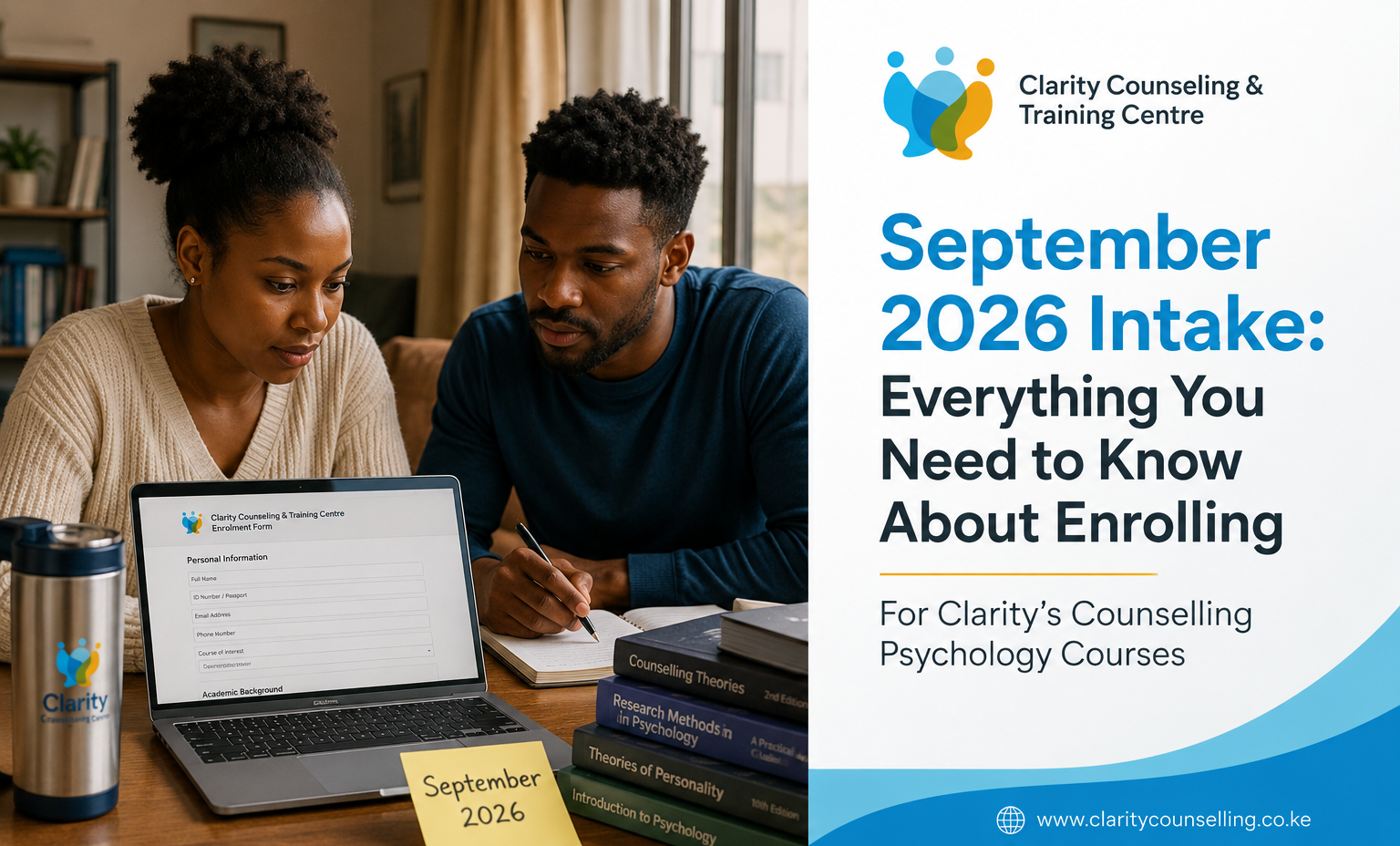
The September 2026 intake is approaching. Applications are currently open.
Download our Career Roadmap Infographic + 2026 Prospectus — or call us directly.
Clarity Counselling and Training Centre | KCPA Accredited No. KCPA/INST/0147/019 | NITA-certified
Finance House, 13th Floor, Loita Street Nairobi.
Call: +254 114 444 300
Or visit: claritycounseling.co.ke/contact-us