Love Languages and Mental Health: What Healthy Relationships Actually Look Like
A Therapist’s Valentine’s Day Truth
Valentine’s Day. The restaurant is dim, candlelit.
Sarah sits across from her partner, the bouquet of red roses resting in her lap.
Heavy. Expensive. Her love language is Receiving Gifts, and he remembered.
But her stomach is in knots.
Because yesterday, he screamed at her in front of his family.
Called her too sensitive when she tried to talk about it.
And two days before that, she woke up to find him scrolling through her phone.
She forces a smile at the waiter. Orders something she won’t eat.
Her partner looks confused. Why isn’t she happy? He got her flowers.
The flowers feel like a band-aid on a wound that needs stitches.
Here’s the truth therapists see every Valentine’s Day:
Love languages have become the most popular relationship framework in Kenya and globally. Churches teach them in premarital programs. Dating apps ask about them. Couples speak fluent Acts of Service and Quality Time.
But many couples who know each other’s love languages inside out still report high relationship distress.
Because knowing your partner’s love language doesn’t teach you how to fight without contempt, respect boundaries, communicate during conflict, build emotional safety, or repair after you’ve hurt each other.
Love languages are a starting point, not a solution.
Healthy relationships, the kind that protect your mental health, require so much more.
| IN THIS ARTICLE, YOU’LL DISCOVER:
✓ Why love languages alone can’t fix relationship problems ✓ The 5 research-backed foundations of healthy relationships ✓ Warning signs your relationship is hurting your mental health ✓ Practical skills you can try today ✓ When to seek couples counseling (and where to find it in Kenya) |
First, let’s look at what science actually says about love languages.
Love Languages Research: What Science Actually Says
Gary Chapman’s Five Love Languages revolutionized the way we talk about relationships in 1992.
The concept: People express and receive love differently through Words of Affirmation, Quality Time, Acts of Service, Physical Touch, and Receiving Gifts.
Twenty million copies sold. Everywhere in Kenya, from church programs to social media advice.
But do love languages really work?
The evidence is mixed:
A 2020 study by Hughes and Camden (Psi Chi Journal) found that when partners perceive their love language being used well, they report greater relationship satisfaction.
However, a 2017 study by Bunt and Hazelwood (Personal Relationships) found limited evidence that matching love languages leads to satisfaction. A
2023 comprehensive review by Impett et al. (published online Dec 2023; Current Directions) found no strong evidence that people have one dominant love language, or that matching languages consistently improves relationships.
The finding? People value multiple forms of love expression, not just one preferred language.

Love languages can increase understanding. But they don’t fix communication breakdowns, heal emotional wounds, address power imbalances, or teach conflict resolution
So what does research show about healthy vs unhealthy relationships? Let’s look at what actually protects your mental health.
5 Foundations of Healthy Relationships and Mental Health
What makes a relationship healthy?
Relationship quality is THE strongest predictor of mental health outcomes, stronger than income, job satisfaction, and even physical health.
Healthy relationships = lower anxiety, lower depression, better stress regulation.
Unhealthy relationships = higher stress hormones, worse sleep, increased depression.

Foundation 1: Emotional Safety
Can you express feelings without fear of ridicule? Can you disagree without being punished? Can you be vulnerable without it being weaponized later?
In Kenya, many women are raised to believe that respecting a husband means never disagreeing. Many men are taught that emotions are a sign of weakness.
The standard: You should feel SAFER in your relationship than outside it.
Ask yourself: Do I feel more relaxed or more anxious when my partner comes home?
Foundation 2: Respectful Communication
Research by John Gottman shows: It’s not whether you fight, it’s how.
He identified the Four Horsemen that predict divorce with over 90% accuracy. Here’s how to recognize them, and what to do instead:

Ask yourself: Which of the Four Horsemen show up in our conflicts?
Foundation 3: Boundaries Both Respect
You can say no without guilt. Your time, body, and emotions are yours. Privacy is respected. Financial autonomy exists.
Kenya reality: Dowry systems can create an ownership mentality. Financial dependence limits autonomy. Extended family boundary violations are normalized.
The standard: Your partner respects your limits, even when inconvenient.
Ask yourself: Can I say no to sex, plans, or requests without fear of punishment?
Foundation 4: Reciprocity
Both partners invest. Effort flows both ways. Emotional labor is shared. Support isn’t conditional.
Red flag: One person always accommodating, always apologizing, always adjusting. That’s not love, that’s exhaustion.
Ask yourself: Who’s making all the compromises in this relationship?
Foundation 5: Repair After Rupture
Every relationship has conflict. Healthy relationships have repair.
Genuine apologies: I was wrong about [specific thing]. That hurt you. I’ll [specific change].
Not: I’m sorry you feel that way (invalidating)
Not: Sorry BUT you also… (deflecting)
Ask yourself: When we hurt each other, do we actually apologize and change? Or just wait for it to blow over?
Now here’s the hard part. Because recognizing what’s missing means confronting some uncomfortable truths.
Relationship Red Flags: Warning Signs for Mental Health
In Kenya, intimate partner violence (IPV) remains a pressing issue, with the 2022 Kenya Demographic and Health Survey (KDHS) revealing that:
- 41% of women experience physical or sexual IPV over their lifetime,
- 31% are enduring active violence in their current relationships,
- Fewer than 50% seek any form of help.
These figures highlight the pervasive nature of IPV, particularly physical violence reported at around 29-35% prevalence in recent analyses of the same dataset.
But you are not alone. Help is available through resources like Kenya’s Gender-Based Violence hotline (1195) or local counseling services.
How do I know if my relationship is toxic?
Not all harmful relationships involve physical violence. Sometimes the harm is quieter. And it still destroys your mental health.
Here are the signs of a toxic relationship:
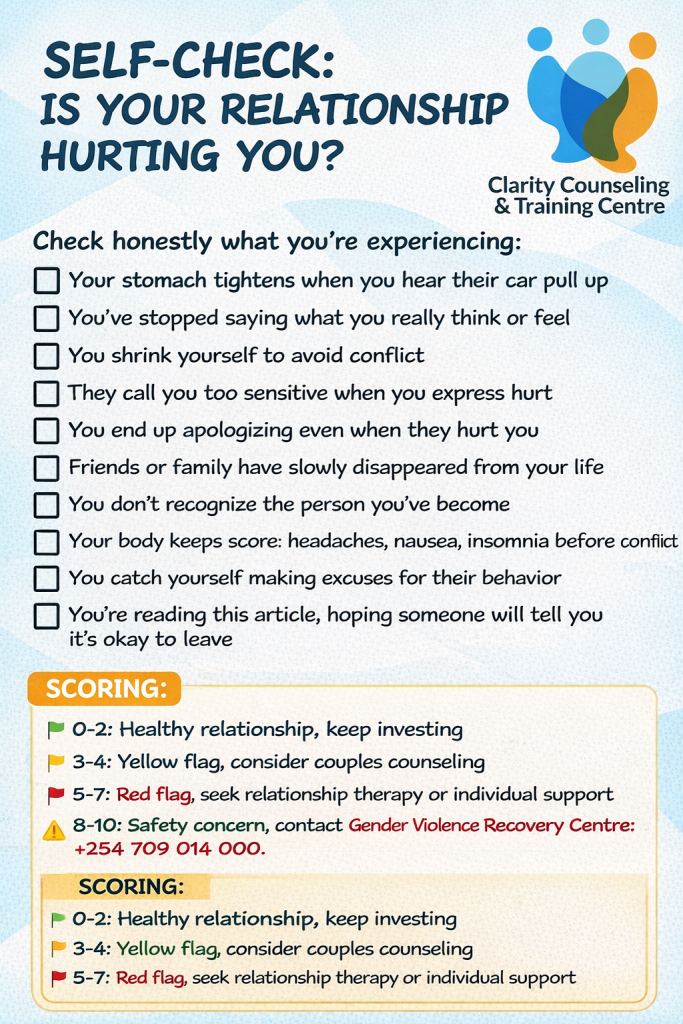
If you checked 3 or more:
You’re not broken. You’re not failing. And you’re not alone.
41% of Kenyan women experience intimate partner challenges. This is your invitation to get support, not your indictment.
Sometimes the most loving thing you can do is admit: This relationship, as it currently exists, is not safe for me.
The Hard Truth
Love languages won’t fix these patterns. Communication skills won’t work if one person refuses to change. You can’t love someone into respecting you.
That doesn’t always mean leaving (though sometimes it does). It means: Something must fundamentally change.
Common Kenyan Barriers to Seeking Help
- Shame: What will people say?
- Religious pressure: Marriage is forever
- Economic dependence: Can’t afford to leave
- Family pressure: Dowry already paid
- Normalizing abuse: All men/relationships are like this
When to get couples therapy: When you’ve checked 3+ warning signs but still want to try. When both partners are willing to change. When safety isn’t the immediate concern.
When to seek individual therapy first: When you’ve checked 7+ signs. When only one partner is willing. When your safety is compromised.
So how do you fix relationship problems and build something healthier? Here are the skills you never got taught.
How to Build Healthy Relationships: Skills That Actually Work
Most of us weren’t taught relationship skills. We learned by watching our parents and making it up as we went.
But healthy relationship therapy in Kenya and globally shows us that these are learnable skills.
Skill 1: Learn to Fight Fair
- No name-calling, no character attacks
- Use I statements: I feel hurt when… vs You’re so selfish
- Take breaks when escalated (return to discuss, don’t stonewall)
- Focus on one issue at a time
Try this today: Next disagreement, use this script: I feel [emotion] when [behavior]. I need [request].
Skill 2: Build Emotional Literacy
- Name feelings accurately: I feel dismissed vs You don’t care
- Understand your triggers
- Regulate before engaging
Try this today: When upset, pause and name the specific emotion: Hurt? Scared? Disappointed?
Skill 3: Practice Genuine Repair
Real apologies: I was wrong about [specific]. That hurt you. I’ll [change].
Not: Sorry if you were hurt (invalidating)
Not: Sorry BUT you also… (deflecting)
Try this today: If you hurt your partner recently, apologize using that 3-part script.
Skill 4: Honor Boundaries
- Say no without elaborate justifications
- Accept no without pressure
- Respect privacy
Try this today: Practice saying ‘I’m not available for that’ without explaining why.
Skill 5: Know When to Get Help
Couples therapy isn’t an admission of failure; it’s an investment in success.
Evidence:
- 70% of couples report significant improvement
- Premarital counseling: 30% lower divorce rates
- Couples who learn to repair: 83% stay happy long-term
Healthy relationships are built, not found. They require skills you weren’t born with.
Want to see what this looks like in real life?
Couples Therapy Success Story: From Love Languages to Real Change
James and Mercy came to Clarity Counseling in Nairobi six months before their wedding for premarital counseling.
Both could recite each other’s love languages. Mercy: Acts of Service. James: Physical Touch.
They thought they had it figured out.
The first session revealed what was missing: the 5 foundations.
Foundation 2: Respectful Communication, James stonewalled. Learned it from watching his dad give his mom the silent treatment for days.
Mercy criticized. Over-functioned. Anxiously pursued when James withdrew.
Foundation 5: Repair. Neither knew how to apologize genuinely. They’d go days in cold silence.
Love languages weren’t the problem. They weren’t the solution either.
Twelve weeks of premarital counseling in Nairobi. Practice repair conversations. Individuals work on attachment wounds.
Wedding day: They got married. Not because everything was perfect. But because they’d built foundations that could handle imperfection.
James now: Love languages taught us vocabulary. Therapy taught us grammar.
Mercy now: We still speak different love languages. But we speak the same language of respect.
This could be your story too.
Couples Counseling Kenya: Get Professional Relationship Support
If you’re reading this thinking, “My relationship needs more than love languages,”
You’re right. And you don’t have to figure it out alone.
Clarity Counseling & Training Centre
Professional Couples Therapy Nairobi & Across Kenya
KCPA-accredited and board-licensed counseling specialists based in Nairobi.
We Offer:
Couples Therapy & Relationship Counseling
- Communication skills training
- Conflict resolution strategies
- Rebuilding trust after betrayal
- Navigating cultural pressures
- Online and in-person sessions
Premarital Counseling
- Build strong foundations before the wedding
- 6-12 week structured programs
- 30% lower divorce risk
Individual Therapy for Relationship Issues
- Process past trauma
- Build healthier patterns
- Discern whether to stay or leave
| WHAT TO EXPECT IN COUPLES THERAPY
First session: Assessment and goal-setting, not judgment You’ll learn specific communication tools Homework between sessions to practice Average duration: 12-16 weeks Success rate: 70% report significant improvement Online sessions available across Kenya In-person sessions at our Nairobi office |
Your first consultation is FREE (15 minutes). Book this week, before Valentine’s Day.
Don’t wait until the pain becomes unbearable. Early intervention is 3x more effective.
You didn’t learn relationship skills in school. Let us teach you what healthy love actually requires.
| CONTACT CLARITY COUNSELING TODAY
📍 Location: Finance House, Loita Street, Nairobi 🌐 Website: www.claritycounseling.co.ke 📧 Email: [email protected] 📞 Phone: +254 1144443000 💬 WhatsApp: 0101515101-Available for booking Relationship counseling near me: Search ‘Clarity Counseling Nairobi.’ FREE 15-minute consultation. Book online or call today. |
This Valentine’s Day, Choose Yourself
Forget the flowers and chocolate for a moment.
Ask the harder question: Does this relationship protect my mental health? Or compromise it?
Love languages and mental health go together, but love languages alone aren’t enough.
Healthy relationships require:
- Emotional safety
- Respectful communication
- Clear boundaries
- Reciprocity
- Repair after conflict
These are learnable skills.
You’re not doomed to repeat painful patterns. You deserve a relationship that heals, not harms. That builds you up, not breaks you down. That improves your mental health, not worsens it.
This Valentine’s Day, choose yourself. Choose safety. Choose a love that doesn’t cost you your peace.
You deserve that.
Tomorrow doesn’t have to look like today.
Additional Support Resources in Kenya
- Gender Violence Recovery Centre: +254 709 014 000
- FIDA Kenya (legal support): +254 20 386 5000
- Befrienders Kenya (24/7 crisis): +254 722 178 177
- Mental Health Kenya: www.mentalhealthkenya.org