Online Therapy vs In-Person in Kenya: Which Is Better, Costs, & How to Choose
Aisha made the decision on a Tuesday evening in Mombasa.
She had been thinking about therapy for close to a year. The anxiety had been manageable — until it wasn’t. Her job was demanding. Her marriage was under strain. She couldn’t concentrate the way she used to, and the constant, low-grade dread had started following her into mornings.
She finally typed “therapist Mombasa” into Google.
The results were thin. A few listings. One outdated directory. A couple of names with no reviews, no websites, no sense of who these people were.
She almost gave up.
Then she searched “therapy Kenya online.” The results were different.
Within twenty minutes, she had found a therapist, booked a free consultation, and scheduled her first session for Thursday morning — a time slot that wouldn’t affect her work schedule and didn’t require a two-hour round trip to Nairobi.
Aisha’s question — can I actually do this online? — is one that thousands of Kenyans are asking in 2026. And the answer is more layered, more interesting, and more practical than most people expect.
This guide answers it properly.
| The Short Answer: Online therapy is clinically effective for the most common mental health concerns — anxiety, depression, stress, grief, and relationship challenges. The format is different. The outcomes, research consistently shows, are comparable. Whether online or in-person is right for you depends on your specific situation, location, needs, and personal preferences — not on a fixed rule that one format is always better. |
What Is Online Therapy, Actually?
Before the comparison, let’s be clear about what online therapy means in the Kenyan context in 2026.
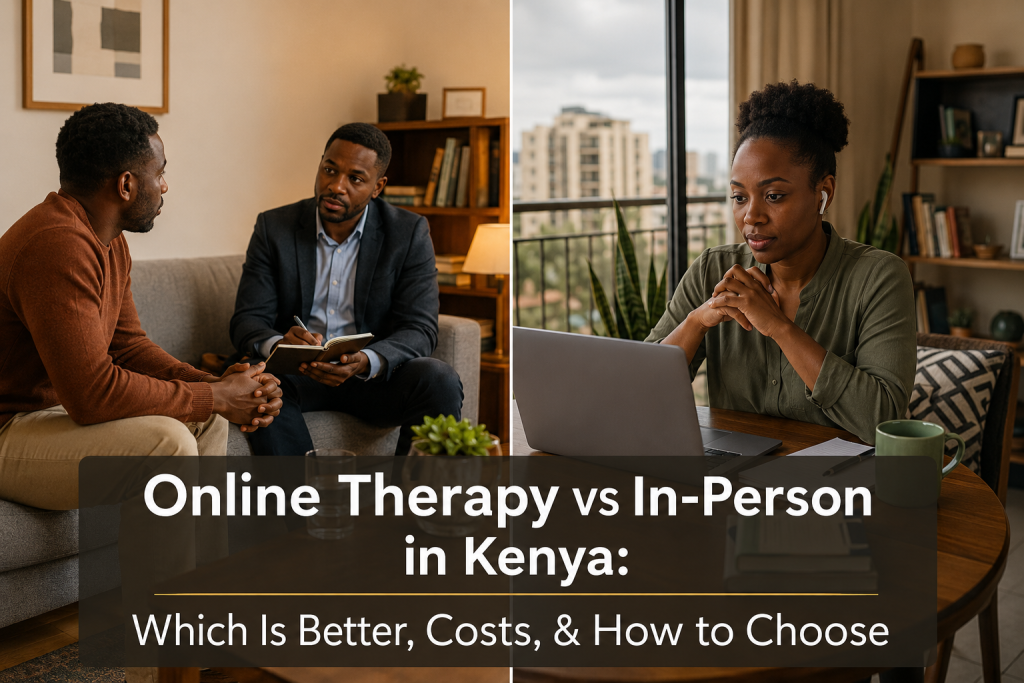
Online therapy — also called teletherapy, virtual counselling, or e-therapy — is therapy conducted through a digital platform rather than in a physical office. In Kenya, this typically means:
- Video call sessions via platforms like Zoom, Google Meet, or WhatsApp Video
- Voice call sessions for clients without stable video connectivity
- Secure messaging-based therapy on dedicated apps (less common in Kenya currently)
Sessions are the same length as in-person sessions (typically 50–60 minutes), follow the same therapeutic structure, and are conducted by the same qualified, licensed counsellors. The couch is different. The work is the same.
Online vs In-Person Therapy in Kenya: A Direct Comparison
| Online Therapy | In-Person Therapy | |
| Location requirement | Anywhere with internet | Must be in the same city as your therapist |
| Who does it suit best | Professionals, diaspora, people outside Nairobi, those with stigma concerns | People who prefer physical presence, severe or complex diagnoses |
| Cost per session | KES 3,500–6,000 (Clarity) | KES 3,000–8,000+ (includes practice overhead) |
| Hidden costs | Mobile data (variable) | Transport, parking, time away from the office |
| Insurance coverage | Often excluded — confirm with your provider | Generally covered where available |
| Privacy | High — you control your environment | Moderate — you’re seen entering an office |
| Clinical effectiveness | Comparable for most presentations | Preferred for severe or complex diagnoses |
| Scheduling flexibility | High — mornings, evenings, weekends | Limited to office hours and proximity |
| Tech requirement | Stable internet, smartphone or laptop | None |
| Best for | People outside Nairobi, diaspora, those managing tight schedules or stigma concerns | Complex presentations, somatic work, active crisis, children under 12 |
Is Online Therapy Actually Effective?
This is the question that stops most people. And it is a fair one.
The short answer: yes — for most people, most of the time.
A 2026 comparative policy analysis published in the International Journal of Environmental Research and Public Health studied teletherapy adoption and outcomes across low-, middle-, and high-income countries, including Kenya. While adoption in Kenya remains under 5% — compared to 70% in Norway and 68% in Canada — the clinical evidence base consistently showed comparable outcomes between online and in-person therapy for anxiety, depression, trauma, and stress-related presentations.
Closer to home, a telepsychiatry acceptability study conducted at Chiromo Mental Health Hospital in Nairobi (published in BJPsych Open, 2022) found that patients reported feeling comfortable and connected during online sessions — and cited the removal of commuting costs as a meaningful benefit for those managing tight budgets.
A USIU Kenya study on clinical supervision in teletherapy further found that Kenyan teletherapists strongly agreed that supervision improved the quality of their online work, with a mean score of 4.04 out of 5.
Online therapy in Kenya is not a stopgap. It is a maturing, quality-monitored field.
Where the Research Is More Nuanced
Online therapy may be less effective for:
- Clients experiencing active psychosis or severe psychiatric presentations requiring in-person clinical oversight
- Those with complex trauma requiring somatic (body-based) therapeutic approaches
- People in active crisis situations where physical proximity matters for safety
- Children under 12, for whom in-person interaction is generally developmentally preferable
If you are unsure whether your situation calls for in-person work, the right step is a consultation—not a guess —to help you figure out which format is right for you before committing.
How Much Does Online Therapy Cost in Kenya in 2026?
Cost is one of the most searched questions — and one of the least transparently answered by therapy platforms in Kenya. Here is an honest breakdown.
At Clarity Counselling
Clarity offers both online and in-person sessions. Online sessions are priced comparably to in-person, with the added savings of no commuting, parking, or time out of the office. See our full fees and session options →
Across the Market
| Provider | Format | Approximate Cost Per Session |
| Clarity Counselling | Online + In-person | KES 3,500–6,000 |
| Wazi | Online only (anonymous) | ~KES 2,000–4,500 |
| MantraCare | Online (international platform) | USD 15–40 (~KES 1,900–5,200) |
| Private practice therapists (Nairobi) | In-person | KES 4,000–10,000+ |
| Public hospital psychiatry | In-person | KES 200–500 (long waits, limited availability) |
Rates are approximate and may change. Always confirm directly with the provider.
What About Insurance?
The Nairobi telepsychiatry acceptability study found that insurance non-coverage of online sessions was described by some participants as “sometimes a complete barrier” — affecting how frequently clients could access therapy even when they wanted to.
As of 2026, most Kenyan insurers do not explicitly include online counselling in their mental health benefit schedules. Before you begin, call your insurer directly and ask: Does my policy cover online counselling sessions with a CPB-registered therapist?
| If Your Insurance Doesn’t Cover It
Confirming that your insurer excludes online therapy is frustrating — but it is not the end of the road. Three practical options:
Book a free 15-minute consultation to discuss what works for you → |
Who Should Choose Online Therapy?
You may be a strong candidate for online therapy if you:
- Live outside Nairobi, and access to qualified therapists in your area is limited or nonexistent
- Have a demanding schedule — and flexibility matters more than physical location
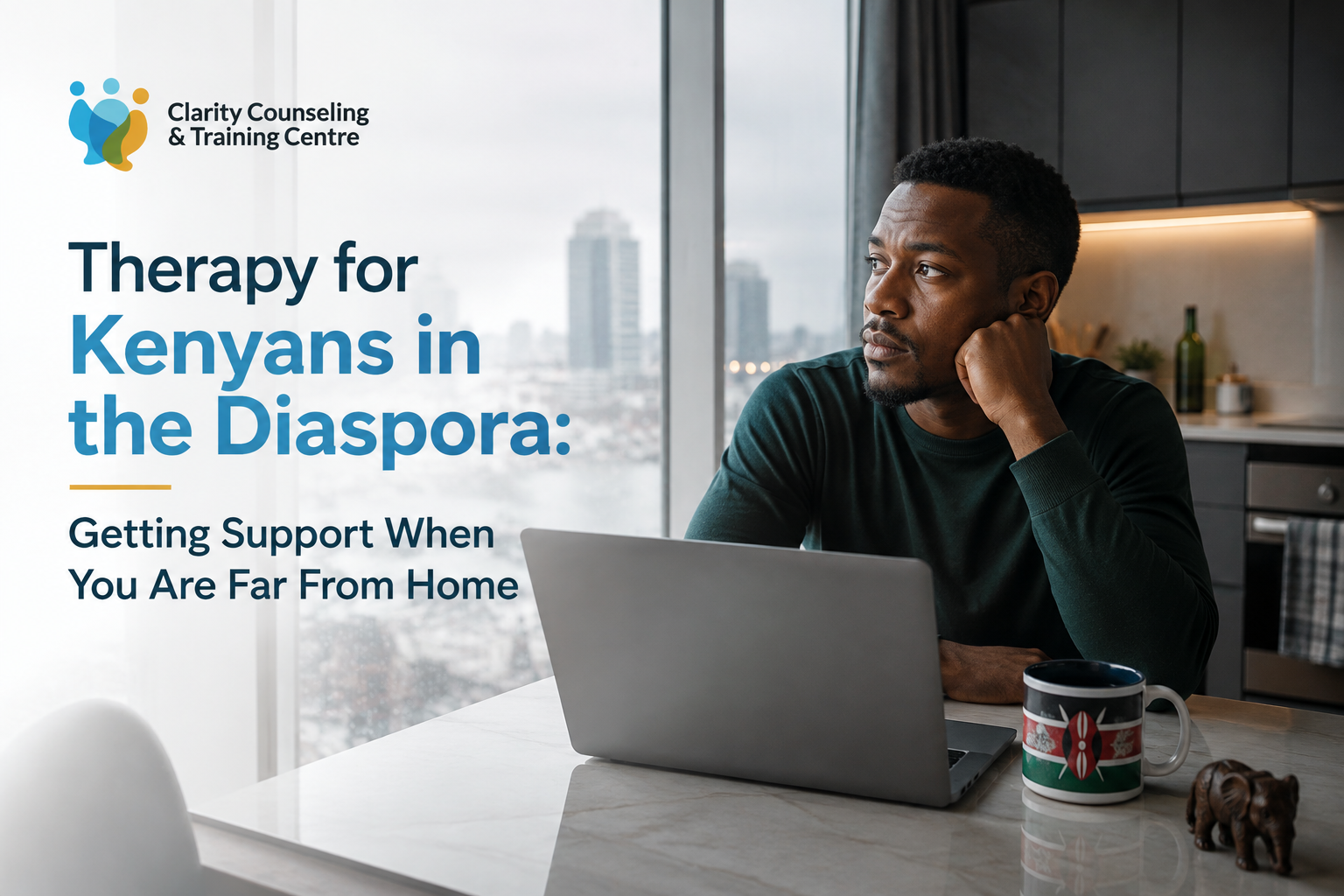
- Are you a Kenyan living abroad, and want to work with a therapist who understands Kenyan culture, family dynamics, and the specific pressures of diaspora life
- Value privacy — and prefer not to be seen entering a counselling office
- Are new to therapy — and want to ease in from a familiar, comfortable environment first
- Have already done in-person therapy, and want to continue your work without location becoming a barrier
→ If you are in the diaspora, see our dedicated page: Therapy for Kenyans Abroad →
| Clarity and the Kenyan Diaspora
Clarity works with Kenyan clients in the UK, US, Canada, Australia, and the Gulf. If you are abroad, here is what you need to know:
|
Who Should Choose In-Person Therapy?
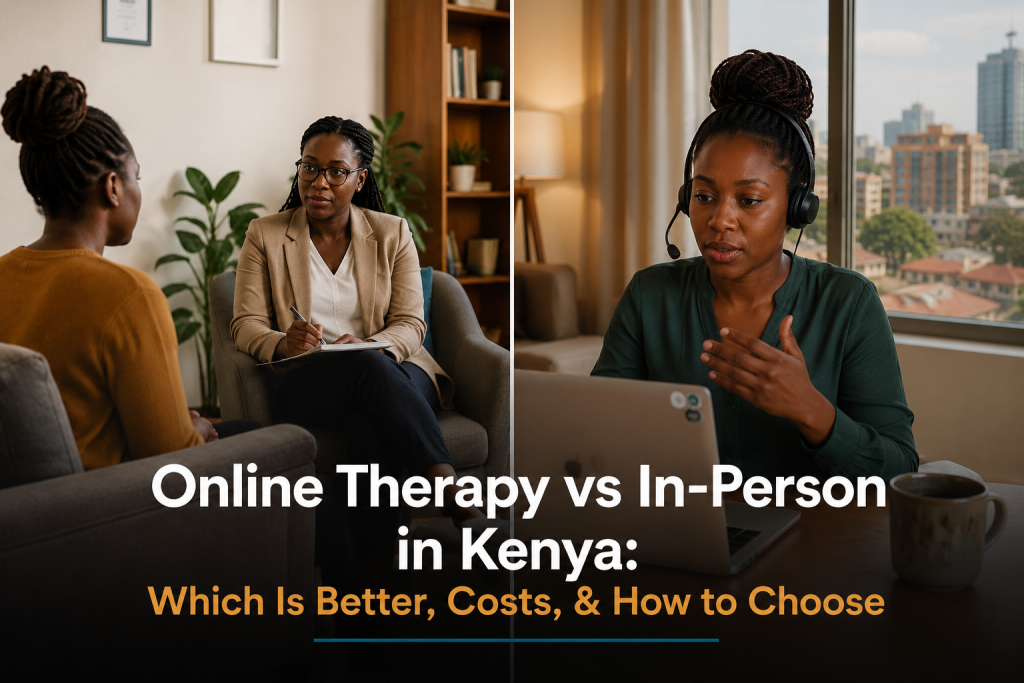
In-person therapy is the better fit if:
- You are dealing with a severe or complex mental health diagnosis that benefits from clinical oversight in a structured environment
- You find screens distracting or uncomfortable during emotionally intense conversations
- You need the physical container of a dedicated therapy space — separate from your home or workplace
- You are working through somatic or body-based trauma where physical presence enhances the work
- You are a child under 12, for whom in-person engagement is generally more developmentally effective
- You are in an active crisis, and safety planning is part of your care
Common Questions Kenyan Clients Ask Before Starting Online Therapy
Is online therapy as private as in-person?
In many ways, more so. There is no waiting room. No receptionist who knows your name. No risk of running into a colleague or neighbour in the car park. Sessions are conducted on encrypted platforms, and your therapist is bound by the same professional confidentiality obligations as in a physical office — under the ethical standards set by the Counsellors and Psychologists Board (CPB).
You do need to manage your environment: headphones are strongly recommended, and a private space matters.
| A Note on Data Privacy
All client information held by Clarity is managed in compliance with Kenya’s Data Protection Act 2019, which establishes your rights regarding the collection, storage, and use of your personal information. You have the right to access, correct, or request deletion of your data. If you have questions about how your information is handled, ask before your first session. |
What if I don’t feel connected to my therapist online?
This is one of the most common concerns — and it deserves a direct answer.
Therapeutic alliance—the quality of the relationship between therapist and client—is the strongest predictor of therapy outcomes, regardless of format. Research consistently shows that therapeutic alliance forms comparably in online and in-person settings. The screen does not prevent connection. It changes the frame of it.
That said, not every therapist-client fit works. That is true in person, too. If, after your first two sessions, you feel the fit is not right — that the therapist’s style is not what you need, or that you simply do not feel comfortable — Clarity will discuss what is not working. We can help you find a better match within our team or provide an external referral if needed.
Booking a session is not a commitment to that therapist for the long term. It is an opening.
What platform does Clarity use?
Clarity uses secure video conferencing platforms for all online sessions. The session link is confirmed in your booking confirmation. WhatsApp calls are used when video connectivity is unstable. Sessions are not recorded.
Can I switch from online to in-person later?
Yes. Many clients begin online — particularly those who live outside Nairobi — and transition to in-person when circumstances allow. Clarity supports hybrid arrangements and continuity of care across formats.
What if my internet connection is poor?
Kenyan connectivity has improved significantly, particularly in urban areas. A stable 4G mobile data connection is usually sufficient for video therapy. If a video drops during a session, most therapists seamlessly switch to voice. Clarity’s therapists are trained to manage session disruptions without breaking the therapeutic relationship.
Your First Online Session at Clarity: What to Expect
Most people feel some version of this before their first session: What if I don’t know what to say? What if the technology fails? What if it feels strange?
Here is what actually happens.
| Stage | What Happens |
| Before the session | You receive a booking confirmation with your session link, your therapist’s name, and a brief intake form. The form asks what brings you in and any relevant background. It is not a test. There are no wrong answers. |
| Five minutes before | Open your session link — Zoom or Google Meet, confirmed in your booking. Test your audio and video. Find a private space, ideally with headphones. Close your door. Your therapist will be waiting. |
| In the session | Your therapist will introduce themselves, briefly explain how the session works, and ask what brings you in. The first session is an assessment — not advice-giving, but careful listening. They are building an understanding of your situation. You drive the pace. You do not have to say anything you are not ready to say. |
| After the session | Your therapist will summarise what they heard and suggest how working together could look. They will ask if you want to continue. You are not obligated. If you proceed, you will agree on a session frequency — weekly is typical, fortnightly also common. |
That is it. It is a conversation. A careful, confidential, held one. But a conversation.
→ Book your free 15-minute online consultation
What the Mental Health Act 2023 Means for Online Therapy
Kenya’s Mental Health Act 2023 formally recognises teletherapy as a legitimate and regulated channel for mental health service delivery. This is a significant milestone — online counselling in Kenya is not a grey zone. It is a recognised modality operating within a legal framework.
For clients, this creates accountability. Any therapist offering online sessions in Kenya should be registered with the Counsellors and Psychologists Board (CPB) and operating within its ethical guidelines — regardless of format. When choosing an online therapist, always ask: Are you registered with the CPB?
| A Word on Clarity’s Approach: Clarity Counselling operates both in-person and online — and our view is not that one is better than the other. Our view is that the right fit is the one that makes therapy accessible and sustainable for you. We have worked with clients in Mombasa, Kisumu, Nakuru, Eldoret, and Kitale — all online. We have worked with Kenyans in the UK, the US, Canada, and Australia who wanted therapy that understood their cultural context. And we have worked with clients in Nairobi who simply preferred the privacy of their own home. The goal is not the format. The goal is healing. |
→ Related reading: 5 Myths About Therapy in Kenya That Are Keeping People From Getting Help →
How to Choose: A Quick Decision Framework
Ask yourself three questions:
1. Where am I physically?
If you are outside Nairobi or outside Kenya, start with online.
2. What am I working on?
For anxiety, stress, grief, relationship challenges, work burnout, or mild-to-moderate depression, online therapy is appropriate. For complex trauma, severe psychiatric presentation, or active crisis contact us to discuss in-person options first.
3. What environment do I feel safest in?
If home feels like your safest space — online. If you need a dedicated space outside your home or office, in-person.
If you are still unsure, book a 30-minute consultation session. That conversation will tell you more than any article can.
| What Clarity Clients Often Tell Us After Their First Online Session
“I kept thinking I’d feel like I wasn’t really there. I was surprised — I actually felt more present than I expected. Having my own space took the anxiety about the commute completely away, and I just… arrived.” This is a consistent pattern. For many clients, the familiarity of their own environment — sitting in a chair they chose, in a space that is theirs — actually lowers the initial barrier to opening up. The session work is not diminished by the screen. For some people, it has helped. |

Frequently Asked Questions
Is online therapy as effective as in-person therapy?
For most mental health concerns — anxiety, depression, stress, grief, and relationship challenges — global and Kenyan research shows comparable clinical outcomes. For complex or severe presentations, in-person therapy may be more appropriate. A free consultation helps clarify which is right for your situation.
How much does online therapy cost in Kenya?
Online therapy at Clarity ranges from KES 3,500 to KES 6,000 per session, depending on session type. See our full pricing page for current details.
Can I do therapy from outside Kenya?
Yes. Clarity works with Kenyan clients globally. Our therapists understand diaspora dynamics — family pressure from a distance, identity questions, and the grief of leaving. We work across time zones and accept international payments. See the therapy for Kenyans abroad page →
What platform does Clarity use for online sessions?
Secure video platforms confirmed at booking. Voice-only sessions are available where video is unstable. Sessions are never recorded.
Does insurance cover online therapy in Kenya?
Not reliably. As of 2026, most Kenyan insurers do not explicitly cover online counselling. Always confirm with your provider. Some insurers will cover sessions if the therapist is CPB-registered. If your insurer does not cover it, contact Clarity to discuss options.
What if I don’t connect with my therapist?
Connection matters, and if, after a couple of sessions, the fit does not feel right, that is worth naming. Clarity can help you find a better match within the team or provide an external referral if needed. You are not locked in.
Whether you are in Nairobi, Mombasa, Kisumu — or London, Toronto, or Dubai — Clarity Counselling is ready to meet you where you are.
Related reading: |