Anxiety in Kenya: The Difference Between Normal Worry and a Disorder Running Your Life
He has a reputation for being thorough.
Colleagues describe him as meticulous. His boss trusts him with the high-stakes projects because he always prepares, always follows up, always has a contingency.
What they do not see is what happens at 2 am. The replaying of conversations from three years ago. The mental simulation of every possible way tomorrow’s presentation can go wrong, running on a loop, gathering detail, becoming more vivid the longer he tries to sleep. The way his chest tightens on the matatu when it stops moving, and he cannot calculate whether he will make the meeting on time.
Nobody has called this anxiety. He has not called it that. He calls it being conscientious. He calls it high standards. He calls it the kind of person he is.
But the body that has not slept properly in eight months has a different name for it.
| A 2022 community study conducted across Nairobi, Mombasa, and Kwale found general anxiety symptoms in 12% of women and 8% of men surveyed. Kenya’s mental health treatment gap sits at approximately 75%, meaning three in four people with a mental health condition access no care at all. Those figures almost certainly undercount the real picture. |
What Anxiety Actually Is
Anxiety is the nervous system’s threat detection system running at a setting too high for the actual level of danger present. The American Psychological Association defines anxiety as an emotion characterised by feelings of tension, worried thoughts, and physical changes. The key clinical distinction is that anxiety disorders involve these responses being persistent, difficult to control, and disproportionate to the actual threat present.
The system itself is not a malfunction. Anxiety evolved to keep humans alive. The spike of alertness before a physical threat, the heightened attention, the body mobilising for action: these are features, not bugs, in their original context.
The problem is a nervous system that cannot distinguish between a lion and a work email. One that treats a difficult conversation with a manager with the same physiological urgency as an actual emergency. One that keeps the alert signal running long after the specific trigger has passed, because it has learned, through repetition or through a specific experience, that threats can come from anywhere and that the safest thing is to keep scanning.
The Kenyan Anxiety Landscape
The 2022 Aga Khan University study across Nairobi, Mombasa and Kwale found general anxiety symptoms in 12% of women and 8% of men surveyed. A separate analysis of the 2022 Kenya Demographic and Health Survey found the overall prevalence of depression and anxiety combined at 3.84%, with anxiety disorders specifically at 1.97% of the adult population. Both figures are almost certainly underestimates given the mental health treatment gap and stigma around disclosure.
What they confirm is that anxiety is not rare. It is not imported. It is not a condition of people who have too much time to think. It is present across income levels, across counties, across professions. It is happening inside the body of the person who looks, from the outside, like they have everything together.
What It Looks Like When It Is Not Being Called Anxiety
Most Kenyans with anxiety have never been told they have it. They have been told other things.
| What it gets called | What is often actually happening |
| Overthinking | Generalised anxiety: a mind that cannot stop running threat simulations regardless of how much the person tells it to stop |
| Being a worrier | A nervous system calibrated to high alert, often from an early period when high alert was genuinely necessary |
| Stage fright | Social anxiety: a specific and intense fear of evaluation by others that goes well beyond ordinary nerves |
| Ulcers or stomach problems | Somatic anxiety: the body expressing what the mind cannot easily name, through physical symptoms that investigations do not explain |
| Heart problems | Panic attacks: sudden surges of extreme physical symptoms including chest pain, racing heart, dizziness, and the conviction that something is catastrophically wrong |
| Being difficult or moody | Irritability driven by a nervous system that is already at maximum capacity and has no buffer left for additional demands |
The Specific Flavours of Anxiety in the Kenyan Context
Financial anxiety
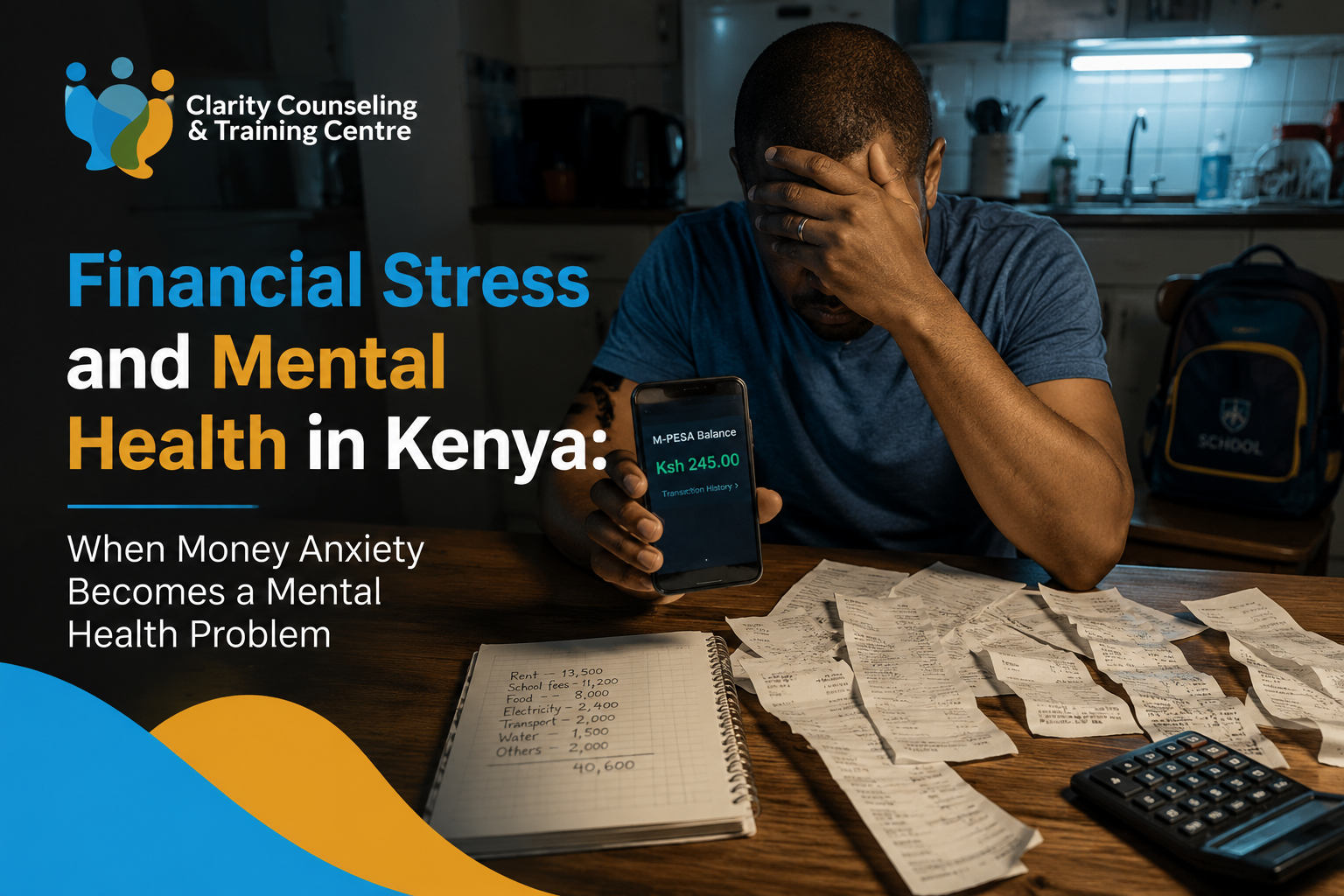
With 47% of working Kenyans reporting that financial stress is badly affecting their mental health, and most Kenyan professionals managing obligations that extend beyond their own household to family, the relationship between financial pressure and anxiety is particularly loaded here. Our post on financial stress and mental health in Kenya covers this connection in depth.
Social anxiety in professional settings
Kenya’s workplaces carry specific social hierarchies and unspoken rules about who speaks and how. For someone with social anxiety, navigating these environments is genuinely exhausting in ways that their colleagues who do not have it cannot fully imagine. See our workplace mental health guide for the broader picture.
The specific burden on women
The 2022 Aga Khan University data showed anxiety symptoms consistently higher in women than men across the Kenyan population. The reasons are structural as much as individual: the mental load, the expectation of simultaneous competence across multiple domains, the chronic low-grade vigilance that many Kenyan women carry as part of daily life.
What Anxiety Is Not
Anxiety is not weakness. The people with the highest-functioning anxiety in Kenya are often the most capable, the most prepared, the most reliable. Anxiety can look indistinguishable from diligence. That is part of what makes it so difficult to catch.
Anxiety is not something you can logic your way out of. The WHO’s framework for mental health conditions is clear that anxiety disorders involve neurological and physiological components that do not respond to willpower alone. Telling a person with anxiety to just stop worrying is structurally equivalent to telling someone with a broken leg to just walk normally.
Anxiety is not a permanent state. It responds very well to treatment. Most people who engage properly with treatment experience meaningful improvement.
What Therapy Does With Anxiety
CBT for anxiety has one of the strongest evidence bases in mental health. Research published in Clinical Psychology Review found CBT significantly more effective than control conditions across multiple anxiety disorder presentations. It does not teach you to stop worrying. It teaches you to relate differently to the worry: to recognise the pattern when it starts, to interrupt the catastrophising loop before it completes, to build a more accurate threat assessment.
Clarity’s individual therapy sessions are available in person at our Nairobi office and online. If cost is a question, read our guide on insurance cover for therapy in Kenya.
When to Take It Seriously
These are the signs that what you are carrying has moved from ordinary stress into something worth addressing with professional support:
- Sleep is regularly disrupted by worry that you cannot switch off
- The anxiety is affecting decisions: avoiding things, people, or situations in ways that are shrinking your life
- Physical symptoms, including chest tightness, breathing difficulty, stomach problems, or headaches, appear regularly without a medical explanation
- You spend significant mental energy managing the anxiety rather than living your actual life
- People who know you well have commented on a change
- You are using alcohol, food, or other substances to manage your internal state.
Frequently Asked Questions
What are the signs of anxiety disorder in Kenya?
Persistent worry that is difficult to control, physical symptoms including chest tightness or stomach problems without a clear medical cause, sleep disruption, avoidance of situations that trigger the anxiety, and significant time spent managing internal fear rather than functioning normally.
Is anxiety common in Kenya?
A 2022 community study found anxiety symptoms in 12% of women and 8% of men across urban and peri-urban Kenyan settings. Given the mental health treatment gap of approximately 75%, the real prevalence is likely higher.
What is the difference between stress and anxiety?
Stress is a response to a specific, identifiable external pressure and typically resolves when that pressure does. Anxiety persists beyond its trigger, operates even in the absence of a specific threat, and involves a nervous system response that feels out of proportion to the actual situation. Stress is situational. Anxiety is a pattern.
Can anxiety be treated without medication?
CBT and related therapeutic approaches are effective for most anxiety presentations without requiring medication. Medication is sometimes used, particularly for severe presentations or when anxiety is causing significant impairment, and the decision is made individually in consultation with a psychiatrist.
→ Is This Anxiety? Download the self-assessment (PDF)
→ Book a confidential session at Clarity
→ Related: Depression in Kenya
→ Related: Financial Stress and Mental Health in Kenya
→ WhatsApp: +254 (0) 101 515 101 | Call: +254 (0) 114 444 300