Counselling Psychology Course Fees in Kenya 2026
Faith spent three months trying to figure out how much a counselling psychology course would cost her.
She visited six school websites. Four of them listed no fees at all. One had fees that were clearly outdated. One quoted a range so broad — “KES 30,000 to KES 150,000 per term” — that it told her nothing.
She wasn’t being unreasonable. She was doing exactly what any sensible person does before committing to a professional training programme. She wanted to know what she was actually getting into.
This guide is the answer she couldn’t find. It explains what drives the cost of counselling psychology courses in Kenya, what you should expect to be included in your fees, what you should watch out for, and what Clarity Counselling & Training Centre specifically charges in 2026. Before diving into costs, if you haven’t yet settled on which career path a certificate would open for you, read our guide: 5 Careers You Can Build with a Counselling Certificate.
What Determines the Cost of a Counselling Psychology Course in Kenya?
Not all courses are priced the same — and the differences aren’t random.
| Cost Factor | Lower Cost | Higher Cost |
|---|---|---|
| Accreditation level | Unaccredited / informal | KNEC-accredited, CPB-recognised |
| Qualification level | Certificate | Diploma or Postgrad |
| Delivery mode | Online / self-paced | In-person / blended with supervision |
| Supervision included? | No supervised practice | Supervised clinical hours included |
| Institution type | Small private college | Established training centre with clinical arm |
| Study materials | Self-sourced | Provided — textbooks, resources, notes |
| Exam / registration fees | Excluded (you pay separately) | Included in programme fee |
Key principle: Cheaper is not always better. A course that doesn’t include supervised practice hours cannot prepare you for CPB registration — which means it cannot advance your career the way you need it to.
What Should Be Included in Your Course Fees?
Before you compare prices, compare what’s actually in each price. Here’s the checklist to apply to every school you evaluate.
Must-Haves (Walk Away If These Are Missing)
- KNEC or TVETA accreditation — your qualification must be nationally recognised
- CPB / KCPA alignment — course should prepare you for board registration
- Supervised practice component — essential for competence and career progression
- Qualified, practising lecturers — not just academic tutors
- Clear curriculum covering core modules: counselling theory, ethics, human development, mental health, research
Good-to-Haves
- Study materials provided (reduces your out-of-pocket costs)
- KNEC exam registration fees included
- Access to a clinical facility for placement hours
- Alumni network and career support
- Flexible payment / instalment options
Red Flags
- No mention of KNEC or TVETA accreditation or board recognition
- Supervised hours sold as a separate expensive add-on
- Vague curriculum — “counselling skills” without specifying modules
- No physical premises or clinical supervision capacity
- Fees that seem suspiciously low for a full programme
The Three Levels of Counselling Psychology Courses in Kenya

| Level | Duration | Entry Requirement | What It Qualifies You For | Typical Fee Range (KES) |
|---|---|---|---|---|
| Certificate in Counselling Psychology | 6–12 months | KCSE D plain / equivalent | Supportive counselling, NGO roles, pastoral work, school welfare, CPB Associate registration | 60,000 – 120,000 total |
| Diploma in Counselling Psychology | 2 years | KCSE C- or Certificate | Counselling practice, clinical supervision, CPB registered counsellor status, healthcare & corporate roles | 130,000 – 260,000 total |
| Degree / Postgraduate | 3–4 years | KCSE B / Diploma | Licensed clinical practice, KCPA full membership, management, research | 250,000 – 800,000+ total |
For most career changers and working professionals, the Certificate → Diploma pathway is the most practical and cost-effective route. Read our complete guide: How to Become a Licensed Counselling Psychologist in Kenya.
Clarity Counselling & Training Centre: 2026 Course Fees
| Programme | Duration | Total Fee (KES) | Monthly Instalment | Materials Included? |
|---|---|---|---|---|
| Certificate in Counselling Psychology | 6 months | KES 61,500 | KES 10,000 / month | Yes |
| Diploma in Counselling Psychology | 2 years | KES 181,500 | KES 10,000 / month | Yes |
What’s Included in Clarity’s Fees
- KNEC and TVETA-accredited qualification — nationally and regionally recognised
- CPB and KCPA-aligned curriculum — built for board registration
- Supervised clinical practice hours
- Study materials and course notes
- Weekend and flexible scheduling options for working professionals
- Faith-integrated counselling approach — suitable for faith-based careers
Payment Options
| Payment Option | Details |
|---|---|
| Full payment | 8% discount on total fee |
| Instalment plan | KES 10,000/month — 3 instalments per semester |
| Employer-sponsored | Employer can pay directly — purchase orders accepted |
| Bursaries | Bursary options available — contact admissions to enquire |
| HELB | HELB funding not yet applicable; check with admissions for updates |
How to Compare Counselling Psychology Schools in Kenya: 10 Questions to Ask
Before you enrol anywhere, run every school through this checklist. The right programme isn’t just the cheapest — it’s the one that gets you to where you want to go.
| Question | Why It Matters | What a Good Answer Looks Like |
|---|---|---|
| Is the programme KNEC or TVETA-accredited? | Non-accredited certificates won’t qualify you for CPB registration or formal employment | Yes — and they can show you the accreditation certificate |
| Is supervised practice included in the fee? | Without supervised hours, you cannot register with CPB or KCPA | Included — minimum hours specified in the curriculum |
| Who are the lecturers? | Academic-only tutors lack real clinical context | Practising counsellors or therapists who teach from the field |
| How many students are in each cohort? | Large classes reduce personal attention and supervision quality | Reasonable cohort size with clear student-to-supervisor ratio |
| What support is there after graduation? | Alumni network, referrals, and career support matter for career starters | Specific programmes or contacts provided |
| Are exam fees included? | Exam fees can add KES 5,000–15,000 unexpectedly | Clearly stated — included or disclosed upfront |
| Can you speak to current students or alumni? | Real testimonials reveal what marketing doesn’t | Yes — and they’re willing to connect you |
| What’s the refund/deferral policy? | Life happens — know the rules before you pay | Clear written policy provided on request |
| Is there a pathway to the diploma? | Career growth requires the diploma — you want continuity | Yes — certificate credits apply toward the diploma |
| What’s the study schedule? | Working professionals need flexibility | Weekend classes, evening options, or blended delivery |
Is the Cost Worth It? How to Think About ROI
The right question isn’t “is this expensive?” — it’s “what does it enable?”
A KES 61,500 certificate that leads to a school counsellor role at KES 80,000/month pays for itself in less than a term. If it opens a corporate wellness role at KES 120,000/month, it pays for itself in a single month. If it launches a pastoral counselling ministry you’ve been building toward for years — the value is harder to quantify and harder to overstate.
The Cost of Not Training
- Continuing in a career that’s the wrong fit
- Watching colleagues with relevant qualifications get promoted over you
- Serving people in your church or community without the tools to actually help them
- Staying stuck at “I’ve always wanted to do this” instead of doing it
Clarity’s graduates aren’t coming in with unlimited budgets. Most are working professionals, parents, and ministry leaders who made a careful decision to invest in a qualification that would move them forward. The instalment options exist because we understand that.
Why Clarity Counselling & Training Centre?
| What Makes Clarity Different | Why It Matters to You |
|---|---|
| KNEC/TVETA-accredited programmes | Your certificate is nationally recognised and career-portable |
| KCPA and CPB-aligned curriculum | Built for board registration — not just classroom learning |
| Taught by practising therapists | Real clinical context, not just academic theory |
| Faith-integrated approach | Particularly relevant for church, NGO, and community settings |
| Located in Nairobi — flexible scheduling | Weekend classes accommodate working professionals |
| Part of a clinical facility | Training and practice under the same roof |
| Direct Certificate → Diploma pathway | No repeat of foundational content — your learning builds forward |
Frequently Asked Questions
How much does a diploma in counselling psychology cost in Kenya?
Diploma fees range from approximately KES 130,000 to KES 260,000 across institutions. The key variable is what’s included: supervised practice hours, exam fees, study materials, and quality of clinical supervision. Clarity’s 2026 diploma fee is KES 181,500. Contact the admissions team for the full fee schedule.
Can I pay for my counselling course in instalments?
At Clarity, yes — KES 10,000/month with 3 instalments per semester. Contact the admissions team to confirm terms for your preferred programme.
Are online counselling courses cheaper in Kenya?
Some online providers offer lower headline fees, but it’s essential to verify KNEC or TVETA accreditation, supervised practice inclusion, and CPB alignment. A lower fee without supervision leaves you with a certificate that won’t qualify you for board registration.
What’s included in Clarity’s course fees?
Clarity’s fee includes a KNEC-accredited programme, CPB-aligned curriculum, supervised clinical practice, study materials, and tuition from practising therapists. KNEC exam registration is charged separately. Contact the admissions team for the complete fee schedule.
The Right Programme Is the One That Gets You to the Career You Actually Want
Faith eventually enrolled at Clarity. Not because we were the cheapest option she found. Because when she came in for a consultation, she got straight answers. She knew exactly what she was paying, what was included, what the pathway looked like, and what she’d be qualified to do at the end.
That’s all any of us need before we make a decision like this. Clarity.
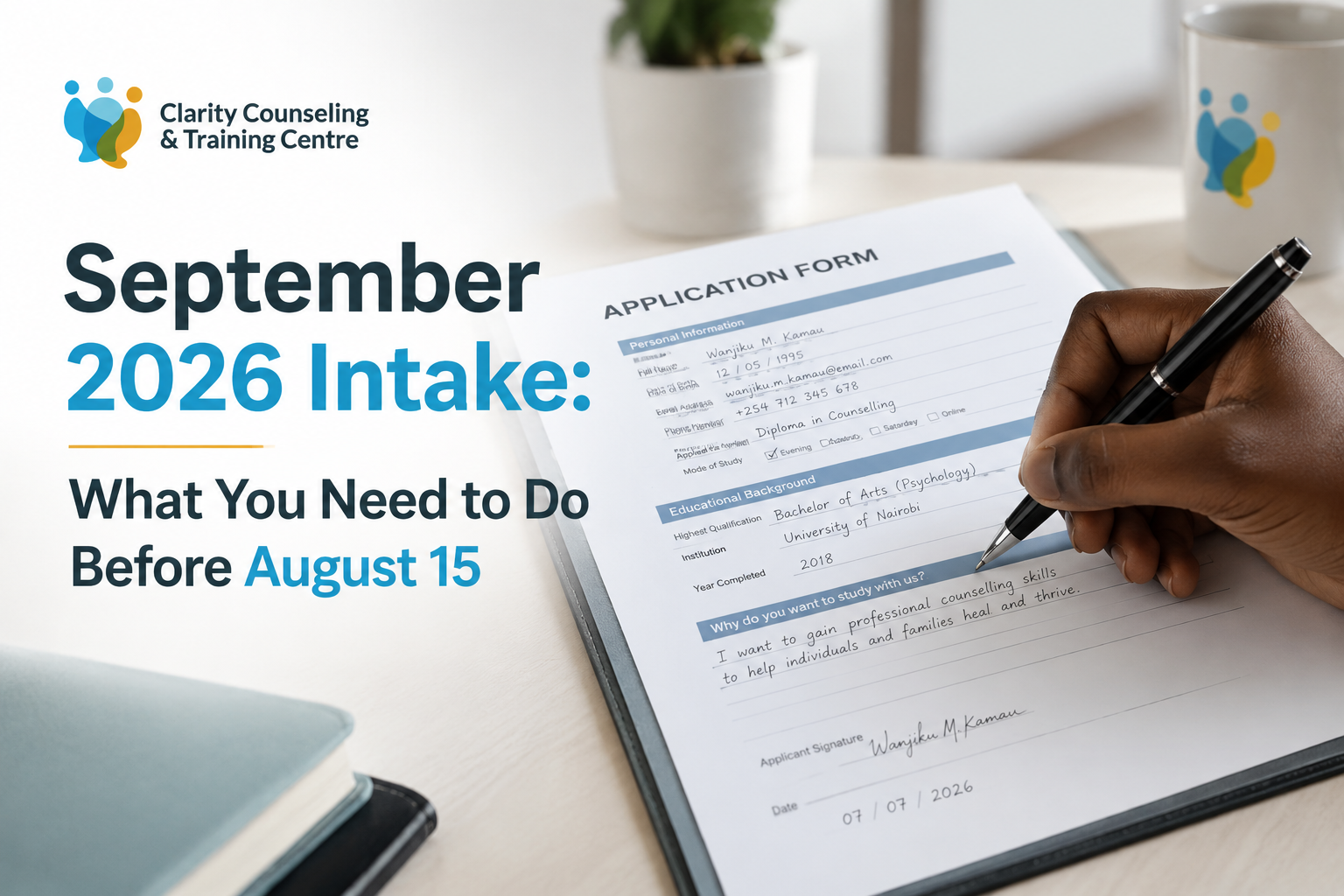
The September 2026 intake is coming. Applications are open now.
[ DOWNLOAD COURSE COMPARISON GUIDE → ] [ BOOK AN ENROLLMENT CONSULTATION → ] [ CERTIFICATE PROGRAMME DETAILS → ] [ DIPLOMA PROGRAMME DETAILS → ]