From Corporate Banking to Counseling Psychology, One Graduate’s Journey
The email sat in his drafts folder for eleven days.
Moses had rewritten it so many times that the words had started to blur. But on that Tuesday morning, sitting in his corner office on the fourteenth floor of a glass tower along Westlands Road, he pressed send.
Two weeks later, he walked out of a decade-long career in corporate banking and into a counseling psychology diploma in Kenya.
His colleagues thought he was having a crisis.
His mother asked if he had been fired. His bank account, for the first time in years, looked uncertain. But Moses will tell you that the only crisis he was having was one of meaning.
He had spent ten years helping institutions grow their wealth and had never once helped a human being grow through pain. He wanted to change that.
This is his story, composited and anonymised from the experiences of several graduates of Clarity Counseling & Training Centre’s programmes. And if you are reading this on your lunch break, in a career that looks good but does not feel right, it might be yours, too.
The Career That Looked Perfect on Paper
Moses had what most Kenyans would call a good life.
A solid salary.
Medical cover.
A company car.
Invitations to conferences in Mombasa and Nairobi’s five-star hotels.
He was the kind of person people pointed to at family gatherings and said, “That one has made it.”
But underneath the performance reviews and quarterly targets, something had been hollowing out for years. He would come home depleted, not from hard work, but from work that did not feel like it mattered.
The turning point came when a close friend experienced a severe depressive episode.
Moses sat across from him at a coffee shop in Kilimani and realised, with a clarity that physically winded him, that he had no idea how to help. He could restructure a loan portfolio, but he could not hold space for someone in pain.
That moment haunted him.
He began reading about mental health in Kenya, and the numbers were staggering. According to the Kenyan Ministry of Health, the country has only about:
- 116 psychiatrists
- 30 clinical psychologists
- Fewer than 500 mental health nurses serve a population of over 50 million
The WHO estimates that 75 % of Kenyans with mental health conditions receive no treatment at all. Moses did not just want to understand the problem; he wanted to become part of the solution.
The question was how.
Leaving a well-paying career to retrain in your mid-thirties is not a decision the Kenyan social script encourages. There is enormous cultural pressure to stay on the path that pays, to endure, to be grateful, to hustle harder.
But Moses had begun to realise that the golden handcuffs were still handcuffs, no matter how well they shone.
If you are reading this and recognising yourself, the success that feels hollow, the quiet pull toward something more meaningful, the fear that people will think you have lost your mind, then you already understand what Moses was feeling.
The difference, Moses took the next step.

How He Found a Diploma Psychology Programme That Fits His Real Life
Moses spent months researching.
He compared university postgraduate programmes with specialist training centres. He sat in on open days. He read accreditation requirements from the Kenya Counsellors and Psychologists’ Board.
He needed a programme that was rigorous enough to lead to professional registration, flexible enough to allow him to work part-time during the transition, and practical enough to put him in front of real clients, not just textbooks.
Three things drew him to Clarity Counseling & Training Centre.
- First, accreditation: Clarity holds both NITA accreditation (NITA/TRN/2202) and KCPA institutional accreditation (KCPA/INST/0147/019), which means his qualification would be recognised across the profession.
- Second, structure: the Diploma in Counseling Psychology included supervised practicum hours, personal therapy, and training by experienced practitioners, not just academics.
- Third, flexibility: classes were scheduled in a way that accommodated working professionals, which gave him the breathing room to transition without financial free-fall.
He started with Clarity’s Certified Basic Counseling Skills and Self-Awareness Course, a shorter programme that served as a kind of taste test. It confirmed what he already suspected: this was the work he was meant to do.
Within two months, he had registered for the full Diploma.
For Moses, the decision was never really choosing between banking and counseling. It was choosing a life that looked good on paper and one that felt right in his bones. The Basic Skills course gave him permission to trust that feeling, and the Diploma gave him the vehicle to act on it.
What Nobody Tells You About Training as a Counselor
Moses expected to learn techniques, and he did, including:
- Active listening
- Case formulation
- Mental Health Ethical Practice
- Crisis intervention
- A range of therapeutic modalities
But the part of the training that changed him most was not the theory. It was self-awareness.
Clarity’s programme requires students to do their own personal therapy alongside their studies. For Moses, who had spent a career perfecting control, this was confronting. He had to sit with his own grief, the loss of his father, unprocessed for years behind a wall of professional competence.
He had to examine his relationship patterns, his need to fix things, and his discomfort with silence.
“The hardest client I ever had in practicum was myself.” He later confessed
The practicum placements were equally transformative.
Moses was placed in a community counselling setting where he worked with clients facing:
- Unemployment
- Domestic conflict
- Substance use
Nothing in his banking career had prepared him for the weight of another person’s story landing in his lap, or for the profound privilege of being trusted with it. Under supervision, he learned not just what to say, but how to be: present, boundaried, and deeply human.
The cohort model added another layer.
He trained alongside teachers, pastors, nurses, and HR professionals, people from vastly different backgrounds who brought rich perspectives to case discussions. Several of those classmates are now her closest professional allies.
What surprised Moses most was the rigour.
This was not a casual workshop or a weekend seminar. The Diploma in Psychology programme demanded serious:
- Academic engagement
- Research
- Written assignments
- Supervised case presentations
- Ongoing assessment
“It was harder than anything I had done in banking,” he says. But unlike banking, every hour of work felt like it was building something that mattered.
What Life Looks Like on the Other Side
Moses graduated and registered with KCPA and CPB.
Today, he runs a small private practice in Nairobi and contracts with two organisations to provide employee wellness and counseling services.
He is not earning what he earned in banking, not yet. He is honest about that. Building a counseling practice takes time, referral networks, and patience.
But the opportunities in Kenya are growing rapidly.
Mental health awareness is rising.
Corporate organisations are investing in employee assistance programmes.
Schools are hiring counselors.
NGOs working in refugee settings, gender-based violence, and community health need trained practitioners.
The 2020 Kenya Mental Health Taskforce report noted that depression and anxiety disorders are the leading mental illnesses diagnosed in the country, and the Ministry of Health’s 2024 clinical guidelines confirmed a 75 % treatment gap that needs trained professionals to close.
The demand far exceeds the supply, and for those with quality training and professional registration, meaningful work is available.
Moses also discovered something he had not anticipated: his banking background was an asset, not a liability. He understood corporate culture from the inside, which made him uniquely effective in workplace wellness consulting.
He could speak the language of HR directors and line managers in a way that many affordable therapists could not. His career change was not a deletion of his past; it was a synthesis.
He occasionally gets calls from former banking colleagues, curious about his path. He tells them the same thing he would tell you: it is not a step down. It is a step toward purpose.
If This Story Sounds Like Yours
Maybe you are wondering: what if I am too old?
You are not. Moses was in his mid-thirties.
Many of Clarity’s students are in their forties and fifties.
What if I cannot afford it? Clarity’s fee structures are designed for working Kenyans, and the Basic Skills course is an affordable entry point.
What if people think I am crazy? They might. Moses’s mother did. She came around when she saw her son come alive for the first time in years.
If something in Moses’s story resonated, if you have been Googling “how to become a counselor in Kenya” at midnight, if you have been the person everyone turns to but you lack the skills to help them properly, then perhaps this is your sign.
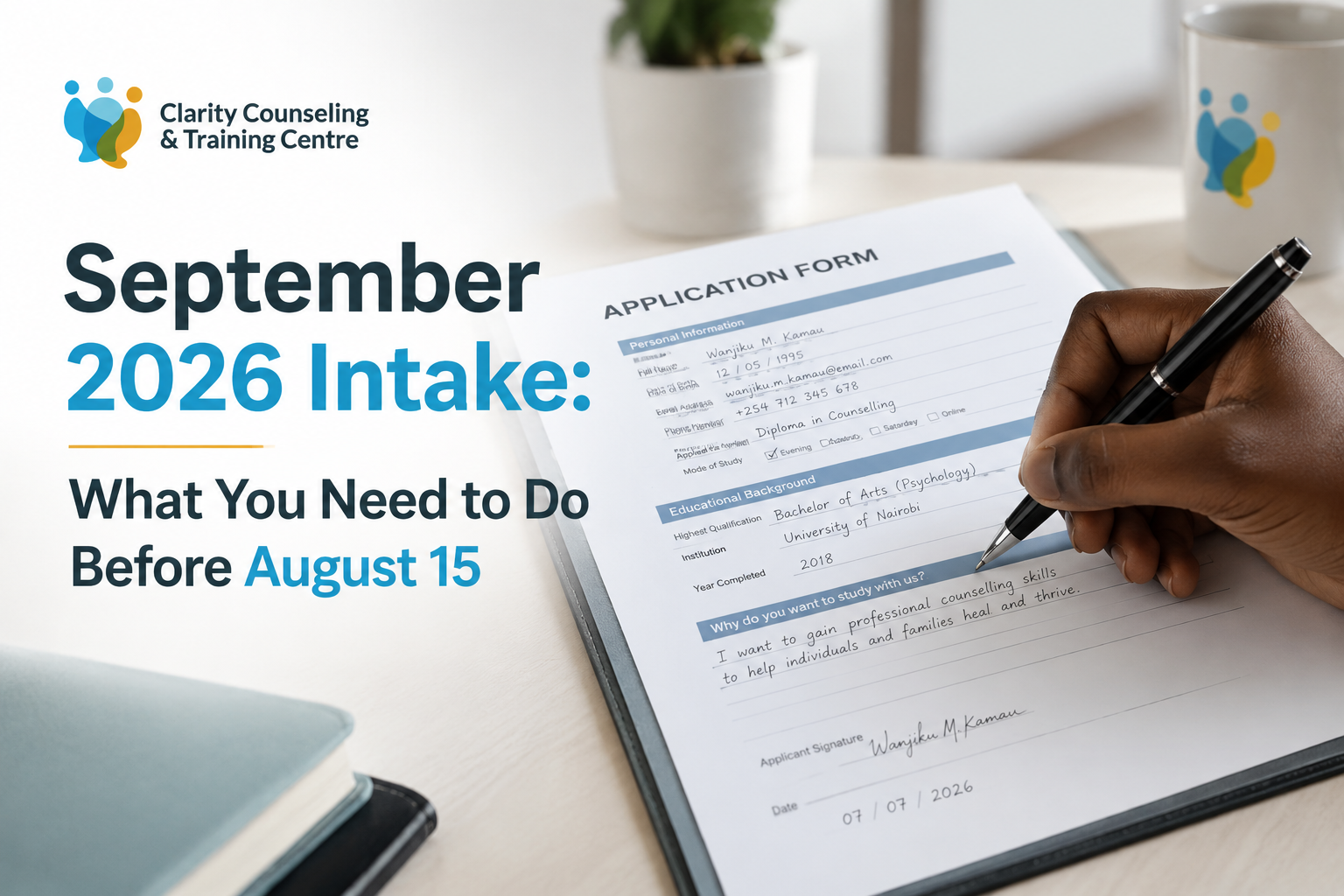
Clarity Counseling & Training Centre’s next Diploma in Counseling Psychology cohort is enrolling now. The programme is NITA-, TVETA and KCPA-accredited, includes a supervised practicum and personal therapy, and is designed for working professionals making a career transition.
If you are not ready for the full Diploma, start with the Certificate in Counseling Psychology or the Certified Basic Counseling Skills and Self-Awareness Course to explore whether this field is right for you.
No commitment required for a first conversation. Speak to the admissions team at +254 (0) 114 444 300 or visit claritycounseling.co.ke/our-courses. Your next chapter is waiting.