Understanding Anxiety in Kenya: Why Your Body Feels Like It’s Always Waiting for Bad News
It starts before you are fully awake.
Three in the morning, and your eyes are open, your mind already running.
Not thinking about anything specific, just a low, humming dread, like your body is braced for an impact that never comes.
By the time the alarm goes off, you are already exhausted.
During the day, it wears different masks. Tightness in your chest as you head to work. A surge of panic when your phone rings and the caller ID shows your boss.
A creeping unease before opening your M-Pesa balance. At night, you replay conversations from the day, searching for mistakes.
Your jaw aches from clenching it in your sleep.
If this sounds familiar, you are not going crazy. What you are likely experiencing is anxiety. According to the World Health Organization, one in four Kenyans will experience a mental health challenge in their lifetime, with the national prevalence of common mental disorders standing at 10.3 % according to the Kenya Ministry of Health.
Depression and anxiety are the most frequently diagnosed mental health conditions in the country. Yet anxiety remains one of the least understood. This article is not here to diagnose you.
It is here to help you understand what is happening in your body, and to show you that there is a clear path forward.
It’s Not ‘Just Overthinking’ — Here’s What’s Really Happening
Anxiety is not a character flaw or a lack of faith. It is a physiological state, a condition that lives as much in your body as in your mind. At its core, anxiety is your nervous system’s threat-detection system stuck in the “on” position.
Here is what happens biologically.
When your brain perceives danger, it activates the fight-or-flight response: adrenaline floods your bloodstream, your heart rate increases, your muscles tense, your digestion slows, and your focus narrows.
This system evolved to help you survive genuine physical threats, such as predators, fire, or attacks. The problem is that your brain is not very good at distinguishing between a lion and a WhatsApp message from your landlord about overdue rent.
Both register as “threat,” and your body responds accordingly.
In Kenya, anxiety often goes by other names.
People describe it as “pressure,” “being unsettled,” or sometimes attribute it to a spiritual attack.
These descriptions are valid experiences of the same underlying condition.
Whatever you call it, it deserves attention, because when your nervous system is chronically activated, it wears your body and mind down.
Why Anxiety Hits Different in Kenya
Context matters. Anxiety does not exist in a vacuum; it is shaped by the world you live in. And several features of contemporary Kenyan life create conditions where anxiety thrives.
Start with Economics
The cost of living crisis is not abstract; it is felt in every trip to the supermarket, every school fees deadline, every call from a relative in the village who needs help.
Hustle culture glorifies working three jobs, but the body keeps score of the chronic stress that pace produces. Financial insecurity is one of the most potent anxiety triggers, and it affects millions of Kenyans daily.
Meanwhile, the government spends just 0.01% of its total health expenditure on mental health, according to the Institute of Public Finance, a fraction of the global median of 1.8%. The infrastructure to help is simply not there for most people.
Then There is Social Media
The comparison trap is relentless, particularly among young professionals in Nairobi. Everyone else appears to be thriving, buying land, getting promoted, and travelling.
What you do not see is the anxiety behind their highlight reel, which is often identical to yours.
Add the aftermath of COVID-19, unprocessed grief, job losses, disrupted routines that never fully recovered, and you have a population carrying enormous psychological weight.
The silence factor compounds everything: mental health stigma in Kenya means that many people suffer for years before seeking help.
The data confirms this: a 2025 study published in PLOS ONE, using the 2022 Kenya Demographic and Health Survey, found that the physician-diagnosed prevalence of depression and anxiety among Kenyan adults was 3.84 %.
But researchers noted this is likely a significant undercount, given that the vast majority of cases go undiagnosed.
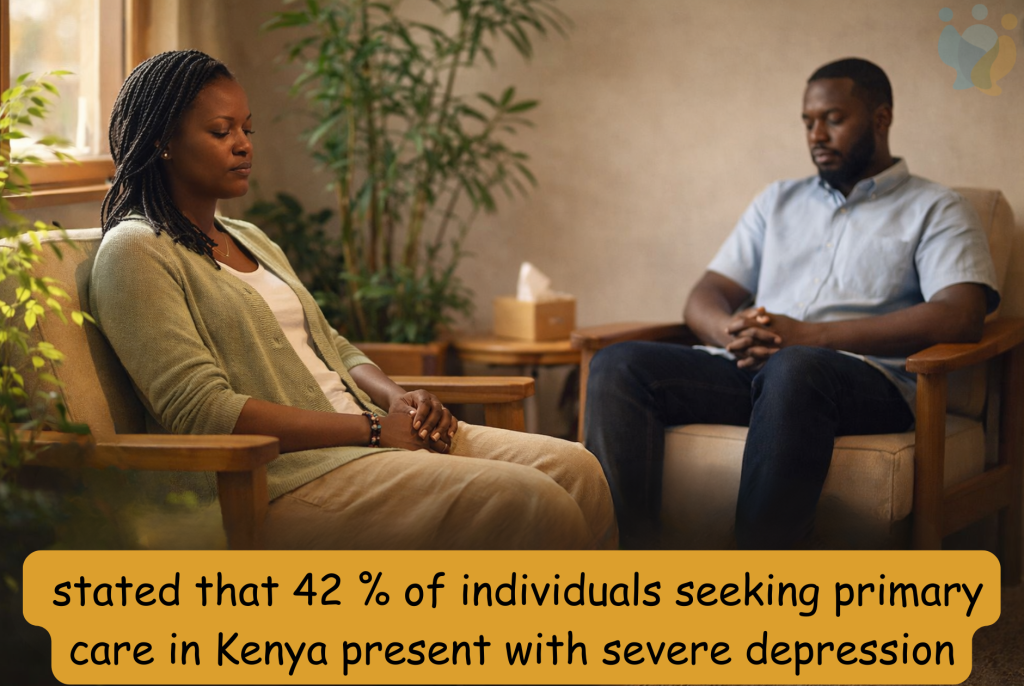
Kenya’s Director General of Health, Dr. Patrick Amoth, has stated that 42 % of individuals seeking primary care in Kenya present with severe depression. By the time many people consider getting help, anxiety has become a way of life rather than a condition to be treated.
If you are recognising your own experience in these words, you are not alone. And you do not have to figure this out on your own. Clarity Counseling & Training Centre offers confidential therapy with therapists who understand the Kenyan context because they live in it.
A Checklist Your Body Wishes You’d Read Sooner
Anxiety is often invisible to outsiders because its most debilitating symptoms are internal. What follows is a list of what it commonly looks and feels like. Read slowly. Be honest with yourself.
- Persistent muscle tension, especially in the jaw, shoulders, neck, and stomach. You may not even notice it until someone points out that your shoulders are sitting by your ears.
- Sleep disruption: either you cannot fall asleep because your mind will not switch off, or you sleep excessively because your body is so fatigued from running on adrenaline all day.
- Digestive issues: nausea, bloating, irritable bowel symptoms. Your gut has its own nervous system, and when your brain is stressed, your gut knows.
- Heart racing or palpitations without physical exertion. You might have gone to the doctor convinced you were having a cardiac event, only to be told everything is normal.
- Irritability that seems disproportionate to the trigger, or emotional numbness, a flatness where you feel disconnected from joy, as though you are watching your life from behind glass.
- Difficulty concentrating or making even simple decisions. Brain fog. Reading the same paragraph three times and retaining nothing.
- Avoidance behaviours: cancelling plans at the last minute, procrastinating on important tasks, isolating from people you care about.
If you recognised yourself in three or more of those, your body has been trying to tell you something for a while. This is not a diagnosis. But it is an invitation to take yourself seriously, and to explore what support could look like.
What Actually Happens When You Walk Into a Therapist’s Office
Let us demystify this, because the gap between what Kenyans imagine therapy to be and what it actually is may be the biggest barrier to seeking help.
Therapy is not: Lying on a couch while someone takes notes and nods. Being told what to do. A sign that you are “too far gone.”
Therapy is a structured, confidential conversation with a trained professional who helps you understand what is happening in your mind and body, and gives you practical tools to manage it.
At Clarity Counseling & Training Centre, a first session typically involves an intake conversation: your therapist will ask about what brought you in, your history, and what you are hoping to achieve. There is no pressure to disclose everything at once. The pace is yours. Over subsequent sessions, your therapist may draw on approaches like:
Cognitive behavioural therapy (which helps you identify and reframe anxious thought patterns), Person-centred therapy (which prioritises the therapeutic relationship itself as a vehicle for healing), and Somatic awareness techniques (which help you tune into and release the tension your body is holding).
As one client told us, “I expected to cry for an hour. Instead, I left with a plan.”
Sessions are available both in person at Clarity’s Nairobi centre and online. Scheduling is flexible, confidentiality is absolute, and the therapists are experienced, licensed professionals. Many clients report that the most surprising thing about therapy is how practical it is.
You do not simply talk about your feelings for an hour and leave. You leave with something, a breathing technique, a thought record, a new way of understanding why Tuesday mornings always trigger a sense of dread.
Over time, those small tools add up to a fundamentally different relationship with your own nervous system.

You Don’t Need Permission to Get Help
There is a stubborn myth in Kenya that therapy is only for people in crisis, that you need to hit rock bottom before you have earned the right to ask for support.
This is not true. The Ministry of Health estimates that 75 % of Kenyans who need mental health care are not receiving it. You do not need a diagnosis.
You do not need to be unable to function. If anxiety is stealing your sleep, your peace, your presence with the people you love, that is enough. You are enough of a reason.
The “I will handle it myself” mindset is understandable. Kenyans are resilient people, and that resilience is something to be proud of. But resilience does not mean suffering in silence.
It means having the wisdom to use every resource available to you, and a skilled therapist is among the most powerful.
Think of it this way: you would not wait until your car engine seized before taking it for a service. You would not wait until a tooth fell out before seeing a dentist. Your mental health deserves the same proactive attention.
The WHO’s mental health investment case for Kenya found that scaling up treatment for depression and anxiety would yield a return of 5.1 and 3.8 Kenyan shillings, respectively, for every 1 shilling invested over 20 years.
In other words, treating anxiety is not just good for you; it is good economics. And with the right support, you can move from surviving each day to actually living it.
If anything in this article felt personal, that is your sign. Clarity Counseling & Training Centre offers confidential, affordable therapy sessions with experienced, licensed therapists, online or in person.
Book your first session today by calling +254 (0) 114 444 300 or visiting claritycounseling.co.ke/therapy-in-kenya.
No referral needed. Just you, ready to start.
Living abroad but want a Kenyan therapist who understands your context? Clarity’s diaspora therapy service connects you with therapists who get it, no matter where in the world you are.